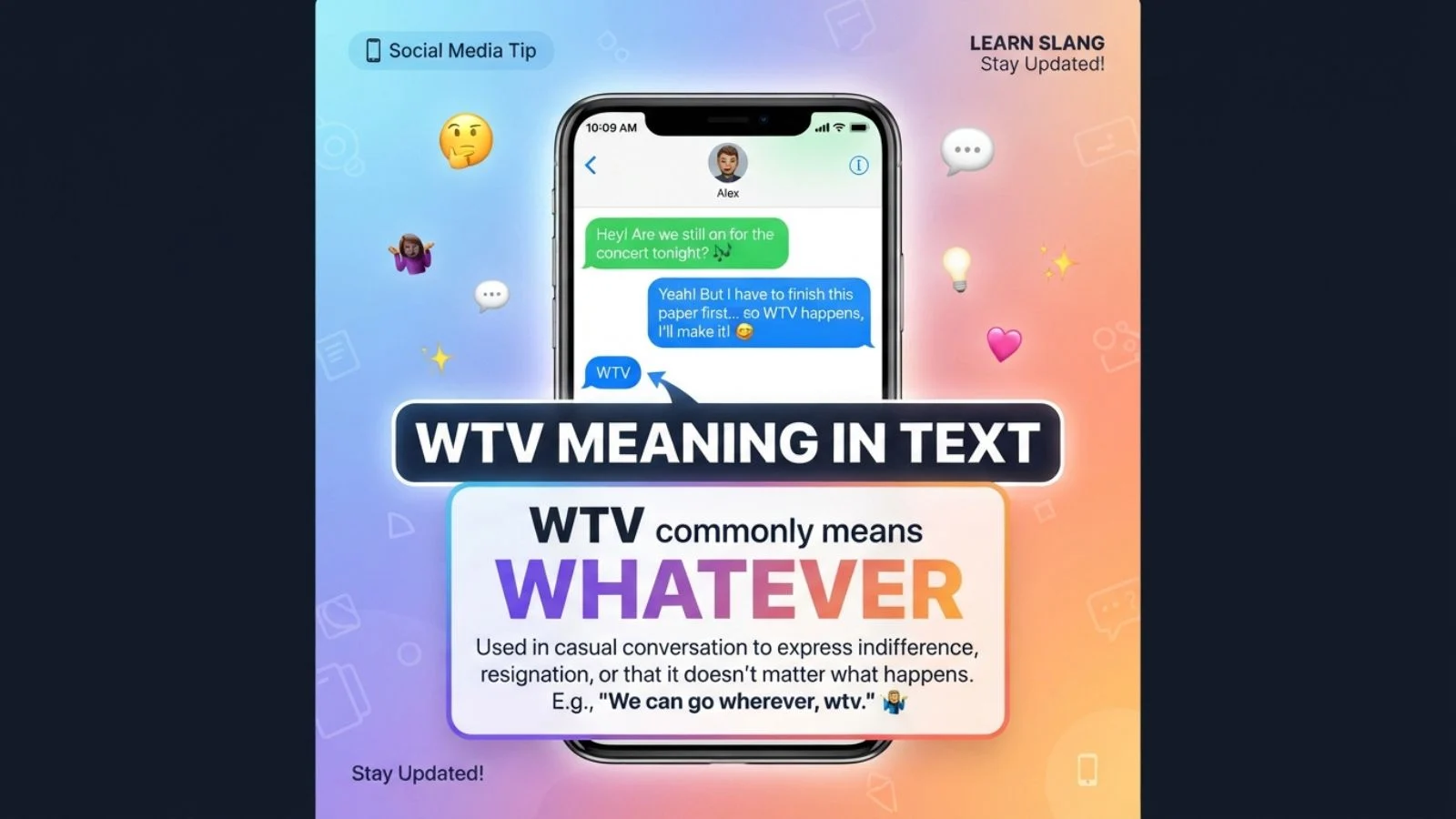
You’re mid-conversation waiting for a response that actually says something and all you get back is “wtv.”
No punctuation, no explanation , just three letters hanging there. Bored? Genuinely fine with whatever you suggested?
That’s the strange power of “wtv” , a text abbreviation so short it barely qualifies as a word yet loaded enough to end arguments, dodge decisions or quietly signal that someone’s checked out of the conversation.
WTV stands for “whatever” , one of the most versatile and tonally slippery words in casual English.
But its brevity is exactly what makes it tricky: the same three letters can mean genuine indifference, playful agreement or barely-concealed irritation depending on who sends it and when.
Core Definition
WTV is an internet and text shorthand for the word “whatever.” It’s part of a broader family of vowel-dropped abbreviations that emerged to make typing faster on early mobile phones and instant messaging platforms where every keystroke counted. Like “thx” for “thanks” or “msg” for “message” WTV strips out the vowels from “whatever” leaving just the consonant skeleton: W-T-V.
Functionally WTV operates as an interjection or a dismissive filler response. It doesn’t carry a fixed grammatical role the way a noun or verb does; instead it acts as a stand-in for an entire attitude.
Case doesn’t change the meaning. Whether someone types “WTV” “Wtv” or “wtv” the word underneath is identical capitalization here is a stylistic choice not a signal of emphasis the way it might be in other slang (though ALL CAPS can still intensify tone which we’ll cover later).
It’s worth distinguishing typed WTV from spoken “whatever.” When people say “whatever” out loud, facial expression and body language do a lot of the communicative work. An eye-roll or a flat delivery instantly clarifies intent. Texted WTV loses all of that.
Origin and Etymology
The roots of WTV trace back further than texting itself to “whatever” as a dismissive catchphrase that exploded in 1990s American youth culture. Sitcoms, teen movies and pop culture moments cemented “whatever” (often paired with the iconic “W” hand gesture) as the go-to verbal shrug for indifference, defiance or ending an argument without conceding a point. By the time mobile texting arrived in the early 2000s “whatever” was already culturally loaded with attitude it just needed to get shorter.
Early SMS technology had strict character limits and clunky multi-tap keyboards which pushed users to develop a whole shorthand vocabulary built around dropping vowels and unnecessary letters. WTV fit naturally into this pattern alongside abbreviations like “btw” (by the way) “thx” (thanks) “msg” (message) and “plz” (please). The goal wasn’t cleverness, it was speed and thumb efficiency.
As instant messaging platforms like AIM and MSN Messenger grew alongside SMS WTV carried over into desktop chat culture too, cementing its place as a cross-platform shorthand rather than a texting-only quirk. Later as smartphones introduced full QWERTY keyboards and predictive text many vowel-dropped abbreviations became less necessary; typing “whatever” in full took barely more effort. Yet WTV survived likely because its brevity itself became part of its meaning: typing three letters instead of eight subtly reinforces the “I’m not putting in effort here” attitude the word already conveys.
How WTV Is Used in Context
WTV shows up in several distinct conversational roles and the same three letters can land completely differently depending on the situation.
Dismissive/end-of-conversation use. This is the most common way WTV gets read. It signals that the sender wants to stop discussing something often because they’re frustrated, tired of the topic or unwilling to keep debating. Example: “You always do this.” / “wtv I’m not arguing about it again.”
Genuine indifference or agreement. Sometimes WTV simply means “either option works for me” with no negative charge attached. Example: “Pizza or tacos tonight?” / “wtv sounds good you pick.”
Sarcastic or passive-aggressive use. Here WTV carries a sharper edge often implying the sender disagrees but doesn’t want to escalate. Example: “I already made the reservation for 7.” / “wtv guess that’s happening then.”
Standalone vs. mid-sentence use. As a standalone reply WTV usually functions as a full response on its own closing out a message thread. Mid-sentence it softens into a more casual filler: “wtv you decide is fine with me” reads far more neutral than a bare “wtv.”
Context: the relationship between texts, the conversation’s history and what came right before does most of the interpretive work. A “wtv” from a close friend settling a minor decision reads nothing like a “wtv” dropped at the end of a tense exchange with a partner or coworker.
Reading the Tone: A Breakdown
Because WTV strips away vocal cues readers rely on secondary signals to figure out what the sender actually means.
Punctuation. A bare “wtv” often reads as neutral or slightly flat. Adding a period “wtv.” tends to sharpen the tone making it feel more final or clipped almost like a door closing. An exclamation point (“wtv!”) can flip it toward playful or exaggerated frustration while an ellipsis (“wtv…”) often signals hesitation, passive-aggressiveness or unresolved tension.
Capitalization. Lowercase “wtv” is the default and generally reads as casual or low-stakes. Full caps “WTV” usually intensifies the message suggesting genuine annoyance or emphasis rather than a throwaway response.
Timing and response speed. A quick immediate “wtv” often reads as reflexive and low-effort, not necessarily upset. A “wtv” that arrives after a long delay can carry more weight implying the sender stewed on the conversation before responding.
WTV Across Platforms
While WTV’s core meaning stays consistent, how it functions shifts slightly depending on where it’s used.
SMS/iMessage. This is WTV’s home turf, the environment it was built for. In one-on-one texting WTV tends to carry the most emotional weight since it’s usually a direct reply to a specific question or statement from a single person making tone easier (though not foolproof) to gauge from context.
Instagram/TikTok comments and DMs. On these platforms WTV often appears more casually and publicly, sometimes as a comment reacting to a post rather than a private exchange. Here it can read as breezy indifference toward content rather than a personal jab at someone.
Twitter/X replies. WTV shows up frequently in reply threads often used to shut down a debate or signal disengagement from an argument playing out in public view, sometimes doubling as a way to “win” without further engagement.
Discord and gaming chat. In gaming culture WTV moves fast and casually frequently used mid-match to brush off a mistake, a lost round or a teammate’s complaint without disrupting gameplay flow.
Group chats vs. one-on-one. In group settings WTV often reads as lower-stakes since it’s not always clear who it’s directed at diffusing potential tension. In 1:1 conversations the same word lands more personally and is more likely to be scrutinized for hidden meaning.
Generational and Cultural Usage Patterns
WTV doesn’t land the same way across every age group and understanding these differences helps explain why misreadings happen so often.
Gen Z. For younger digital natives WTV tends to function as a low-stakes, almost reflexive shorthand used constantly and often stripped of heavy emotional weight. It’s woven into everyday texting rhythm rather than reserved for moments of real indifference or frustration making it feel more like conversational punctuation than a strong statement.
Millennials. This group came of age alongside “whatever” as a defining 90s/2000s catchphrase so WTV often retains a bit more of that original dismissive eye-roll energy. Millennials may be slightly more likely to read WTV as pointed or passive-aggressive by default given the word’s cultural baggage from that era.
Gen X and older users. For those less immersed in constant abbreviated texting culture WTV can come across as colder or more dismissive than intended since the shorthand itself may register as impersonal or curt rather than casual.
Is WTV dated or still active? Despite predictive text making full spelling nearly effortless, WTV remains active across platforms; its brevity has become part of its identity rather than a pure convenience. It hasn’t faded the way some early SMS-era abbreviations have.
Regional variation is minimal since WTV is primarily an English-language digital shorthand without strong dialect-specific alternatives though usage frequency can vary by online community and platform culture.
WTV vs. Similar/Related Terms
WTV vs. “whatever” (spelled out). Typing the full word often feels more deliberate and can actually intensify the dismissiveness spelling it out takes more effort which can read as someone making a point of their annoyance rather than tossing off a quick reply.
WTV vs. “idc” (I don’t care). IDC is more explicit and direct about emotional detachment leaving less room for ambiguity. WTV is vague which is exactly what makes it more flexible and more prone to misinterpretation.
WTV vs. “np” (no problem). NP is reassuring and closes a conversation on a positive note. WTV even when meant neutrally rarely carries that same warmth it’s indifference not affirmation.
WTV vs. “k” or “kk.” Both are minimal-effort replies but “k” often reads as curt acknowledgment of information while WTV specifically signals indifference toward a choice or opinion rather than just confirming receipt.
WTV vs. “meh.” “Meh” leans purely into lack of enthusiasm without any conversational finality. WTV can carry that same flatness but more often implies a decision has been reached or a topic is being closed.
Quick comparison:
- Most neutral: np
- Most ambiguous: wtv
- Most direct: idc
- Most curt: k/kk
- Most purely unenthusiastic: meh
Understanding these distinctions helps explain why WTV specifically tends to spark more tone confusion than its shorthand cousins.
Psychological/Social Read: Why WTV Can Sting
Of all the dismissive text shorthands WTV has a particular reputation for landing hard, often harder than the sender intended.
Perceived conversation-ending power. WTV frequently functions as a conversational full stop. Unlike a question or an open-ended comment it doesn’t invite further discussion it signals that the sender is done engaging which can feel abrupt or shutting-out to the person on the receiving end even when no real hostility was meant.
Why is it flagged as a “text fight ender.” In disagreements WTV often shows up right when tension peaks functioning as a way to exit an argument without admitting fault or continuing to negotiate. This makes it a common trigger point in conflicts the recipient may feel dismissed or unheard rather than sensing genuine resolution.
Boundary-setting or shutdown mechanism. For some people WTV is a low-effort way to protect their energy, a way of saying “I’m not engaging with this anymore” without escalating further. Used this way it can function similarly to walking away from a face-to-face conversation.
Relationship context matters heavily. Between close friends WTV often carries little weight and gets brushed off easily. Between romantic partners it can feel more loaded, sometimes read as emotional withdrawal. In professional or acquaintance relationships it can come across as unprofessional or oddly curt since there’s less established trust to soften its impact.
Etiquette: When to Use (and Avoid) WTV
Knowing when WTV is harmless versus when it can backfire makes a real difference in how conversations land.
When it’s fine to use. WTV works well in casual low-stakes exchanges deciding between two restaurant options, agreeing on a movie or responding to something genuinely inconsequential among close friends. In these contexts its brevity reads as relaxed rather than dismissive since both people usually share enough rapport to interpret it correctly.
Risky contexts to avoid. WTV tends to backfire in situations that call for care or clarity: resolving a disagreement, discussing feelings, responding to bad news or any conversation where the other person is emotionally invested in the outcome. In these moments its ambiguity can easily be read as indifference or dismissal even if that’s not the intent.
Professional settings. WTV is generally a poor fit for work Slack messages client emails or any professional correspondence. It can come across as unprofessional, careless or even insubordinate, especially to colleagues or supervisors who may not share the same texting shorthand fluency.
Better alternatives in professional contexts. Phrases like “either option works” “no strong preference” or “happy to go with your call” convey the same underlying flexibility without the risk of sounding dismissive.
Softening WTV if you’ve already sent it. A quick follow-up “sorry didn’t mean that to sound dismissive I really am fine with either” can clarify intent and prevent unnecessary tension from lingering.
Common Misinterpretations and Mistakes
Because WTV carries so little built-in context it’s one of the easiest texting terms to misread in both directions.
Assuming rudeness when none was intended. The most frequent mistake is reading a neutral or genuinely indifferent “wtv” as cold or dismissive. Someone might type it quickly while multitasking with zero attitude behind it only for the recipient to interpret withdrawal or annoyance that was never there.
Missing sarcasm or hidden meaning. The opposite error also happens taking a sarcastic or passive-aggressive “wtv” at face value as if it were neutral and missing that the sender is actually frustrated or disagreeing beneath the surface. This often leads to a conversation quietly souring without either person addressing the real issue.
Cross-generational miscommunication. As covered earlier, different age groups assign different default weights to WTV. A younger sender using it reflexively and casually may unintentionally upset an older recipient who reads it as unusually curt while an older sender using it deliberately to signal irritation might be brushed off by a younger recipient as no big deal.
Tips for clarifying intent. When in doubt adding a short clarifying line prevents most misfires: “wtv no big deal either way” removes ambiguity in the neutral direction while “wtv but I really wish you’d asked me first” makes underlying frustration explicit rather than leaving it to guesswork. When receiving an ambiguous WTV a simple follow-up like “just checking are you actually annoyed?” can head off unnecessary conflict.
Fun/Trivia Angle
WTV’s cultural footprint runs deeper than its texting use alone; it’s tied to decades of pop culture moments that shaped how “whatever” gets perceived.
The “whatever” hand gesture. The iconic “W” shape formed with both hands became inseparable from the word itself in 1990s and early-2000s youth culture visually reinforcing its dismissive conversation-ending energy. Even people who’ve never made the gesture themselves often picture it when they read “wtv” in a sarcastic context.
Sitcom and teen-movie influence. “Whatever” became a defining catchphrase across countless teen shows and films of that era often delivered by characters embodying detached coolness or eye-rolling defiance. This cultural association is part of why WTV can still carry a slightly rebellious or too-cool-to-care undertone today even decades later.
Meme culture. WTV and “whatever” energy have been repurposed into countless reaction memes and image macros representing apathy, unbothered confidence or comedic indifference to chaos often paired with exaggerated shrugging or deadpan facial expressions.
Related slang it helped normalize. WTV’s success as a dismissive shorthand helped pave the way for other brevity-driven indifference terms like “meh” “idc” and “shrug emoji culture” (🤷) becoming mainstream ways to express low-effort reactions in digital spaces.
A lasting linguistic export. Few abbreviations manage to outlive the technical constraints that created them WTV’s continued relevance even with full keyboards and predictive text shows how deeply “whatever” energy is embedded in casual digital communication.
FAQ
Is WTV rude or dismissive by default?
Not inherently. WTV’s meaning depends heavily on context punctuation and the relationship between texters. It can be genuinely neutral but it does carry a higher-than-average risk of being read as dismissive compared to other casual replies simply because it offers so little additional information to soften it.
Is WTV the same as saying “whatever” out loud?
Mostly yes but spoken “whatever” comes with a tone of voice, facial expression and body language that instantly clarify intent. Texted WTV strips all of that away which is why it’s more prone to misinterpretation than its spoken counterpart.
Can WTV be used positively or agreeably?
Yes. When paired with friendly emojis or used in low-stakes decision-making (“wtv you want to watch is fine with me”) WTV often functions as genuine flexibility rather than annoyance.
Is WTV appropriate in work Slack or email?
Generally no. It reads as too casual and can come across as careless or dismissive in professional settings even when meant innocently. Alternatives like “no strong preference” or “either works” communicate the same flexibility more appropriately.
What’s the difference between “wtv” and “wateva”?
They’re functionally identical in meaning. “Wateva” is a more phonetic stylized spelling often used for emphasis or a playful exaggerated tone while “wtv” remains the more standard efficiency-driven abbreviation.
Conclusion
At first glance WTV looks like one of the simplest abbreviations in texting culture, three letters standing in for a single common word.
But as this guide has shown, simplicity is deceptive. WTV carries an unusually wide emotional range for such a short term, capable of expressing genuine indifference, friendly flexibility, quiet frustration or outright dismissal often within the exact same three characters.
What separates a harmless “wtv” from one that damages a conversation isn’t the word itself, it’s everything surrounding it.
Punctuation capitalization, emoji choices, response timing and especially the relationship and history between the people texting all shape how WTV should be read.
Strip away those contextual clues and the word becomes a blank slate onto which readers project their own assumptions which is exactly why it causes so much miscommunication.