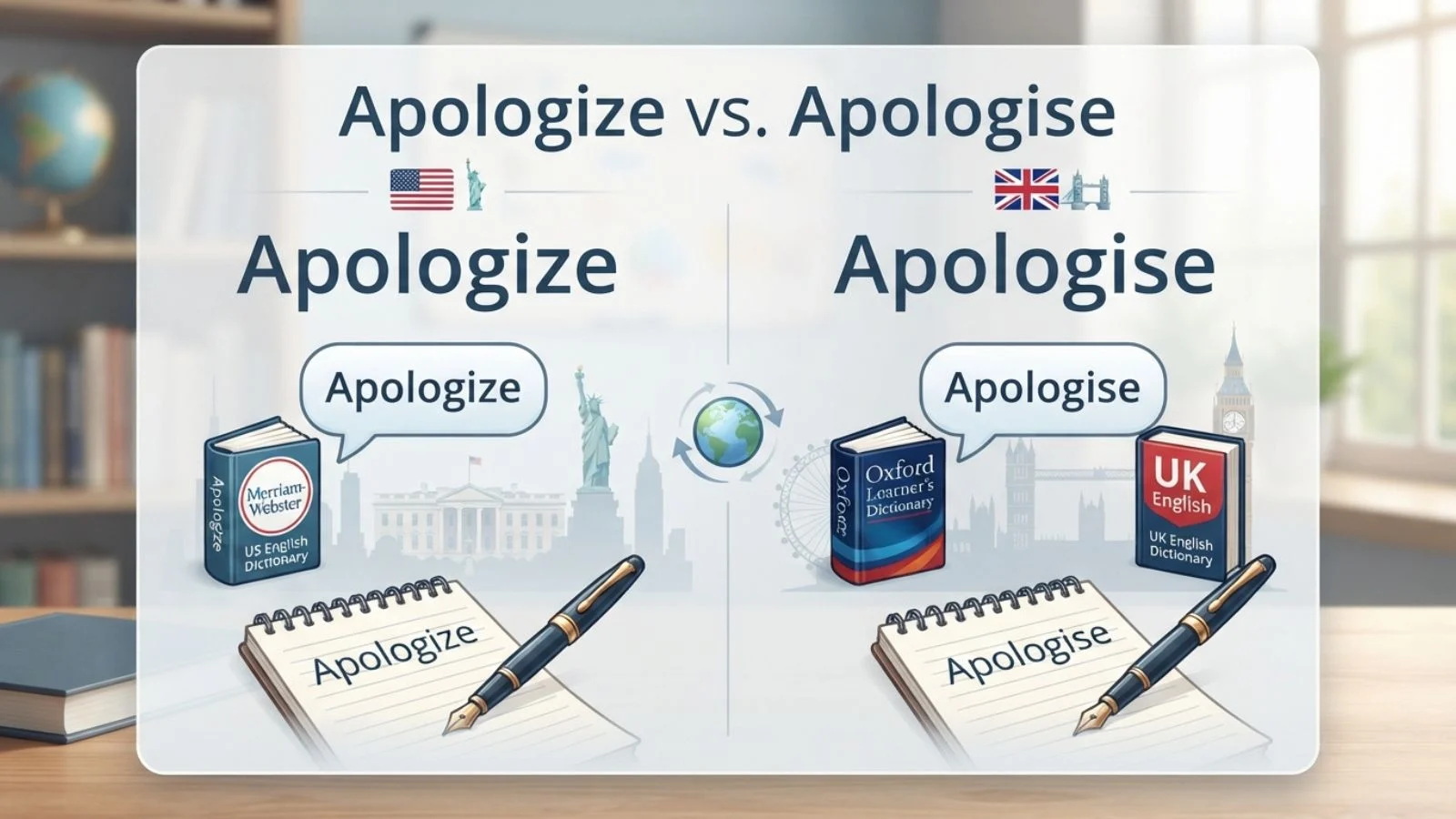
Both spellings are correct. Apologize is the standard spelling in American and Canadian English.
Apologise is the standard spelling in British, Australian, and most other varieties of English outside North America.
Neither spelling is a mistake, the right one just depends on which English you’re writing.
Key Takeaways
- Apologizing (with a “z”) is standard in the US and Canada.
- Apologise (with an “s”) is standard in the UK, Australia, and most Commonwealth countries.
- Both spellings mean the same thing: to say sorry or admit fault.
- “Apologize” is actually the older spelling; it isn’t an American invention.
- If you’re unsure who’s reading, pick one spelling and stay consistent throughout your writing.
What’s the Difference Between Apologize and Apologise?
The two words mean exactly the same thing. There’s no difference in meaning, pronunciation, or grammar. The only difference is the ending “z” or “s” and that comes down to regional spelling convention, not correctness.
If you say “I need to apologize” or “I need to apologise,” you’re expressing the same idea: admitting you did something wrong and expressing regret for it. A dictionary in New York will list “apologize” as the main entry. A dictionary in London will often list “apologise” first instead.
Apologize vs. Apologise: Quick Comparison Table
| Feature | Apologize | Apologise |
| Region | US, Canada | UK, Australia, NZ, most Commonwealth countries |
| Ending | -ize | -ise |
| Meaning | Same | Same |
| Pronunciation | Same | Same |
| Used by | AP Style, Chicago Manual of Style | Most British publishers, The Guardian, BBC |
Why Are There Two Spellings?
The -ize vs. -ise Pattern
“Apology” comes from Greek, and words with Greek roots traditionally took the -ize ending when they entered English. That’s why “apologize” showed up first, back in the 16th century. Other -ize/-ise pairs follow the same regional pattern: realize/realise, organize/organise, recognize/recognise, and criticize/criticise.
American English kept the original -ize spelling almost across the board. British English gradually shifted toward -ise for many of these words, though it’s not a hard rule even British style guides don’t agree completely on it.
A Common Myth, Debunked
A lot of people assume “apologise” is the “proper” British form and “apologize” was invented in America. That’s backward. “Apologize” is actually the original, older spelling, and it was standard in Britain too for a long time. The -ise spelling became popular in the UK more recently, partly because writers assumed -ize must be an Americanism and avoided it even though it wasn’t. In fact, the Oxford English Dictionary still lists “apologize” as an accepted British spelling today.
When to Use “Apologize”
Use “apologize” if:
- You’re writing for a US or Canadian audience.
- You’re following AP Style or the Chicago Manual of Style.
- Your spell-checker or content management system is set to American English.
- You work for a US-based company, publication, or school.
Example: “The company issued a statement to apologize for the shipping delay.”
When to Use “Apologise”
Use “apologise” if:
- You’re writing for a UK, Australian, New Zealand, or other Commonwealth audience.
- You’re following Oxford style guides that favor -ise in modern usage, or a British publication’s house style.
- Your document, browser, or spell-checker is set to British/Australian English.
- Your employer or client specifically asks for British spelling.
Example: “She wanted to apologise before the meeting started.”
A Simple Trick to Remember Which One to Use
Match the letter to the country:
- UZA → apologize (American)
- Britain uSes “s” → apologise (British)
If you can remember that the US and the letter “Z” go together, the rest follows.
What Style Guides Say
Major American style guides AP Style and the Chicago Manual of Style use “apologize.” British publications like The Guardian and the BBC generally use “apologise,” though some British academic and legal writing still allows “apologize,” especially when following Oxford spelling conventions (sometimes called “Oxford spelling” or “-ize spelling”), which prefer -ize even in UK English. This is why you’ll occasionally see “apologize” in British academic journals or Oxford University Press books.
Other Words With the Same Spelling Split
If you’re writing across US and UK audiences, it helps to know this isn’t a one-off case. The same -ize/-ise pattern shows up in many everyday words:
- Organize / Organise
- Realize / Realise
- Recognize / Recognise
- Criticize / Criticise
- Specialize / Specialise
Once you pick American or British spelling for one of these, stay consistent and apply the same choice to the rest.
Which Should You Use for a Global or Mixed Audience?
If you’re writing for an international audience and there’s no house style to follow, either spelling’s acceptable consistency matters more than which one you pick. Many global brands and international publications default to American spelling simply because it has wider reach online, but this isn’t a rule, just a common practice. The safest approach:
- Check if your company, client, or publication has a style guide.
- If not, pick one spelling based on your primary audience’s location.
- Set your word processor’s language/dictionary setting to match, so spell-check stays consistent.
- Stick with that choice throughout the entire document.
FAQs
Is “apologize” American or British?
“Apologize” is standard in American and Canadian English. It’s also an accepted spelling in British English, though “apologise” is more common in the UK today.
Is “apologise” wrong in the US?
It’s not grammatically wrong, but it will look like a spelling error to most American readers and to US-based spell-checkers, since “apologize” is the expected form there.
Can I use “apologize” in the UK?
Yes. It’s historically correct and still used in some British academic and formal writing, particularly under Oxford spelling conventions, though “apologise” is more common in everyday British writing.
Why do Americans spell it with a “z”?
Because “apologize” is the original English spelling, based on the Greek root’s -ize ending. American English simply kept this older form, while British English shifted toward -ise more recently.
Is “apologise” the same word as “apologize”?
Yes, completely. They have identical meanings and pronunciations, only the spelling differs by region.
Conclusion
At the end of the day, “apologize” and “apologise” are the same word wearing two different regional outfits.
Neither one is a mistake: pick “apologize” for American or Canadian readers, “apologise” for British, Australian, or most Commonwealth readers, and stay consistent once you’ve chosen.
When in doubt, match your spelling to your audience’s location or your publication’s style guide, and let your spell-checker’s language setting do the rest.