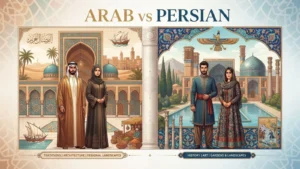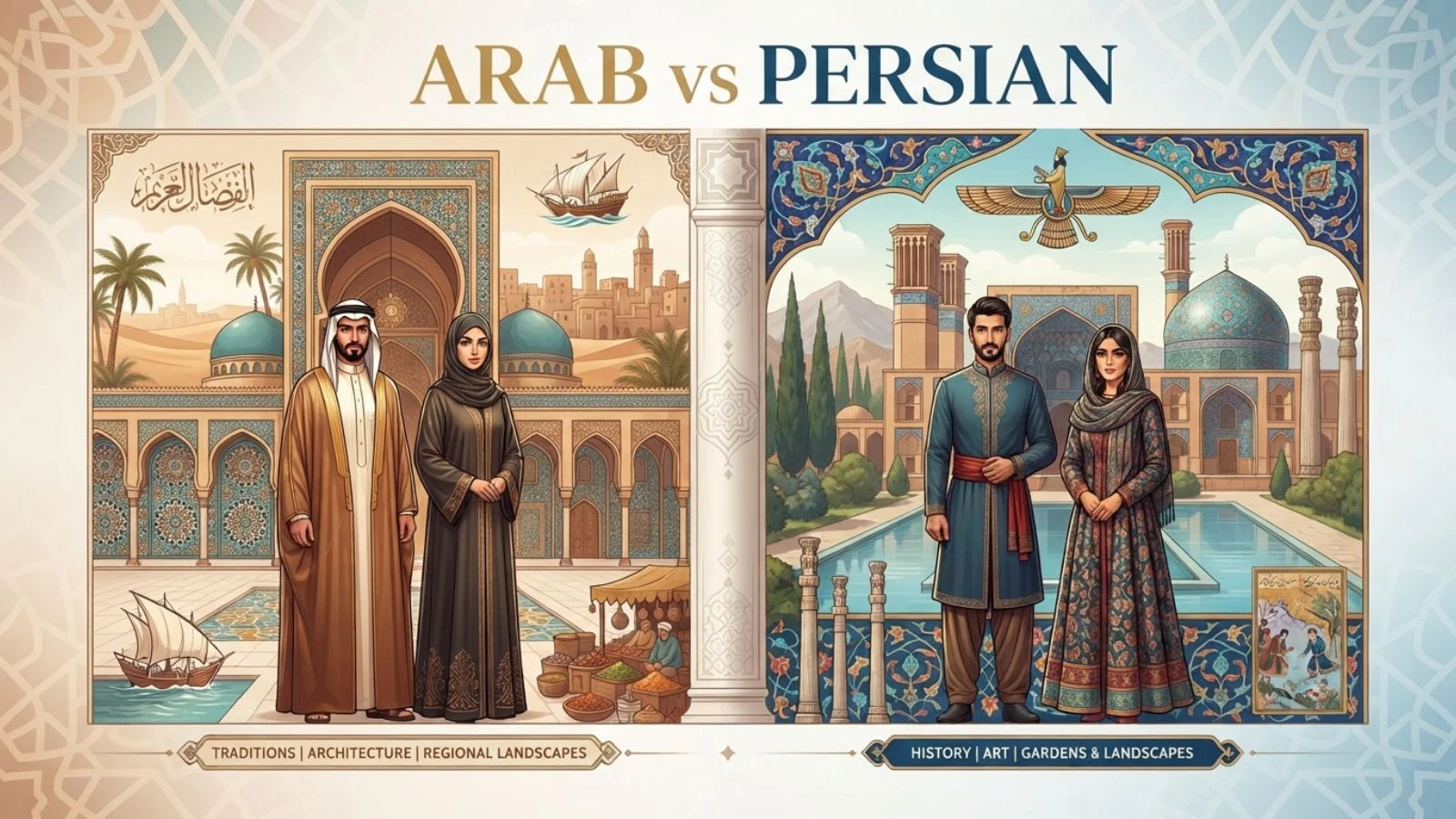
Arab and Persian are two separate ethnic groups. Arabs come from 22 countries across North Africa and Western Asia and speak Arabic.
Persians are the majority ethnic group of Iran speak Farsi (Persian) and trace their roots to ancient Indo-European peoples not Arabian ones.
The two groups share the Middle East but not a language ethnicity or single religious branch.
Key Takeaways
- Arabs and Persians are distinct ethnicities not interchangeable labels for “Middle Eastern.”
- Arabic is a Semitic language; Persian (Farsi) is Indo-European; they aren’t mutually understandable even though Farsi borrowed the Arabic alphabet.
- Iran is a Persian-majority country and is not part of the Arab League.
- Most Arabs are Sunni Muslim; most Iranians are Shia Muslim.
- Persian culture traces back to pre-Islamic Zoroastrian traditions like Nowruz which has no Arab equivalent.
Why People Confuse Arabs and Persians
The mix-up isn’t random. Both groups live in the Middle East, both are majority Muslim and Persian uses a modified version of the Arabic alphabet. News coverage often lumps the whole region together as “Middle Eastern” or “Muslim” which flattens real differences. On top of that, centuries of trade conquest and shared religious texts mean the two cultures have borrowed heavily from each other. Borrowing isn’t the same as being the same group though the core identities stayed separate.
Arab vs Persian at a Glance
| Category | Arab | Persian |
| Homeland | Arab world (North Africa & Western Asia 22 countries) | Iran with historic reach into Central and South Asia |
| Language | Arabic (Semitic) | Farsi / Persian (Indo-European) |
| Majority religion | Sunni Islam | Shia Islam |
| Script origin | Native Arabic script | Arabic script adopted after the 7th-century conquest plus 4 extra letters |
| Key holiday | Islamic holidays (Eid al-Fitr Eid al-Adha) | Nowruz (Persian New Year pre-Islamic) |
| Political body | Arab League member states | Not an Arab League member |
Ethnicity and Geography
Who Counts as Arab?
Being Arab is defined mainly by language culture and shared ancestry rather than by a single nation. It covers people from Morocco to Iraq who speak Arabic as a native language and identify with Arab culture and history. That includes countries such as Saudi Arabia Egypt Jordan Lebanon and the Gulf states 22 in total united under the Arab League.
Who Counts as Persian?
Persian identity centers on Iran and the broader Iranian Plateau. Persians descend from ancient Indo-Iranian peoples who built empires the Achaemenid and Sassanid dynasties among them long before Islam ever reached the region. Iran today is home to Persians as the largest ethnic group alongside Azeris Kurds and other alternative but Persian language and culture define the national identity.
Language: Arabic vs Farsi
This is where the confusion usually breaks down fastest once explained. Arabic belongs to the Semitic language family related to Hebrew and Aramaic. Farsi (Persian) belongs to the Indo-European family distantly related to English, Hindi and Spanish.
They don’t sound alike and a native Arabic speaker generally can’t understand spoken Farsi without studying it and vice versa. What they do share is a writing system: after the Islamic conquest of Persia in the 7th century Persian adopted a modified Arabic script adding four letters (p ch g and zh) to cover sounds Arabic doesn’t have. Farsi also absorbed a large number of Arabic loanwords especially in religious legal and academic vocabulary similar to how English borrowed heavily from French after 1066. Shared letters and loanwords though don’t make the languages related at the root.
Religion: Sunni Islam vs Shia Islam
Both Arabs and Persians are majority Muslim but the branch of Islam splits sharply along these ethnic lines. Most of the Arab world is Sunni Muslim. Iran by contrast is overwhelmingly Shia around 90 to 95 percent of Iranians follow Twelver Shia Islam making Iran the largest Shia-majority country in the world.
The split traces back to a 7th-century dispute over who should lead the Muslim community after the Prophet Muhammad’s death. Sunnis recognized Abu Bakr as the first caliph; Shias believed leadership belonged with the Prophet’s family starting with his cousin and son-in-law Ali. Iran formalized Shia Islam as its state religion under the Safavid dynasty in the 16th century cementing a religious identity distinct from its Sunni-majority neighbors. This isn’t a clean line though Iraq and Bahrain both Arab countries also have large Shia populations.
Culture Holidays and History
Persian culture draws heavily on pre-Islamic roots particularly Zoroastrianism, one of the world’s oldest religions. Nowruz the Persian New Year celebrated every spring comes directly from that Zoroastrian tradition and is marked across Iran, Afghanistan and other Persianate communities but it has no real counterpart in Arab culture.
Arab culture meanwhile developed around a shared language and oral tradition that predates Islam too including pre-Islamic poetry, tribal genealogy and Bedouin heritage later shaped heavily by the rise of Islam and the Arabic-speaking caliphates.
Worth noting: history isn’t a clean wall between the two. During the Islamic Golden Age Persian scholars, poets and scientists contributed enormously to scholarship written in Arabic and some communities today have mixed Arab-Persian ancestry especially in border regions and Gulf port cities.
Is Iran an Arab Country?
No. This is one of the most searched versions of this question and the answer is straightforward: Iran is not an Arab country. Its official language is Persian not Arabic. Its dominant ethnicity is Persian not Arab. And it is not a member of the Arab League, the regional body that defines the Arab world politically. Iran is however a Middle Eastern and Muslim-majority country which is likely where the confusion starts for a lot of people encountering the region for the first time.
FAQs
Are Persians and Arabs the same ethnicity?
No. They’re separate ethnic groups with different ancestral roots, languages and majority religious branches. They share geography and broadly Islam but not ethnicity.
Do Arabs and Persians speak the same language?
No. Arabic is Semitic and Farsi is Indo-European. They use a similar script but the languages themselves aren’t mutually intelligible.
Are most Persians Sunni or Shia?
The vast majority of Persians and Iran overall follow Shia Islam specifically the Twelver branch. Most of the Arab world by comparison is Sunni.
Why do people think Iran is an Arab country?
Likely because Iran is Middle Eastern majority Muslim and uses a script that looks similar to Arabic. None of those things make Iran Arab though its language ethnicity and political classification are distinctly Persian.
Can someone be both Arab and Persian?
Yes. Mixed Arab-Persian ancestry exists particularly in Gulf coastal areas and border regions with a long history of trade and intermarriage between the two groups.
Conclusion
Arab and Persian are two different identities that happen to share a region and broadly a religion.
Once you look past the similar-looking script of Middle Eastern geography and the Muslim majority, the differences are clear.
Separate language families separate ethnic roots and a religious split between Sunni and Shia Islam that shapes culture, politics and daily life on both sides.
Understanding that distinction isn’t just trivia. It’s the difference between describing the Middle East accurately and flattening millions of people into one label they don’t actually share.