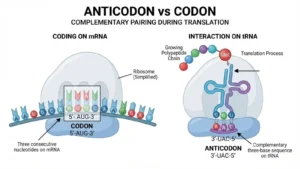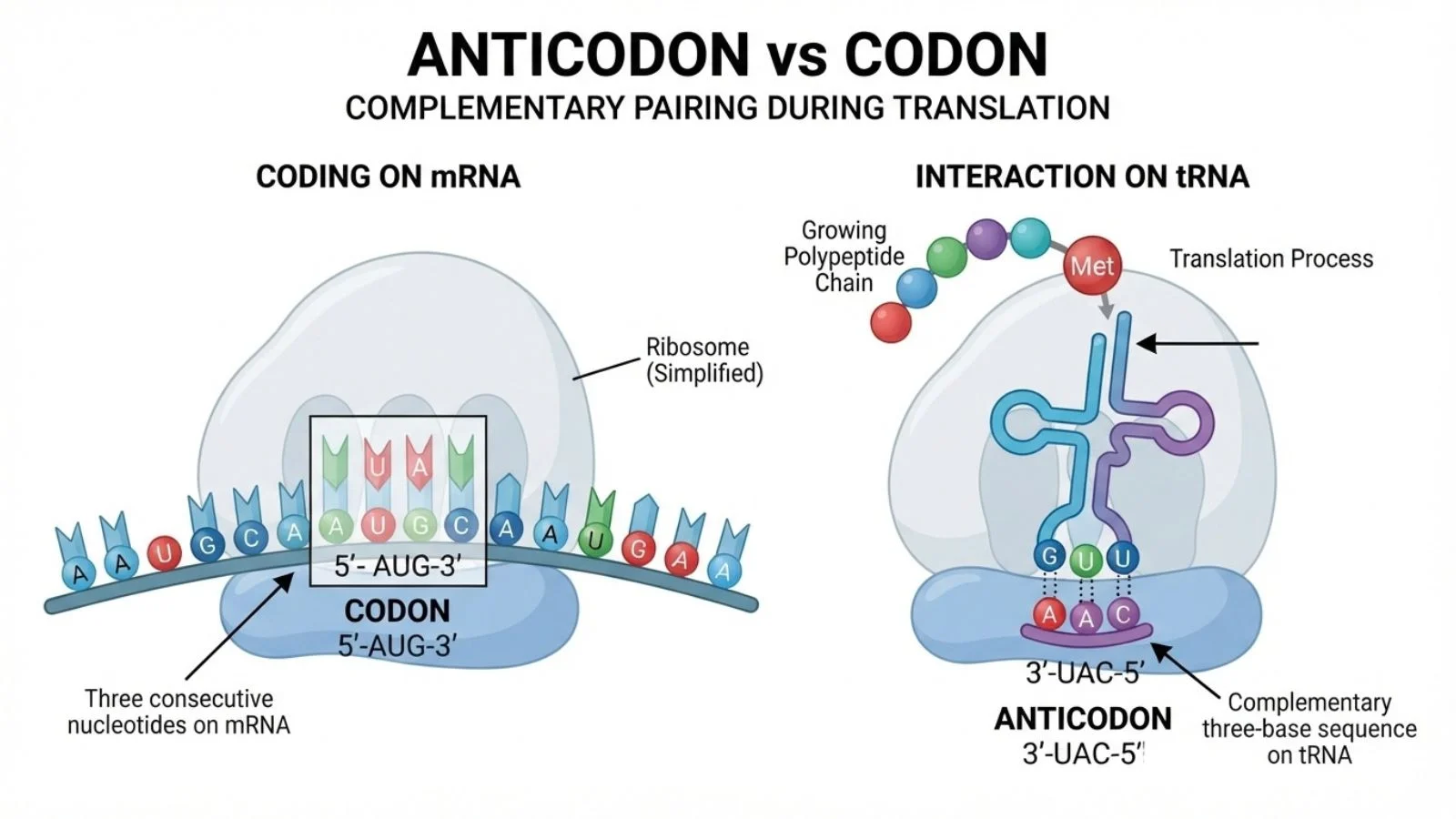
A codon is a sequence of three nucleotides on messenger RNA (mRNA) that codes for a specific amino acid. An anticodon is the matching three-nucleotide sequence on transfer RNA (tRNA) that pairs with the codon during translation. In short: codons carry the genetic instructions, and anticodons read them.
Key Takeaways
- A codon sits on mRNA; an anticodon sits on tRNA.
- Codons and anticodons are complementary; they pair up like puzzle pieces.
- Each codon calls for one specific amino acid; the matching anticodon brings that amino acid to the ribosome.
- There are 64 possible codons but fewer anticodons, thanks to wobble base pairing.
- This codon-anticodon pairing is what allows the ribosome to build proteins accurately.
What Is a Codon?
A codon is a group of three nucleotide bases (A, U, G, or C) found on a strand of messenger RNA. Each codon acts like a three-letter code word. The ribosome reads these code words one at a time and uses them to decide which amino acid to add next to a growing protein chain.
For example, the codon AUG codes for the amino acid methionine, and it also acts as the “start” signal for translation.
Where Codons Are Found
Codons exist on mRNA. mRNA is copied from DNA during a process called transcription, then it travels out of the cell nucleus to the ribosome, where translation happens.
Types of Codons (Start, Sense, and Stop)
- Start codon: AUG signals the ribosome to begin translation.
- Sense codons: These are the 61 codons that each code for a specific amino acid.
- Stop codons: UAA, UAG, and UGA don’t code for an amino acid. Instead, they tell the ribosome to stop building the protein.
What Is an Anticodon?
An anticodon is a three-nucleotide sequence found on transfer RNA. Its job is to recognize and bind to a specific codon on the mRNA. Each tRNA molecule carries one particular amino acid on one end and has an anticodon on the other end that matches up with the codon calling for that amino acid.
Think of the anticodon as a key that fits into the codon’s lock.
Where the Anticodon Is Found
The anticodon is located in the anticodon loop of the tRNA molecule, one of the three loops that make up tRNA’s cloverleaf shape. During translation, this loop swings into position inside the ribosome and pairs with the mRNA codon.
Anticodon vs Codon: Key Differences
| Feature | Codon | Anticodon |
| Found on | mRNA | tRNA |
| Function | Codes for a specific amino acid | Recognizes and pairs with a codon |
| Location | mRNA strand, read by the ribosome | Anticodon loop of tRNA |
| Direction read | 5′ to 3′ | 3′ to 5′ (antiparallel to the codon) |
| Number of possible sequences | 64 | Fewer, due to wobble pairing |
| Role in translation | Carries the “instruction” | Delivers the correct amino acid |
How Codons and Anticodons Pair Up During Translation
During translation, the ribosome moves along the mRNA strand one codon at a time. For each codon, a tRNA molecule with a complementary anticodon binds to it. Because the tRNA is already carrying a specific amino acid, this pairing tells the ribosome exactly which amino acid to add next.
The bases pair the same way DNA bases do: A pairs with U (since this is RNA, not DNA), and G pairs with C.
Step-by-Step Example
- The mRNA codon reads GAA.
- This codon calls for the amino acid glutamic acid.
- A tRNA molecule carrying an anticodon of CUU approaches, since C pairs with G and U pairs with A.
- Because the anticodon matches, the tRNA’s amino acid (glutamic acid) is added to the growing protein chain.
- The ribosome then shifts to the next codon, and the process repeats.
This repeats, codon by codon, until the ribosome reaches a stop codon and translation ends.
What Is Wobble Base Pairing?
There are 61 sense codons but only about 40–45 different tRNA anticodons in most cells. This works because of something called wobble base pairing. The first two bases of a codon must pair exactly with the anticodon, but the third base has some flexibility. This means one tRNA can sometimes recognize more than one codon, as long as the first two bases match. Wobble pairing makes translation more efficient without needing a separate tRNA for every single codon.
Easy Way to Remember the Difference
A simple trick: “C” for Codon comes first, on the messenger. Codons are on messenger RNA, and they come first in the process DNA is transcribed into mRNA codons before anything else happens. Anticodons show up later, on tRNA, to answer or “reply to” the codon’s message. If it helps, think of the codon as the question and the anticodon as the answer.
FAQs
What is the main difference between a codon and an anticodon?
A codon is on mRNA and codes for an amino acid. An anticodon is on tRNA and pairs with the codon to deliver that amino acid during translation.
Do a codon and its anticodon have the same sequence?
No. They are complementary, not identical. For example, the codon AUG pairs with the anticodon UAC.
Where does codon-anticodon pairing take place?
Pairing happens inside the ribosome during translation, the stage of protein synthesis where mRNA’s instructions are converted into a chain of amino acids.
Can one anticodon match more than one codon?
Yes, in some cases. Through wobble base pairing, the third base of the codon can pair loosely enough that a single tRNA anticodon recognizes more than one codon.
Why are there 64 codons but fewer anticodons?
There are 64 possible three-base combinations for codons, but wobble pairing allows some tRNAs to recognize multiple related codons, so cells don’t need a unique tRNA anticodon for every codon.
Conclusion
Codons and anticodons work as a matched pair during protein synthesis, but they play very different roles.
A codon is the three-base instruction on mRNA that names a specific amino acid, while an anticodon is the matching three-base sequence on tRNA that reads that instruction and delivers the right amino acid to the ribosome.
Without this precise pairing, cells couldn’t translate genetic information into the proteins that keep them running.
Once you see codons as the “message” and anticodons as the “response,” the rest of the translation process falls into place naturally.