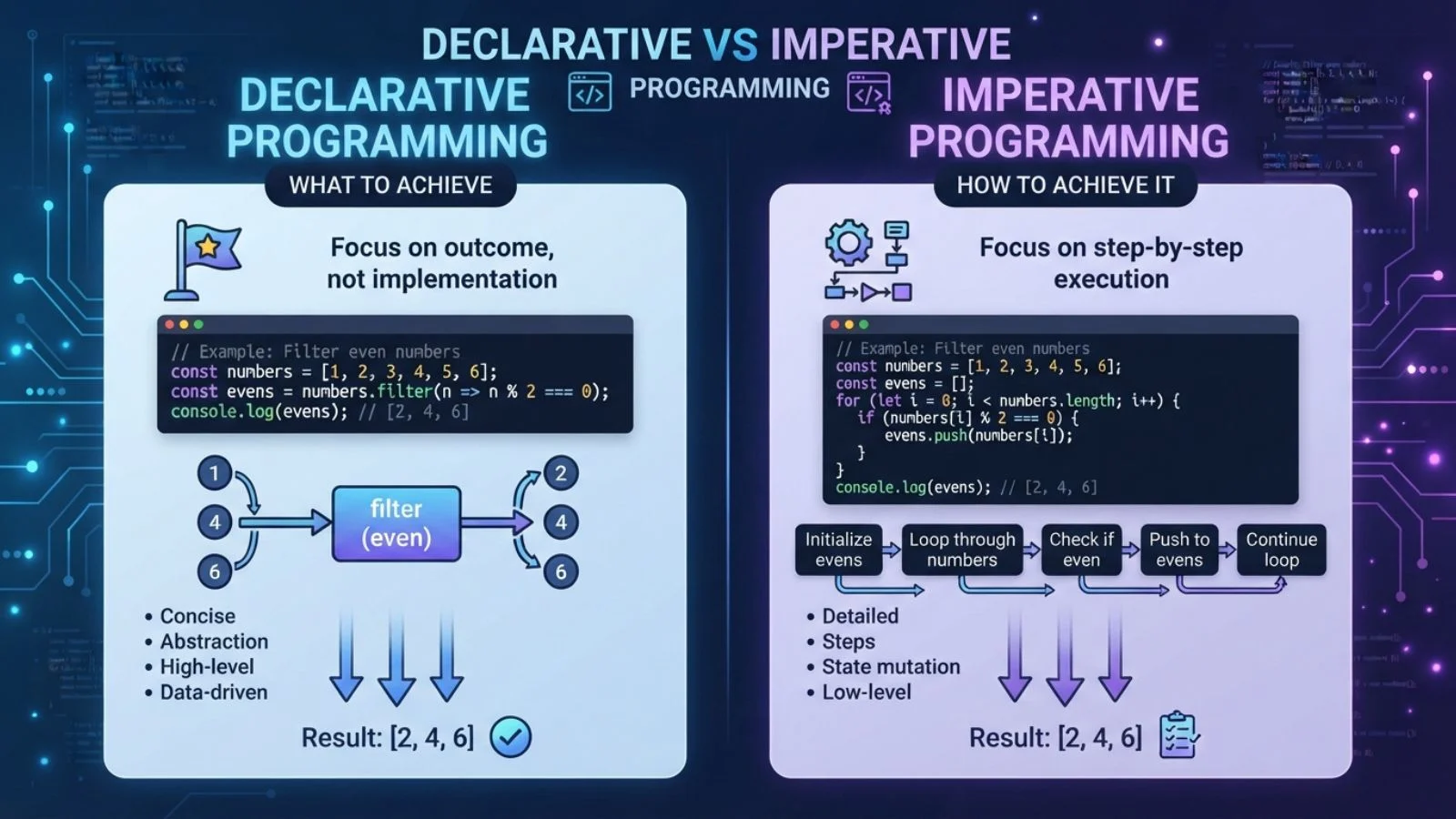
Declarative programming describes what result you want, letting the language or tool figure out how to get there.
Imperative programming describes how to get that result, step by step, through explicit instructions and control flow.
SQL and HTML are declarative; a for loop written by hand is imperative.
Key Takeaways
- Declarative code focuses on the outcome; imperative code focuses on the steps.
- SQL, HTML, CSS, and regular expressions are mostly declarative.
- C, Java loops, and Python scripts using for/while loops are typically imperative.
- Most modern codebases mix both styles depending on the task.
- Declarative code is often shorter and easier to read; imperative code gives more control over exact behavior.
What Does “Declarative” Mean?
Declarative programming tells the computer what you want, not how to do it. You describe the end result, and the underlying system handles the logic behind the scenes.
Think of ordering food at a restaurant. You say, “I’ll have the grilled salmon.” You don’t tell the kitchen how to season it, what temperature to cook it at, or which pan to use. That’s declarative thinking applied to everyday life.
In code, this looks like:
sql
SELECT name FROM users WHERE age > 18;
You never wrote a loop to check each row. You just declared the result you wanted.
What Does “Imperative” Mean?
Imperative programming tells the computer how to do something, one instruction at a time. You control the exact steps, the order they run in, and how the state changes along the way.
Going back to the restaurant example, the imperative would be walking into the kitchen yourself and cooking the salmon step by step: heat the pan, add oil, place the fish, flip after four minutes.
In code:
python
adults = []
for user in users:
if user.age > 18:
adults.append(user.name)
Here, you’re explicitly managing the loop, the condition, and the list.
Declarative vs Imperative: Side-by-Side Code Example
Here’s the same task solved both ways in JavaScript, so you can see the contrast directly.
Imperative (manual steps):
javascript
const doubled = [];
for (let i = 0; i < numbers.length; i++) {
doubled.push(numbers[i] * 2);
}
Declarative (describe the outcome):
javascript
const doubled = numbers.map(n => n * 2);
Both produce the same result. The imperative version spells out every step. The declarative version simply states the transformation, and .map() handles the looping internally.
Key Differences Table
| Aspect | Declarative | Imperative |
| Focus | What to achieve | How to achieve it |
| Control flow | Handled internally | Written explicitly by the developer |
| Code length | Usually shorter | Usually longer |
| Readability | Often easier to scan | Requires tracing logic step by step |
| Debugging | Can be harder to trace internals | Easier to step through line by line |
| Examples | SQL, HTML, CSS, React | C, assembly, for loops, Python scripts |
Real-World Examples of Each Style
SQL
SQL is a classic declarative language. You write SELECT, WHERE, and ORDER BY clauses to describe the data you want. The database engine decides how to fetch it efficiently, choosing indexes and execution plans on its own.
HTML and CSS
HTML declares the structure of a page, and CSS declares how it should look. You never write instructions like “create a rectangle, then place text inside it, then color the border.” You just declare <div>, <p>, and color: blue;, and the browser renders it.
React
React is a good example of a framework that shifted an entire ecosystem from imperative to declarative UI building. Older approaches (like manually updating the DOM with vanilla JavaScript) are imperative: you find an element, then change its text, then update its class.
React lets you declare what the UI should look like for a given state, and it handles the DOM updates:
jsx
function Greeting({ name }) {
return <h1>Hello, {name}</h1>;
}
You never tell React how to update the DOM when the name changes. You just declare what the output should be.
Pros and Cons of Each Approach
Declarative
- Pros: shorter code, easier to read, less room for manual bugs, closer to plain-language intent
- Cons: less control over performance details, harder to debug when the abstraction breaks
Imperative
- Pros: full control over execution, easier to optimize for specific performance needs, straightforward to trace with a debugger
- Cons: more code to write and maintain, higher chance of logic errors, harder to read at a glance
Which One Should You Use?
Most real-world projects use both. Modern languages like JavaScript, Python, and Java support imperative loops and declarative methods (like map, filter, and reduce) side by side.
A simple rule of thumb:
- Use declarative style when the task is common and a built-in method already exists (transforming lists, querying data, describing UI).
- Use imperative style when you need precise control over performance, custom logic, or low-level behavior that no built-in function covers.
Neither approach is universally “better.” The right choice depends on the problem, the team’s habits, and how much control you actually need over each step.
FAQs
Is SQL declarative or imperative?
SQL is declarative. You describe the data you want with statements like SELECT and WHERE, and the database engine decides how to retrieve it.
Is React declarative or imperative?
React is declarative. You describe what the UI should look like for a given state, and React updates the actual DOM for you.
Is Python declarative or imperative?
Python supports both. Writing a for loop is imperative; using list comprehensions or built-in functions like map() and filter() is more declarative.
Which is easier for beginners, declarative or imperative?
Imperative code is often easier for beginners to trace step by step, since every action is spelled out. Declarative code becomes easier once you’re comfortable with the underlying tools doing the work for you.
Can a language be both declarative and imperative?
Yes. Most modern general-purpose languages, including JavaScript, Python, and Java, support both styles, and developers often mix them within the same codebase.
Conclusion
Declarative and imperative programming aren’t rivals they’re two different lenses for solving the same problems.
Declarative code tells the system what you want and lets it handle the details, which is why SQL queries, HTML markup, and React components read so cleanly.
Imperative code tells the system how to do something, step by step, which gives you more control but demands more code.
In practice, you’ll use both. A React app might declare its UI with JSX while an internal utility function loops through data imperatively for a custom calculation.
Understanding the difference helps you recognize which style fits a given task, read other people’s code faster, and make better design decisions as your projects grow.