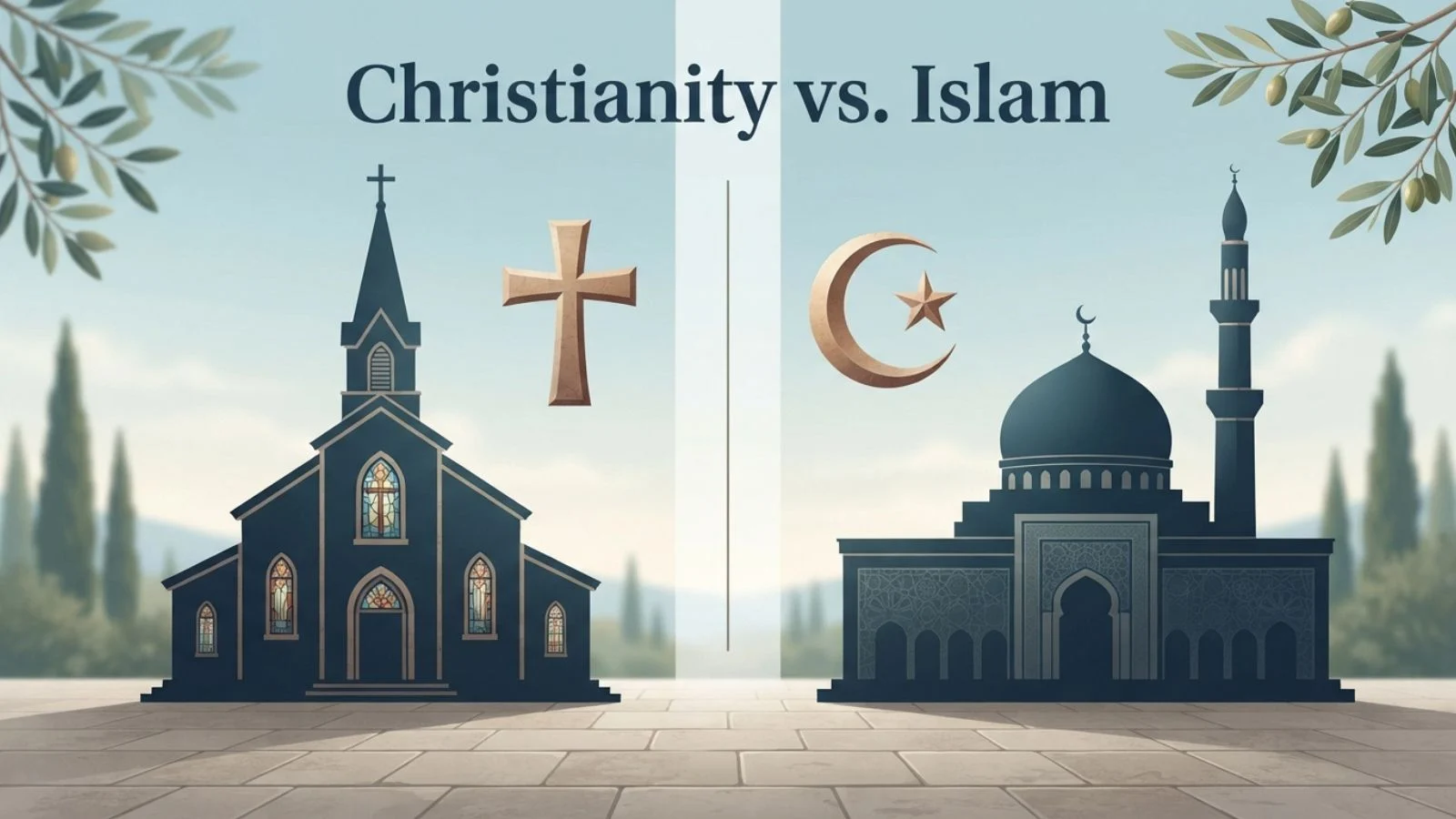
Christianity and Islam are both monotheistic Abrahamic religions, but they differ on core beliefs.
Christianity holds that Jesus Christ is the Son of God and part of the Trinity, offering salvation through faith in him.
Islam teaches strict monotheism (tawhid), views Jesus as a prophet not divine and follows Muhammad as God’s final messenger.
Key Takeaways
- Christianity and Islam are both Abrahamic, monotheistic religions that trace their roots back to Abraham.
- The biggest theological divide is the nature of God: Christianity teaches the Trinity, while Islam teaches strict, indivisible monotheism.
- Christians see Jesus as the divine Son of God; Muslims honor Jesus (Isa) as a major prophet, not as God.
- The Bible is Christianity’s scripture; the Quran is Islam’s, believed by Muslims to be God’s exact words revealed to Muhammad.
- Christianity is the world’s largest religion by population; Islam is the second-largest and the fastest-growing.
Christianity and Islam at a Glance
| Aspect | Christianity | Islam |
| Founded | c. 30 CE, in the Roman province of Judea | 610–632 CE, in the Arabian Peninsula |
| Founder/central figure | Jesus Christ | Prophet Muhammad |
| Sacred text | The Bible (Old and New Testament) | The Quran |
| View of God | Trinity: Father, Son, Holy Spirit | Strict monotheism: Allah, indivisible |
| View of Jesus | Son of God, divine, savior | A prophet and messenger, not divine |
| Place of worship | Church | Mosque |
| Core practice | Prayer, sacraments, church attendance | Five Pillars of Islam |
| Holy day | Sunday | Friday (Jumu’ah) |
| Salvation | Through faith in Jesus Christ | Through faith, good deeds, and God’s mercy |
| Adherents worldwide | About 2.3 billion | About 2 billion |
What Christianity and Islam Have in Common
Before getting into the differences, it helps to see why these two religions are so often compared in the first place: they share real common ground.
Both are Abrahamic religions, meaning they trace their spiritual lineage back to the patriarch are strictly monotheistic they teach belief in one God, not share figures from the Hebrew Bible, including Adam, Noah, Abraham, and Moses, whom they regard as important prophets. also believe in angels, a final Day of Judgment, heaven and hell, and the idea that humans are accountable to God for their actions.
Where they diverge is in how they answer three big questions: Who is God? Who was Jesus? And how is a person made right with God?
The Core Difference: How Each Religion Sees God
This is the single biggest theological split between the two faiths.
Christianity teaches the doctrine of the Trinity, one God who exists as three distinct persons: Father, Son (Jesus Christ), and Holy Spirit. Christians insist this is still strict monotheism, just a God whose nature is triune.
Islam rejects this framing entirely. The Islamic concept of tawhid (the oneness of God) holds that God is absolutely indivisible, with no partners, no sons, and no separate “persons.” From an Islamic theological standpoint, the Trinity compromises pure monotheism, which is why the Quran explicitly addresses and rejects it.
Jesus in Christianity vs. Jesus in Islam
Both religions honor Jesus, but in very different ways.
In Christianity, Jesus Christ is the central figure of the entire faith: the divine Son of God, born of the Virgin Mary, crucified, and resurrected to atone for humanity’s sins. Faith in Jesus as savior is the foundation of Christian salvation.
In Islam, Jesus (called Isa in the Quran) is deeply respected as one of the greatest prophets, also born of a virgin, but he is not considered divine and was not crucified in the way Christians describe. Muslims believe Muhammad, who came roughly six centuries later, was the final prophet in a line that includes Jesus, Moses, Abraham, and others.
Sacred Texts: The Bible vs. the Quran
Christians follow the Bible, a collection of 66 books (in most Protestant traditions) written by many authors over roughly 1,500 years, split into the Old Testament and New Testament. Christians generally view it as divinely inspired but written through human authors.
Muslims follow the Quran, which they believe was revealed directly to Muhammad by the angel Gabriel over about 23 years and preserved as the literal, unaltered word of God in Arabic. This is a key distinction: most Muslims hold that the Quran’s wording itself is sacred, not just its message.
Core Practices and Worship
The Five Pillars of Islam
Muslim religious life is built around five core obligations:
- Shahada – declaring faith that there is no god but God and Muhammad is His messenger
- Salat – praying five times a day facing Mecca
- Zakat – giving a portion of one’s wealth to those in need
- Sawm – fasting during the month of Ramadan
- Hajj – making a pilgrimage to Mecca at least once, if able
Christian Practices and Sacraments
Christian practice varies more by denomination (Catholic, Orthodox, Protestant), but common elements include regular prayer, attending church services (typically on Sunday), reading Scripture, and participating in sacraments or ordinances such as baptism and communion. Many Christians also observe seasons like Lent and Advent and holidays such as Christmas and Easter.
Beliefs About Salvation and the Afterlife
Both religions teach that this life is followed by judgment, heaven, and hell but they differ on how someone gets there.
Christianity generally teaches that salvation comes through faith in Jesus Christ, not through earning it with good deeds. A commonly cited passage is Ephesians 2:8–9, which frames salvation as a gift received by grace through faith.
Islam teaches that a person’s eternal fate depends on a combination of faith, deeds, and God’s mercy. Good actions matter and are weighed, but final judgment ultimately rests on Allah’s mercy. The Quran describes paradise for the righteous and warns of punishment for those who reject God or persist in wrongdoing.
How Christianity and Islam Spread and Grew
Christianity began in the 1st century CE in the region of modern-day Israel and Palestine and spread through the Roman Empire, becoming the empire’s official religion by the end of the 4th century. It later spread globally through European colonization and missionary work.
Islam began in the 7th century CE on the Arabian Peninsula. Within about a century of Muhammad’s death, the Muslim world had expanded from the Atlantic coast to Central Asia, spread through conquest, trade, and missionary activity.
Today, the latest Pew Research study found that followers of Islam outpaced every world religion in population growth over the past decade, while Christianity remained the largest religion overall. The global Christian population stood at about 2.3 billion in 2020, while the global Muslim population reached about 2 billion. Some longer-range projections suggest the gap could narrow further in the coming decades, though projections that far out carry real uncertainty.
FAQs
Do Christians and Muslims worship the same God?
Both traditions trace their belief to the God of Abraham, and both are strictly monotheistic. However, how each defines that God differs sharply Christianity’s Trinity versus Islam’s indivisible oneness so while there’s shared ancestry, the theological understanding of God’s nature is not the same.
Do Muslims believe in Jesus?
Yes. Muslims consider Jesus (Isa) one of the most important prophets in Islam, born of the Virgin Mary and given miracles by God. They do not, however, believe he is divine or the Son of God.
Which religion came first, Christianity or Islam?
Christianity came first, emerging in the 1st century CE. Islam began about six centuries later, in the early 7th century CE.
What is the main difference between Christianity and Islam?
The central difference is theological: Christianity teaches that God exists as a Trinity and that Jesus is divine, while Islam teaches strict, undivided monotheism and views Jesus as a prophet, not God.
Can Christians and Muslims intermarry or share community life?
This varies widely by country, family, and individual interpretation of religious teaching, and isn’t something a general comparison article can answer definitively; it depends on personal, cultural, and legal factors specific to each situation.
Conclusion
Christianity and Islam both trace their roots back to Abraham and share belief in one God, prophets, judgment, and an afterlife but they part ways on the questions that matter most to each faith.
Christianity centers on the Trinity and salvation through faith in Jesus as the divine Son of God.
Islam centers on strict, undivided monotheism and salvation through faith, deeds, and God’s mercy, with Jesus honored as a prophet rather than God himself.
Neither tradition is a smaller or simpler version of the other; they’re two distinct, fully developed answers to the same core human questions: who God is, how people are saved, and how to live rightly.
Understanding those differences clearly, without flattening them into “basically the same” or exaggerating them into pure opposition, is what makes real interfaith understanding possible.
For anyone comparing the two if out of curiosity, study, or interfaith dialogue the goal isn’t to declare a winner, but to see each faith accurately on its own terms.