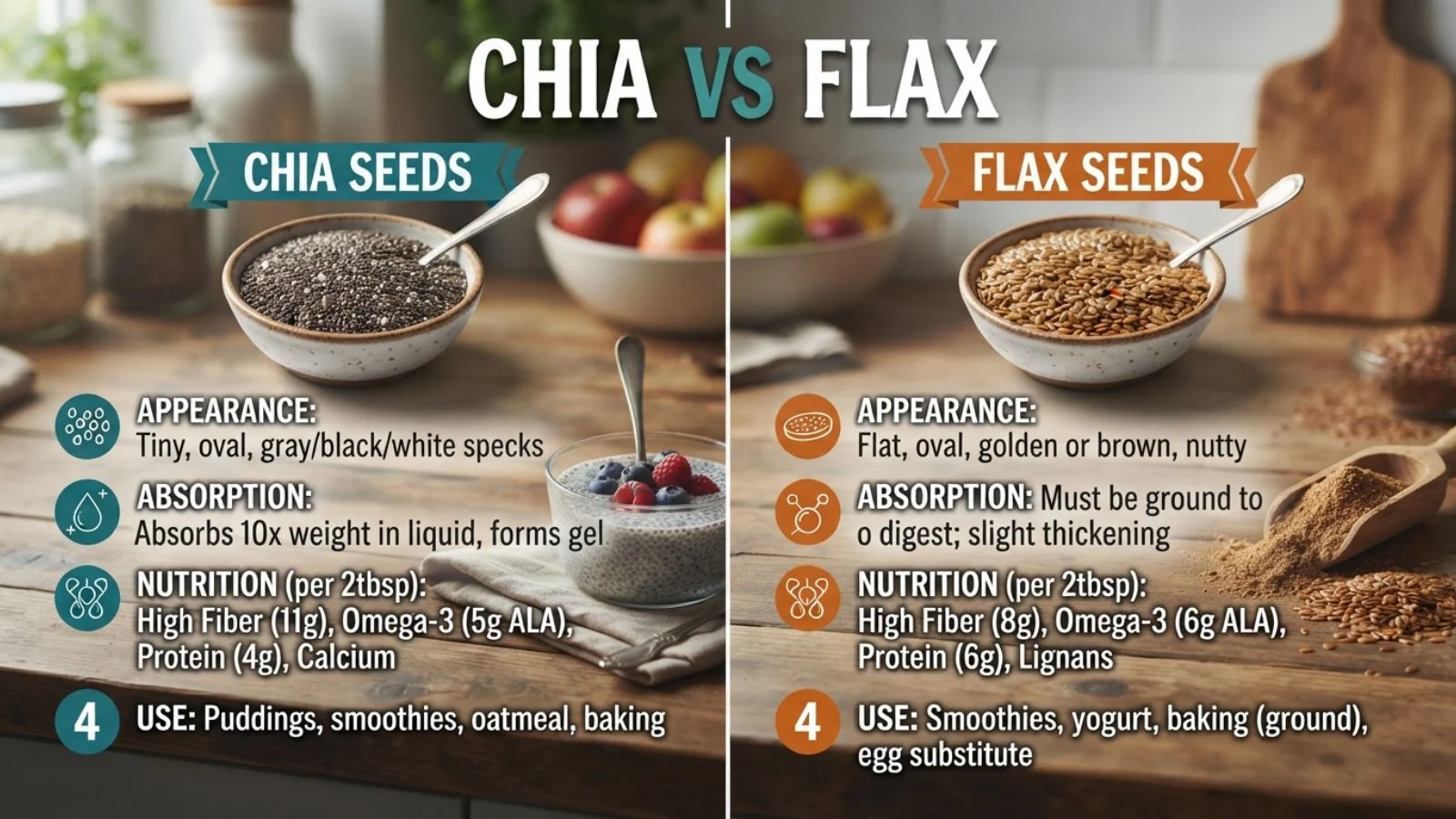
Chia and flax seeds are both nutrient-dense superfoods, but they’re not identical. Chia has more fiber, calcium, and antioxidants and can be eaten whole.
Flax has more omega-3 fats, protein, and B vitamins, but whole flaxseed must be ground for your body to absorb its nutrients. Neither is objectively “better” ; the right pick depends on your goal.
Key Takeaways
- Fiber: Chia has more fiber per serving and forms a gel when soaked in liquid.
- Omega-3s: Flax delivers more ALA (plant omega-3) per tablespoon than chia.
- Prep matters: Chia can be eaten whole; flaxseed should be ground, or it passes through your body largely undigested.
- Hormone-related compounds: Flax is far richer in lignans, a plant compound linked to hormone and heart health.
- Shelf life: Flax goes rancid faster than chia and stores best in the fridge or freezer.
Chia vs Flax Nutrition Facts
Here’s how a 1-ounce (28-gram) serving of each seed compares, based on USDA nutrition data compiled by Healthline:
| Nutrient | Chia Seeds (1 oz) | Flax Seeds (1 oz) |
| Calories | 138 | 150 |
| Carbs | 12 g | 8 g |
| Fiber | 10 g | 8 g |
| Protein | 5 g | 5 g |
| Fat | 9 g | 12 g |
| Calcium | 14% DV | 6% DV |
| Magnesium | 23% DV | 26% DV |
| Thiamine (B1) | 15% DV | 38% DV |
| Copper | 29% DV | 38% DV |
The two seeds look almost interchangeable at first glance. Both are low-carb, high-fat, high-fiber, and loaded with minerals in a tiny serving. The real differences show up once you look at which nutrients each one specializes in, and how your body actually absorbs them.
Fiber: Which Seed Wins?
Both seeds are fiber powerhouses, but they behave differently in your digestive system.
Chia’s Gel-Forming Fiber
Chia seeds are mostly soluble fiber. When they meet liquid in a smoothie, oatmeal, or your stomach they absorb up to 10 times their weight and form a thick gel. This gel slows digestion, which helps you feel full longer and may help stabilize blood sugar after meals. It’s also why chia seeds are the base for chia pudding.
Flax’s Fiber Blend
Flaxseed has a mix of soluble and insoluble fiber, with insoluble fiber playing a bigger role. Insoluble fiber doesn’t dissolve; it adds bulk and helps move food through your gut, which supports regularity. Flax provides slightly less total fiber than chia per ounce, but its blend is especially useful if constipation, rather than fullness, is your main concern.
Omega-3s and Heart Health
Both seeds are among the best plant sources of alpha-linolenic acid (ALA), an essential omega-3 fat your body can’t make on its own. Flax has the edge here, providing noticeably more ALA per ounce than chia. Chia still delivers far more omega-3s than almost any other plant food, just not quite as much as flax.
One caveat applies to both seeds: your body converts only a small percentage of ALA into the more active omega-3 forms (EPA and DHA) found in fatty fish. That doesn’t erase the benefit ALA on its own is linked to lower inflammation and better heart health but it’s worth knowing if omega-3s are your main reason for eating either seed.
Protein and Other Nutrients
Flax has a slight edge in protein per serving, though the difference is small enough that neither seed should be treated as a primary protein source. Think of them as boosters added to a smoothie or yogurt bowl rather than a meat or bean substitute.
Chia pulls ahead on calcium, making it a useful add-in for people limiting dairy. Flax leads on thiamine (B1) and copper, both of which support energy metabolism. Magnesium is close between the two, with flax slightly ahead.
The Big Difference: Do You Need to Grind Flaxseed?
This is the detail most comparisons skip, and it matters more than any single nutrient.
Chia seeds have a soft outer shell that breaks down in liquid, so your body can absorb their nutrients whether you eat them whole, soaked, or ground.
Whole flaxseed has a tough outer coat that resists your digestive system. If you eat it whole, a large share of it passes through undigested meaning you miss out on much of the fiber, omega-3s, and lignans it contains. Grinding flaxseed (or buying it pre-ground) breaks that shell open so your body can actually use what’s inside. A basic coffee grinder works fine, and ground flax stores well in the freezer.
Chia vs Flax for Weight Loss and Blood Sugar
Neither seed burns fat on its own, but both can support a weight-management plan by increasing satiety. Chia’s gel-forming fiber tends to have a slightly stronger fullness effect because of how much liquid it absorbs, which may also help blunt post-meal blood sugar spikes. Flax’s insoluble fiber contributes to fullness too, just through bulk rather than gelling.
Flax’s Lignan Advantage
Lignans are plant compounds with mild estrogen-like and antioxidant properties. Flaxseed contains dramatically more lignans than almost any other food, including chia. Some research links lignans to improved cholesterol levels and hormone balance, particularly around menopause, though study results are mixed and this isn’t a substitute for medical guidance. If lignans are your main interest, flax is the clear choice over chia.
Taste, Texture, and How to Use Each
Chia seeds are nearly flavorless and stay slightly crunchy unless soaked, when they turn gelatinous. That makes them ideal for:
- Chia pudding and overnight oats
- Smoothies (no grinding needed)
- A crunchy topping on yogurt or toast
Flaxseed has a mild, nutty flavor. Ground flax blends smoothly into batters and doughs, which is why it’s a common egg substitute in vegan baking (1 tablespoon ground flax mixed with 3 tablespoons water replaces one egg). Whole flaxseed adds crunch to granola or bread crusts, but remember it won’t be well digested unless ground first.
Storage: Why Flax Goes Rancid Faster
Both seeds are high in polyunsaturated fat, which can oxidize and spoil over time. Flaxseed, especially ground flax, is more sensitive to this than chia because grinding exposes more surface area to air. Store ground flaxseed in an airtight container in the fridge or freezer and use it within a few months. Whole chia seeds are more stable at room temperature but still last longer in a cool, dark pantry or the fridge.
Can You Use Chia and Flax Together?
Yes. There’s no nutritional downside to using both, and doing so covers more ground than either seed alone, chia’s fiber and calcium alongside flax’s omega-3s and lignans. A common approach is splitting a recipe’s seed quantity between the two, such as half a tablespoon of each in a smoothie or oatmeal bowl.
FAQs
Is chia or flax better for you?
Neither is universally better. Chia has more fiber, calcium, and antioxidants and needs no grinding. Flax has more omega-3s, B vitamins, and lignans but must be ground to be digested. The better choice depends on which nutrients you’re prioritizing.
Can I substitute chia seeds for flaxseed in a recipe?
Usually, yes, at a 1:1 ratio. Keep in mind chia forms a thicker gel when soaked, so a recipe may need slightly more liquid. In baking as an egg replacer, both work with the same 1 tablespoon seed to 3 tablespoons water ratio.
Do I need to grind chia seeds like flaxseed?
No. Chia’s shell breaks down naturally in liquid, so whole chia seeds are fully digestible. Flaxseed needs to be ground, or its nutrients largely pass through undigested.
Which is better for weight loss, chia or flax?
Chia has a slight edge due to its strong gel-forming fiber, which increases fullness. The difference is modest, and both work well as part of a higher-fiber diet.
Can you eat chia and flax seeds together?
Yes, combining them is a common and safe way to get the benefits of both in one serving.
Conclusion
Chia and flax seeds are more alike than different; both are compact, nutrient-dense seeds that deliver fiber, plant-based omega-3s, and minerals in a single spoonful. The real difference comes down to what you’re optimizing for.
If fiber, calcium, and no-prep convenience matter most, chia is the easier choice since it’s fully digestible whole.
If omega-3s, lignans, and B vitamins are the priority, flax pulls ahead just remember to grind it first, or you’ll miss out on most of its benefits.
For most people, there’s no need to pick a side. Rotating both into smoothies, oatmeal, or baked goods covers more nutritional ground than relying on either seed alone, and neither one requires a big lifestyle change to add.