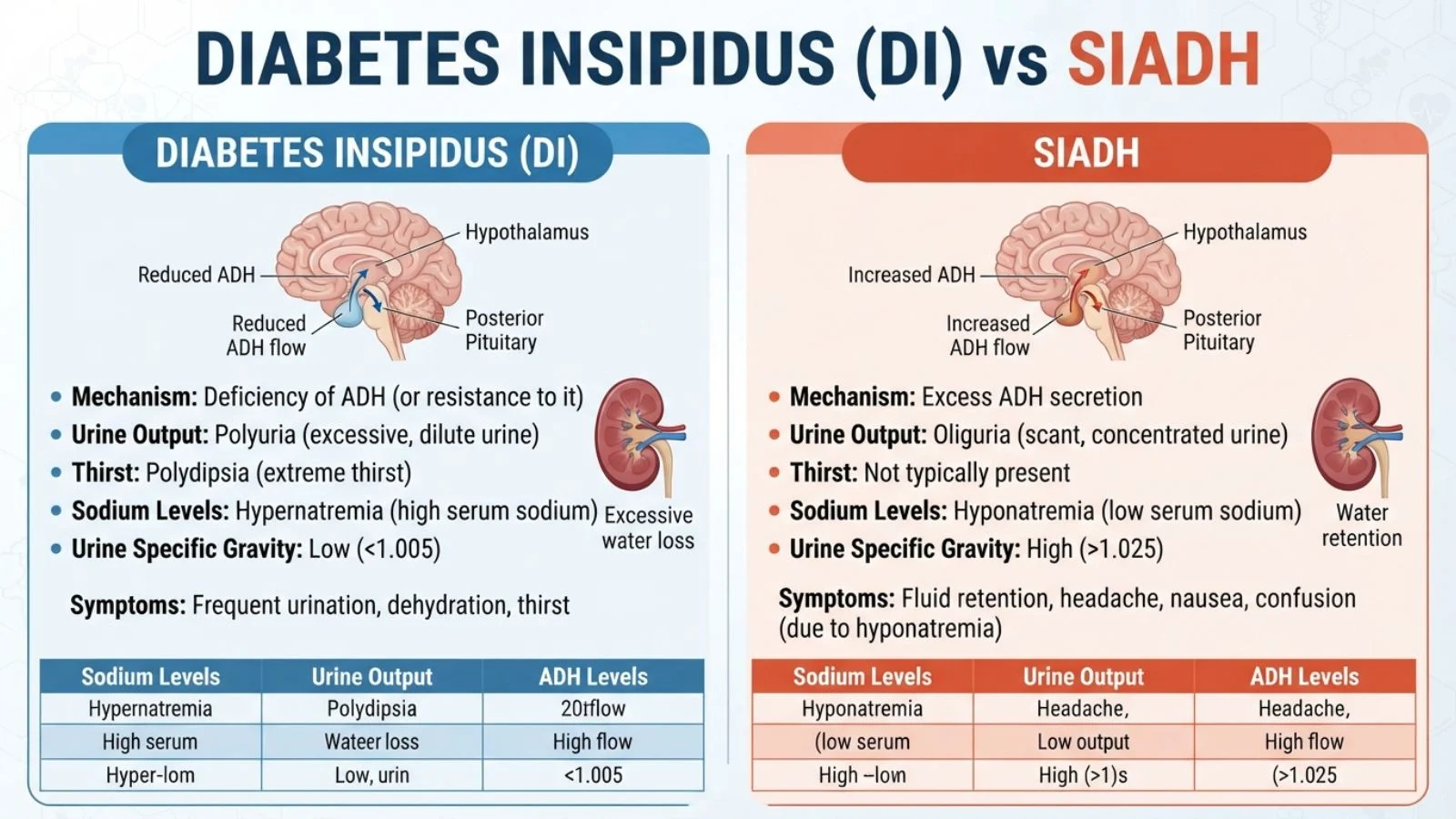
DI (diabetes insipidus) and SIADH (syndrome of inappropriate antidiuretic hormone secretion) are opposite disorders of antidiuretic hormone (ADH).
DI causes too little ADH activity, leading to excess dilute urine, dehydration, and high sodium (hypernatremia).
SIADH causes too much ADH, leading to water retention, concentrated urine, and low sodium (hyponatremia).
Key Takeaways
- DI and SIADH both involve antidiuretic hormone (ADH), but they cause opposite problems.
- DI leads to too much urine and high blood sodium. SIADH leads to too little urine and low blood sodium.
- DI is treated with fluids and sometimes desmopressin. SIADH is treated mainly with fluid restriction.
- Getting the two mixed up is common, especially in nursing school, because the names sound similar.
- A quick way to remember: DI “dries you out.” SIADH “drowns you in fluid.”
What Is Diabetes Insipidus (DI)?
Diabetes insipidus happens when the body can’t hold onto water the way it should. Despite the name, it has nothing to do with blood sugar diabetes. The “insipidus” in the name means “tasteless” , a nod to how, centuries ago, doctors compared the urine of DI patients (watery, dilute) to the sweet urine of diabetes mellitus.
In DI, ADH isn’t doing its job. ADH normally tells the kidneys to reabsorb water back into the body. When ADH is missing or the kidneys ignore it, water passes straight through and leaves the body as urine.
Central DI vs. Nephrogenic DI
There are two types of DI, and they have different root causes:
- Central DI The pituitary gland doesn’t release enough ADH. This can happen after brain surgery, head trauma, a pituitary tumor, or in some cases for no clear reason at all.
- Nephrogenic DI The pituitary makes plenty of ADH, but the kidneys don’t respond to it. This can be caused by certain medications (lithium is a well-known trigger), kidney disease, or inherited genetic conditions.
Either way, the result looks the same: large amounts of watery urine, constant thirst, and a risk of dehydration if fluid losses aren’t replaced.
What Is SIADH?
SIADH is essentially the mirror image of DI. Instead of too little ADH, the body releases too much and it doesn’t shut off when it should. Normally, ADH release drops once the body has enough water. In SIADH, that shutoff signal doesn’t work correctly.
The extra ADH tells the kidneys to hold onto water no matter what. That water dilutes the blood, and sodium levels drop. In severe cases, this can cause confusion, headaches, and even seizures.
DI vs SIADH: Side-by-Side Comparison Table
| Feature | Diabetes Insipidus (DI) | SIADH |
| ADH level | Too low, or kidneys ignore it | Too high |
| Urine output | Very high (dilute urine) | Low (concentrated urine) |
| Blood sodium | High (hypernatremia) | Low (hyponatremia) |
| Blood osmolality | High | Low |
| Urine osmolality | Low | High |
| Main risk | Dehydration | Water retention, brain swelling |
| Typical thirst level | Extreme thirst | Usually normal or reduced |
| Main treatment | Fluids, desmopressin (central DI) | Fluid restriction |
Why Sodium Moves in Opposite Directions
Sodium levels don’t move on their own; they follow water. In DI, the body loses water faster than sodium, so the sodium left behind becomes more concentrated, pushing levels up. In SIADH, the body holds onto extra water while sodium intake stays the same, so the sodium gets diluted and levels drop. Once this water-sodium relationship clicks, the rest of the comparison becomes much easier to follow.
Symptoms: How to Tell Them Apart
DI symptoms tend to center on fluid loss:
- Frequent urination, including waking up at night to urinate
- Intense thirst, often for cold water specifically
- Signs of dehydration if fluids aren’t replaced (dry mouth, dizziness, low blood pressure)
SIADH symptoms tend to center on fluid buildup and low sodium:
- Nausea and headache
- Confusion or trouble concentrating
- Muscle cramps or weakness
- In severe cases, seizures or reduced consciousness
A useful bedside clue: a DI patient is often producing large volumes of urine and asking for water constantly. A SIADH patient often has normal or reduced urine output and may seem confused out of proportion to any obvious cause.
Causes of DI vs SIADH
Common causes of DI:
- Brain surgery, head injury, or pituitary tumors (central DI)
- Certain medications, especially lithium (nephrogenic DI)
- Genetic kidney conditions
- Some cases have no identifiable cause
Common causes of SIADH:
- Certain lung conditions, including pneumonia
- Central nervous system problems, such as head injury, stroke, or meningitis
- Some cancers, particularly small cell lung cancer, which can produce ADH-like activity
- Certain medications, including some antidepressants and seizure medications
How Doctors Diagnose DI and SIADH
Diagnosis usually starts with basic blood and urine tests: serum sodium, serum osmolality, and urine osmolality. A patient with high sodium and very dilute urine points toward DI. A patient with low sodium and inappropriately concentrated urine points toward SIADH.
For DI, doctors may also use a water deprivation test, where fluids are withheld under supervision to see how the body responds, sometimes followed by a dose of synthetic ADH to tell central DI apart from nephrogenic DI. For SIADH, doctors typically rule out other causes of low sodium, such as kidney or thyroid problems, adrenal insufficiency, or a related condition called cerebral salt wasting, which can look similar but is caused by fluid loss rather than fluid retention.
Treatment Differences
DI treatment focuses on replacing lost fluids and, for central DI, replacing the missing hormone with desmopressin, a synthetic form of ADH. Nephrogenic DI is harder to treat with hormone replacement since the kidneys aren’t responding to ADH in the first place, so treatment often focuses on diet changes and sometimes specific medications that reduce urine volume.
SIADH treatment usually starts with fluid restriction, often limiting intake to less than a liter a day, to let sodium levels rise back toward normal. If fluid restriction isn’t enough, doctors may use medications that block ADH’s effect on the kidneys, allowing the body to release extra water without losing sodium. Correcting sodium too quickly is avoided, since that carries its own serious risks.
A Simple Way to Remember DI vs SIADH
If the names keep blurring together, try this: think of DI as “Dehydration Incoming” too much urine, not enough water in the body. Think of SIADH as holding onto fluid, almost like a sponge that won’t wring out too much water, not enough sodium. Whenever urine output and sodium move in the same direction, it’s a good sign you’re thinking about DI. Whenever they seem to work against you, that’s the SIADH pattern.
Can You Have DI and SIADH at the Same Time?
It’s rare, but possible, particularly after certain types of brain surgery or head trauma. Some patients go through a triphasic pattern: an initial period that looks like DI, followed by a temporary SIADH-like phase, and then a return to DI or normal function. This happens because the pituitary gland’s ability to release ADH can be disrupted and partially recover in stages. This pattern is uncommon and is closely monitored when it does occur.
Frequently Asked Questions
What is the main difference between DI and SIADH?
DI involves too little ADH activity and causes excess dilute urine with high blood sodium. SIADH involves too much ADH and causes water retention with low blood sodium.
Does DI cause high or low sodium?
DI causes high sodium (hypernatremia) because the body loses water faster than sodium.
Does SIADH cause high or low sodium?
SIADH causes low sodium (hyponatremia) because excess water dilutes the sodium already in the blood.
How do you remember the difference between DI and SIADH?
Think of DI as drying the body out through excess urination, and SIADH as the body holding onto extra water it doesn’t need.
What is the treatment for DI vs SIADH?
DI is treated with fluid replacement and, for central DI, desmopressin. SIADH is treated mainly with fluid restriction, sometimes combined with medications that block ADH’s effect on the kidneys.
Conclusion
DI and SIADH sound similar and both revolve around ADH, but they pull the body in opposite directions: one drains fluid and raises sodium, the other retains fluid and lowers it.
Once you connect the water-sodium relationship to each condition, the symptoms, causes, and treatments start to make sense on their own rather than needing to be memorized separately.
Confused about DI vs SIADH? See how diabetes insipidus and SIADH differ in sodium levels, urine output, causes, and treatment explained simply.