Ever been told to use a “supinated grip” during a workout, or heard a podiatrist mention that you “overpronate” when you walk? If those terms left you scratching your head, you’re not alone.
Pronated and supination are two of the most misunderstood yet most important concepts in anatomy, fitness, and injury prevention.
At their core, these words describe rotational movement: supranational turns a body part outward or upward, while probation turns it inward or downward.
But the way this plays out differs dramatically depending on whether you’re talking about your forearm during a bicep curl or your foot striking the pavement mid-run.
Understanding the difference isn’t just academic. It shapes how you train, which shoes you buy, and how you avoid common injuries like tennis elbow or plantar fasciitis. This article breaks down both movements in detail starting with the basics.
Core Definitions
To understand pronation and supination, it helps to start with their origins. Both words come from Latin: supinus means “lying face up,” while pronus means “bent forward” or “face down.” These roots capture the essence of each movement: supination is an upward or outward rotation, and pronation is a downward or inward one.
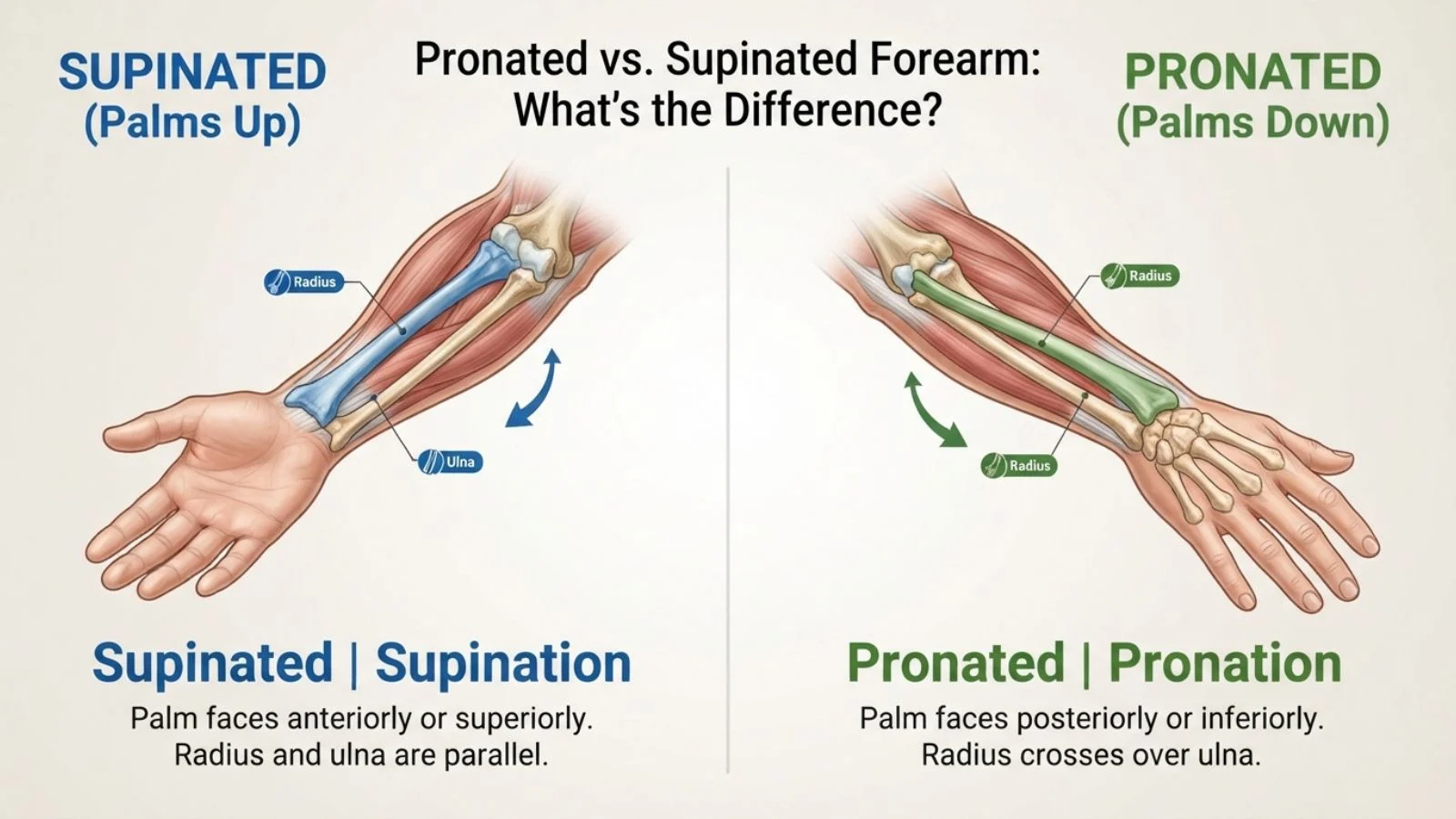
In practical terms, supination occurs when you rotate your palm so it faces upward, as if you were holding a bowl of soup in your hand, a common mnemonic (“supinate = soup”) that makes the concept easy to remember. Pronation is the opposite: rotating the palm so it faces downward, like when you’re about to type on a keyboard or press your palm flat against a table.
The same directional logic applies to the foot, though the mechanics are more complex. When your foot pronates, it rolls slightly inward and downward during walking or running. When it supinates, it rolls outward, with more weight shifting to the outer edge of the foot.
It’s worth noting that these aren’t inherently “good” or “bad” movements; they’re normal, necessary parts of how your body absorbs shock and generates force. Problems arise only when the degree of pronation or supination becomes excessive or insufficient, which we’ll explore later in this article.
The Anatomy Behind the Movement
Pronation and supination happen in two very different parts of the body, each governed by its own set of joints and muscles.
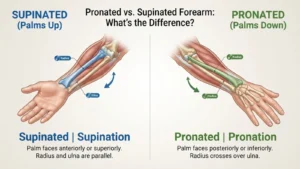
In the forearm, the movement centers on the radius and ulna the two long bones running from your elbow to your wrist. During supination, the radius rotates so it lies parallel to the ulna, turning the palm upward. During pronation, the radius crosses over the ulna, rotating the palm downward. This rotation happens primarily at the proximal and distal radioulnar joints, located near the elbow and wrist.
Several muscles power this motion. Supination is driven mainly by the supinator muscle and, to a lesser extent, the biceps brachii which is why a supinated grip during curls recruits more bicep activation. Pronation relies on the pronator teres and pronator quadratus, two muscles that work together to rotate the forearm inward.
In the foot and ankle, the mechanics are more complex. Pronation and supination occur primarily at the subtalar joint, located just below the ankle. Unlike the forearm’s single-plane rotation, foot pronation and supination involve movement across three planes simultaneously: inversion/eversion (tilting), plantarflexion/dorsiflexion (up-down), and abduction/adduction (side-to-side). This is why foot pronation isn’t simply “rolling inward” it’s a coordinated, tri-planar motion that plays a critical role in shock absorption during walking and running.
Pronation & Supination in the Upper Body
Nowhere is the pronation-supination distinction more practical than in strength training, where grip orientation can change which muscles do the work.
A supinated grip palms facing up or toward you is the classic underhand grip used in chin-ups and bicep curls. Because the biceps brachii is a primary supinator of the forearm, this grip places the biceps in a mechanically advantageous position, making it the go-to choice for anyone targeting arm size and strength. That’s why chin-ups are often considered more bicep-dominant than their pull-up counterparts.
A pronounced grip palms facing away or downward is the standard overhand grip used in pull-ups, bent-over rows, and deadlifts. This position shifts emphasis away from the biceps and toward the lats, upper back, and forearm extensors, making it a staple for back-focused pulling movements.
Between these two lies the neutral grip, where palms face each other (as in neutral-grip pull-ups or hammer curls). This position reduces strain on the wrists and elbows while still allowing solid muscle engagement, making it a popular choice for those managing joint discomfort.
Beyond the gym, these rotations show up constantly in daily life: supination when turning a key or using a screwdriver, pronation when typing or pressing down on a surface. Repetitive strain in either direction can contribute to overuse injuries, which we’ll cover later in the article.
Pronation & Supination in the Lower Body
While upper-body pronation and supination are mostly about grip choice, the lower-body version plays a constant, largely unconscious role in how you walk and run.
Every time your foot strikes the ground, it moves through a natural pronation phase, rolling slightly inward and flattening to absorb shock as weight transfers across the foot. This is a normal, necessary part of the gait cycle, not a flaw to be corrected. The issue arises with overpronation, where the foot rolls inward excessively, placing added stress on the ankles, knees, and shins.
On the opposite end is supination, sometimes called underpronation, where the foot rolls outward and doesn’t flatten enough to absorb shock effectively. This shifts impact toward the outer edge of the foot and can increase strain on the ankles and lower leg.
Foot arch type is closely tied to these patterns. People with flat feet tend toward overpronation, since there’s less natural arch support to control inward roll. Those with high, rigid arches often lean toward supination, since their feet are less able to flatten and absorb shock.
These tendencies matter most when choosing footwear. Stability or motion-control shoes are typically recommended for overpronators, while cushioned, flexible shoes tend to suit supinators better. Neutral shoes work well for those without a pronounced tendency either way.
Clinical & Injury Implications
Understanding your pronation or supination tendencies isn’t just useful for performance, it directly affects your risk of injury, both in the upper and lower body.
In the upper body, repetitive pronation or supination movements are common culprits behind overuse injuries. Lateral epicondylitis, better known as tennis elbow, often stems from repeated forearm extension and pronation-heavy movements, such as those used in racquet sports or certain manual labor tasks. Medial epicondylitis, or golfer’s elbow, is similarly linked to repetitive gripping and forearm rotation, particularly during supination-heavy activities. In more severe cases, excessive or forceful rotation can irritate the radial or ulnar nerves as they pass through the forearm, leading to tingling, weakness, or pain that radiates down to the hand.
In the lower body, the stakes are just as significant. Overpronation is frequently associated with plantar fasciitis, since the excessive inward roll places added tension on the plantar fascia with every step. It’s also linked to shin splints and iliotibial (IT) band syndrome, as the altered foot mechanics change how force travels up through the knee and hip. Supination, meanwhile, is more closely tied to ankle sprains, since the outward roll places the ankle in a less stable position, and to stress fractures along the outer foot due to concentrated impact.
Importantly, not every case of pronation or supination requires intervention. If you’re not experiencing pain or performance issues, these patterns are often just part of your natural movement signature. Persistent discomfort, however, is a signal to consult a physical therapist or podiatrist.
Common Misconceptions
Despite how often these terms come up in fitness and healthcare settings, several myths about pronation and supination persist and clearing them up can prevent unnecessary worry or wasted money on corrective products.
Pronation is always bad. This is perhaps the most widespread misconception. In reality, pronation is a normal, essential part of how the foot absorbs shock during walking and running. Without some degree of pronation, the foot would be far less effective at cushioning impact. The problem isn’t pronation itself, it’s overpronation, an excessive version of a naturally healthy movement.
Everyone needs orthotics or stability shoes. Footwear and insoles marketed toward “correcting” pronation are often sold as universal necessities, but not everyone with a pronation or supination tendency needs intervention. Many people function well without pain or performance issues despite having a pronounced tendency in either direction. Corrective products are most useful when there’s an actual problem, pain, injury history, or diagnosed imbalance not as a blanket precaution.
Pronation and supination are the same as inversion and eversion. While related, these terms aren’t interchangeable. Inversion and eversion refer specifically to the tilting motion of the foot sole (inward or outward), while pronation and supination describe a broader, tri-planar movement that includes inversion/eversion as just one component alongside plantarflexion/dorsiflexion and abduction/adduction.
Practical Takeaways
Now that you understand the mechanics, here’s how to apply this knowledge in real life.
Identify your pattern. For the upper body, pay attention to which grip feels stronger or more comfortable during pulling exercises that can hint at muscle imbalances worth addressing. For the lower body, try the classic wet footprint test: wet the sole of your foot, step onto a piece of paper or dark pavement, and examine the shape. A full, wide footprint suggests overpronation; a thin footprint with a pronounced gap along the arch suggests supination; a moderate curve indicates a neutral pattern.
Choose footwear accordingly. Overpronators generally benefit from stability or motion-control shoes with firmer support on the inner sole. Supinators tend to do better in cushioned, flexible shoes that encourage better shock absorption. If your pattern is neutral, most standard running or training shoes will work fine.
Vary your grip in training. Rotating between supinated, pronated, and neutral grips across your workouts helps build balanced strength and reduces repetitive strain on any single muscle group or joint.
Don’t fix what isn’t broken. If you’re pain-free and performing well, there’s no need to chase corrective products just because you’ve identified a pronation or supination tendency. These patterns are often just part of normal biomechanics.
Know when to seek help. Persistent pain, recurring injuries, or noticeable asymmetry between sides are good reasons to consult a physical therapist or podiatrist for a proper gait or movement assessment.
Conclusion
Pronation and supination may sound like technical jargon reserved for anatomy textbooks, but as this article has shown, they play out in everyday movements from the grip you choose at the gym to the way your foot strikes the pavement on a morning run.
At their core, the distinction is simple: supination rotates a body part upward or outward, while pronation rotates it downward or inward.
But the real value lies in understanding how this plays out differently in the forearm versus the foot, and why neither movement is inherently good or bad.
In the upper body, your grip choice can shift emphasis between your biceps, back, and forearms, giving you a simple tool to fine-tune your training.
In the lower body, your natural pronation or supination tendency influences everything from footwear choice to injury risk, particularly around conditions like plantar fasciitis, shin splints, and ankle sprains.
The key takeaway isn’t to fear these movements, but to understand your own patterns and respond appropriately whether that means adjusting your shoes, varying your grip, or simply recognizing that some degree of pronation or supination is completely normal.