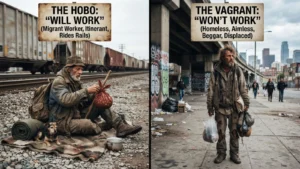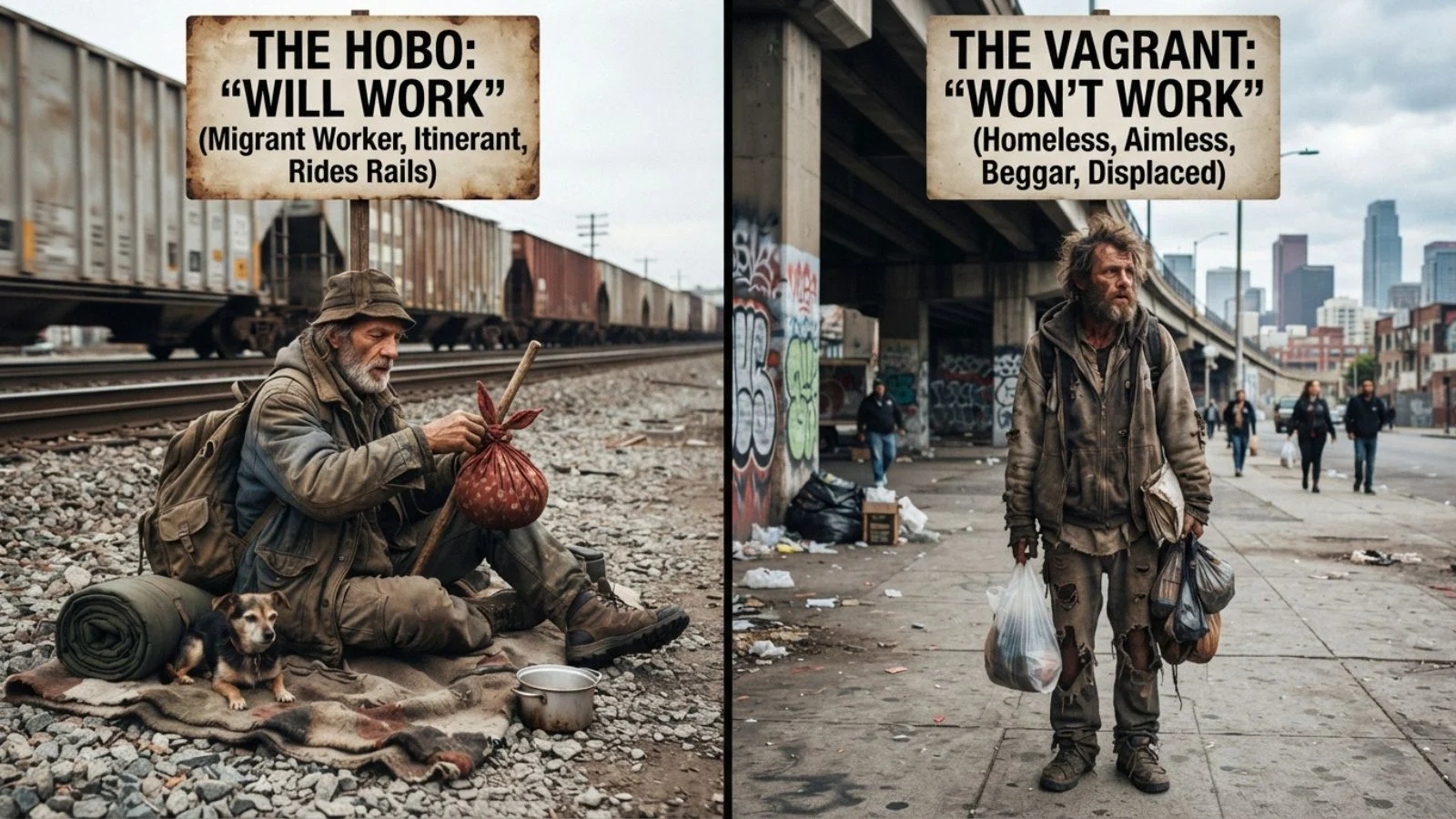
Picture a dusty railroad yard in 1890s America where a weathered figure clutches a bundle and waits for a freight train to slow enough to jump aboard.
Now picture a courtroom a century earlier where a magistrate reads out a vagrancy charge against a man with no fixed address. Both figures might be described today with the same lazy shorthand: homeless wanderer.
But “hobo” and “vagrant” are not interchangeable words plucked from the same drawer of slang; they carry distinct etymological roots, legal histories and cultural weight.
One emerged from the romance and hardship of America’s railroad era; the other from centuries of English law designed to police the income .
Understanding the difference isn’t just a linguistic exercise; it reveals how societies have historically drawn lines between the “deserving” and “undeserving” income and how those lines still echo in the words we use today.
Etymology and Word Origins
The word “hobo” is one of American English’s great etymological mysteries. No one knows for certain where it came from though theories abound. Some linguists trace it to “hoe-boy” , a term for itinerant farmhands who carried hoes from job to job. Others point to a railroad greeting “Ho boy!” shouted between workers which supposedly morphed into a label for the drifters who rode the rails alongside them. Still others suggest a link to “homeward bound” clipped down over time by rail-yard slang. What’s agreed upon is the timing: the word surfaces in print around 1889 to 1890 in the American West right as the transcontinental railroad network was reshaping how laborers moved across the country in search of work.
“Vagrant” by contrast has no mystery about its roots. It descends from the Old French wacrant or walcrant meaning “wandering” itself tied to the Latin vagari “to wander.” Unlike “hobo” which was born from a specific American subculture, “vagrant” entered English centuries earlier as a legal term formalized in statutes like England’s Statute of Cambridge in 1388. That law empowered authorities to restrict the movement of laborers and punish those found wandering without work or a fixed residence. So while “hobo” was coined by the people it described, “vagrant” was coined by the institutions meant to control them, a distinction that shapes everything about how the two words function to this day.
Historical Context
The hobo emerged directly from the economic upheaval of post-Civil War America. As railroads expanded westward they created both opportunity and displacement seasonal work in agriculture mining and logging drew huge numbers of men into a migratory lifestyle and the freight train became their primary mode of transport. The Panic of 1893 and later the Great Depression swelled these ranks dramatically; by the 1930s hundreds of thousands of Americans including many young men and even entire families rode the rails searching for whatever labor they could find. Far from being simply “homeless” hobos were often part of an informal, essential workforce that harvested crops, built infrastructure and filled gaps in seasonal labor markets.
Vagrancy meanwhile has a far older and more explicitly punitive history. England’s vagrancy laws date back to the 14th century developed in the aftermath of the Black Death when labor shortages gave workers new bargaining power that landowners and the state moved quickly to suppress. The Statute of Cambridge (1388) and later the Elizabethan income Laws formalized the criminalization of wandering without employment or a permanent residence. These laws crossed the Atlantic with English colonists and were later adapted in the United States notably reused after the Civil War to re-criminalize freed Black Americans under vagrancy statutes embedded in the Black Codes turning “vagrancy” into a tool for controlling labor and enforcing racial hierarchy long after slavery’s formal abolition.
Definitional Distinctions
Perhaps the most useful framework for separating these terms comes from hobo culture itself: the classic trichotomy of hobo tramp and bum. A hobo by this definition travels and works moving from place to place in search of labor whether seasonal harvests, construction or odd jobs. A tramp travels but avoids work wandering for its own sake or out of necessity without seeking steady employment. A bum neither travels nor works remaining in one place without income or occupation. This internal classification system developed and maintained by hobos themselves reveals something important: hobo identity was rooted in a work ethic and a willingness to labor that distinguished it from mere destitution.
“Vagrant” resists this kind of nuanced self-definition entirely because it was never a self-identified category to begin with. It is fundamentally a legal-administrative label applied from the outside by courts, police and lawmakers to describe anyone lacking a fixed address or visible means of support regardless of whether that person was actively seeking work traveling for legitimate reasons or simply income . Where “hobo” describes a lifestyle and implies agency, “vagrant” describes a legal status and implies suspicion. This is why the same person could be called a hobo by a sympathetic novelist and a vagrant by an unsympathetic magistrate even though their circumstances hadn’t changed at all. The gap between these definitions, one social and self-authored one legal and imposed, is the real heart of the hobo-versus-vagrant distinction.
Legal Status and Treatment
Vagrancy laws gave authorities sweeping power to arrest people not for any specific criminal act but for their perceived status being income , unemployed or without a permanent address. In the post-Reconstruction South vagrancy laws became a central pillar of the Black Codes used to arrest newly freed Black Americans on flimsy pretenses and then lease their labor out through convict-leasing systems effectively reconstituting forced labor under a new legal guise.
This sweeping vagueness eventually became vagrancy law’s undoing. In the landmark 1972 case Papachristou v. City of Jacksonville the U.S. Supreme Court struck down a Jacksonville vagrancy ordinance as unconstitutionally vague ruling that it failed to give fair notice of what conduct was actually prohibited and invited arbitrary discriminatory enforcement by police. The decision effectively dismantled the legal architecture of vagrancy across the country.
Hobos by comparison faced a patchier and less codified form of legal jeopardy. While rarely prosecuted under a formal “hobo” statute they were routinely targeted through trespassing charges loitering ordinances and aggressive railroad policing private “bulls” hired by rail companies to forcibly remove or beat freight-hoppers were a notorious feature of hobo life existing in a legal gray zone rather than a defined statutory one.
Culture and Community
Hobo culture developed something vagrancy never had: a rich self-organized community with its own customs, ethics and even governance. Hobos communicated through a hidden visual language known as the hobo code, chalk or charcoal symbols left on fences, sidewalks and buildings near towns warning of dangerous dogs, kind households willing to offer food or unsafe places to camp. Makeshift camps called “hobo jungles” sprang up near rail yards functioning as temporary communities where food news and safety information were shared. Some hobos even drafted formal ethical codes; the Hobo Ethical Code adopted at early 20th-century hobo conventions urged members to be decent to fellow travelers, avoid trouble with local authorities and take pride in honest work. The National Hobo Convention still held annually in Britt Iowa traces its roots to 1900 and remains a living link to this self-organized identity.
Vagrant “culture” by contrast barely exists as a concept because vagrancy was never something people claimed for themselves, it was a label imposed by outsiders. There are no vagrant conventions, no vagrant codes of ethics, no shared symbols passed among the vagrant community because “vagrant” describes a legal condition rather than a chosen way of life.
This asymmetry extends into romanticization. Hobos have been mythologized in American folk music literature and film Woody Guthrie’s ballads Jack London’s memoirs John Steinbeck’s Depression-era fiction casting them as rugged freedom-seeking figures. Vagrants received no such treatment; they remained almost universally objects of suspicion rather than admiration.
Class Race and Power Dynamics
The hobo-versus-vagrant distinction cannot be separated from questions of class race and who gets to wield the language of respectability. Vagrancy laws were from their earliest English incarnations instruments of social control designed to keep the laboring income in check and prevent them from leveraging labor shortages to demand better wages or conditions. When these laws crossed into the American context they took on an even sharper racial edge. After the Civil War vagrancy statutes became a favored weapon of the Black Codes allowing Southern authorities to arrest freed Black Americans for the “crime” of unemployment and then funnel them into convict-leasing arrangements that functioned as slavery under a new name. The label “vagrant” carried an implicit accusation of moral failure that fell disproportionately on Black communities immigrants and the visibly income .
“Hobo” identity while far from free of hardship or stigma operated with more built-in economic legitimacy it implied willingness to work and popular culture largely depicted hobos as white men which afforded them a degree of sympathy rarely extended to vagrants of color facing the same material circumstances. This is a crucial and uncomfortable asymmetry: two people in nearly identical situations jobless transient without fixed housing could be labeled radically differently depending on their race and that label determined whether they were treated as a folk hero or a criminal. Gender mattered too; women and families in transient poverty were often rendered invisible in both hobo mythology and vagrancy prosecution alike existing outside the frameworks built primarily around men.
Decline and Evolution of the Terms
Both hobo culture and vagrancy law began fading from American life in the mid-to-late 20th century though for very different reasons. The classic hobo lifestyle declined alongside the very infrastructure that had created it. The rise of the interstate highway system after the 1950s shifted freight and labor migration away from railroads while rail companies tightened security sealed boxcars and made freight-hopping increasingly dangerous and difficult. Mechanization reduced demand for the seasonal agricultural labor that had sustained generations of hobos and New Deal-era social programs offered alternatives to a life spent riding the rails in search of work. By the postwar decades the hobo was becoming less a living economic reality and more a nostalgic cultural figure kept alive through folk music literature and events like the Britt Iowa convention rather than through active recruitment of new members.
Vagrancy law’s decline was more abrupt and legally decisive. As the civil rights movement exposed how vagrancy statutes were used to harass and control Black Americans and as courts grew increasingly uncomfortable with laws that criminalized status rather than conduct, the legal foundation of vagrancy began to crumble. The Supreme Court’s 1972 ruling in Papachristou v. The City of Jacksonville delivered the fatal blow declaring vague vagrancy ordinances unconstitutional nationwide. In the decades since most explicit vagrancy statutes have been repealed or replaced by narrower laws targeting specific behaviors like loitering or panhandling rather than status itself.
Modern Usage and Connotations
Today neither “hobo” nor “vagrant” functions as a precise descriptor so much as a word carrying its own distinct emotional charge. “Hobo” has drifted toward nostalgia and even playfulness; it appears in children’s Halloween costumes, casual self-deprecating jokes about a messy lifestyle (“living like a hobo”) and retro branding that evokes rugged Americana rather than genuine hardship. The word has been softened by distance; most people using it today have no direct connection to the railroad-era subculture it once named so it reads as folksy rather than clinical.
“Vagrant” by contrast has retained its colder, more legalistic edge. It still surfaces in municipal codes, police reports and news coverage of encampment sweeps carrying with it an implicit judgment of someone to be moved along, managed or removed rather than understood. Where “hobo” invites a wink, “vagrant” invites suspicion.
Both terms however have been steadily displaced in mainstream and policy discourse by more neutral, less stigmatizing language: “homeless” “unhoused” “transient” and “individuals experiencing homelessness.” This linguistic shift reflects a broader effort among researchers, advocates and policymakers to describe housing instability as a circumstance rather than a fixed identity or moral failing, a deliberate move away from words like “vagrant” that carry centuries of criminalizing baggage. Understanding where “hobo” and “vagrant” came from helps explain why this shift matters: language has never been neutral in how societies talk about poverty and today’s terminology debates are simply the latest chapter in a very old story.
Conclusion
The words “hobo” and “vagrant” may look interchangeable in casual conversation but their histories tell two very different stories about how societies respond to poverty and mobility.
“Hobo” emerged from within a community coined by railroad-era workers themselves carrying connotations of labor resilience and a self-authored code of ethics.
“Vagrant” was imposed from above a legal category crafted by courts and lawmakers to police control and often criminalize those without fixed homes or steady income.
One word tells the story of people defining themselves; the other tells the story of institutions defining people for them.
That distinction is far from academic. The legacy of vagrancy law, its vagueness, its selective enforcement, its entanglement with race and class helped shape decades of policy toward the income and its echoes are still visible in how modern loitering and panhandling ordinances are written and enforced.
Meanwhile the romanticised hobo persists as a cultural touchstone, a reminder that mobility and hardship can also be framed as freedom and grit depending on who’s telling the story and who’s being described.