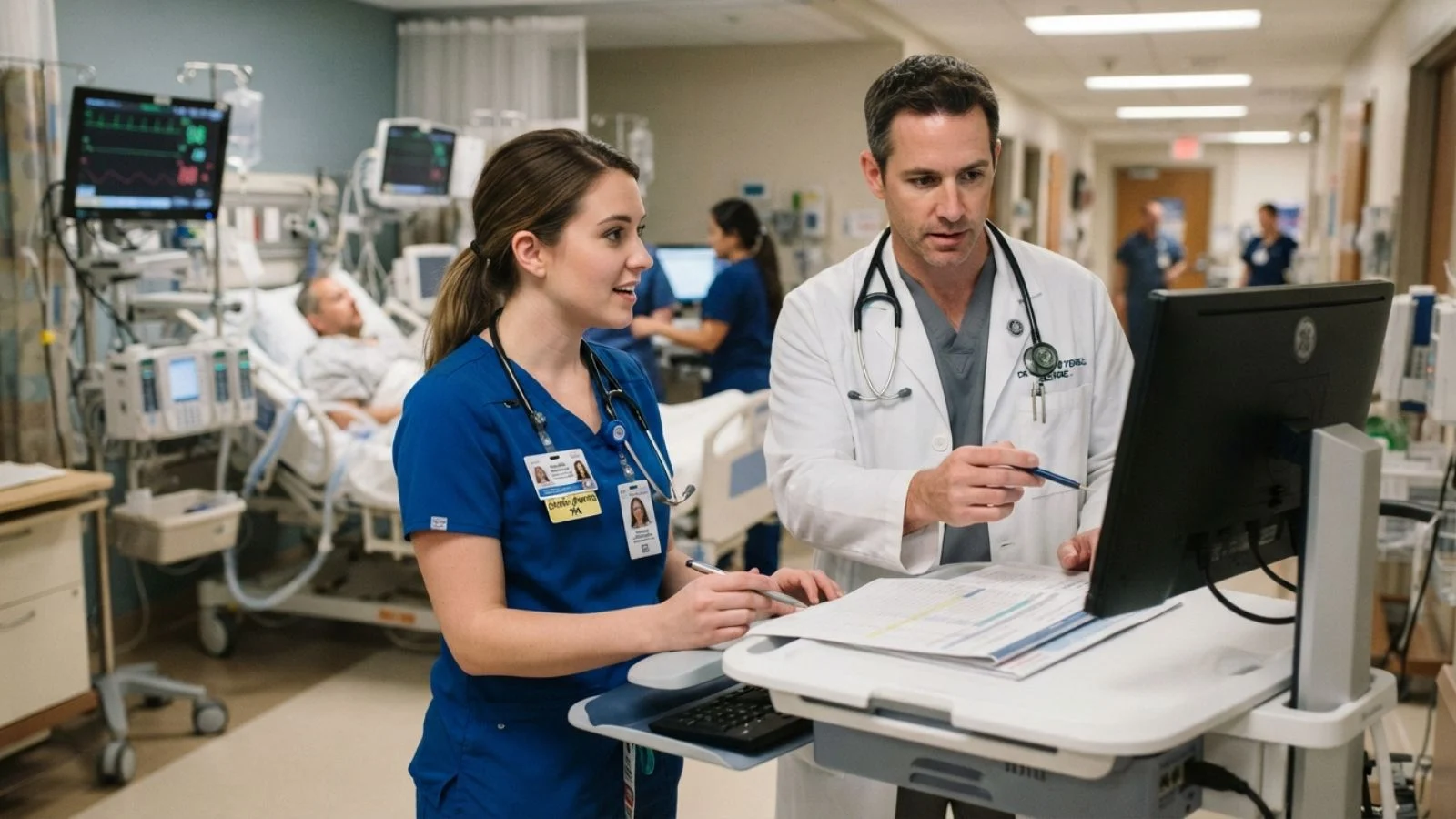
Picture a patient wheeled into a hospital late at night. Within minutes a nurse is checking vital signs, starting an IV and calming a nervous family.
Soon after a doctor arrives to review the results, confirm a diagnosis and decide on a treatment plan. Both are essential yet their jobs are very different.
The Nurse vs Doctor question comes up all the time whether you are choosing a healthcare career or simply trying to understand who is caring for you.
Misconceptions are common too. Some people assume nurses only follow orders while others believe doctors handle everything that matters. Neither is true.
In this article we break down the difference between a nurse and a doctor covering their roles education scope of practice salary and career growth.
We will also look at how they work together so you can see the full picture and decide which path fits you.
Quick Comparison: Nurse vs Doctor at a Glance
If you are short on time this table summarizes the main differences between nurses and doctors. Details vary by country and specialty so treat it as a general guide.
| Category | Nurse | Doctor |
| Main focus | Ongoing patient care monitoring education and support | Diagnosing conditions planning treatment and performing procedures |
| Typical education length | About 2 to 4 years for entry-level roles; longer for advanced practice | Commonly 10 to 15 years including medical school and residency |
| Licensing | Licensing exam after nursing program; additional certification for specialties | Medical licensing exams plus board certification for specialties |
| Scope of practice | Carries out care plans administers medication and assesses patients; nurse practitioners may diagnose and prescribe in some regions | Diagnoses prescribes orders tests and performs surgery; holds final medical decision-making authority |
| Work settings | Hospitals clinics nursing homes schools home care telehealth | Hospitals private practices clinics research and academic institutions |
| Average pay range | Moderate; varies widely by degree specialty and location | Generally higher especially for surgeons and specialists |
| Patient contact time | Usually more time at the bedside throughout a shift | Shorter focused visits with time also spent on diagnosis procedures and paperwork |
Key Takeaway
The biggest differences come down to training length, level of medical authority and how much time is spent with patients. Doctors lead diagnosis and treatment decisions while nurses provide continuous care and act as the patient’s closest point of contact.
Who Are They? Defining Doctors and Nurses
Before comparing the two roles it helps to understand what each title actually means since both cover a wide range of jobs.
What Is a Doctor?
A doctor also called a physician is a medical professional who has completed medical school and holds a degree such as an MD (Doctor of Medicine) or DO (Doctor of Osteopathic Medicine) or an equivalent qualification in other countries. Doctors diagnose illnesses, prescribe treatment and take responsibility for a patient’s overall medical plan.
Common types of doctors include:
- General practitioners (GPs) or family doctors: provide primary care for all ages
- Specialists: focus on one area such as cardiology pediatrics or dermatology
- Surgeons: perform operations and other invasive procedures
What Is a Nurse?
A nurse is a licensed healthcare professional trained to provide coordinate and monitor patient care. Nurses assess patients, carry out treatment plans and support recovery through education and hands-on care.
Common types of nurses include:
- Licensed practical or vocational nurses (LPN/LVN): provide basic nursing care under supervision
- Registered nurses (RN): deliver direct patient care and manage treatment plans
- Nurse practitioners (NP): advanced practice nurses who can diagnose and prescribe in many regions
- Clinical nurse specialists: experts in a specific patient group or condition
- Nurse anesthetists and nurse midwives: advanced roles in anesthesia and childbirth care
Understanding these categories matters because comparisons can change depending on which type of doctor or nurse you mean.
Roles and Responsibilities: What Each One Does
Doctors and nurses share the same goal which is helping patients get better but they contribute in different ways.
What Doctors Do
Doctors are responsible for the medical direction of a patient’s care. Their main duties include:
- Diagnosing illnesses and injuries through examinations patient history and test results
- Ordering and interpreting tests such as blood work imaging and biopsies
- Prescribing medication and creating treatment plans
- Performing surgeries and procedures depending on their specialty
- Leading the care team and making final medical decisions
What Nurses Do
Nurses are the backbone of daily patient care and often spend the most time at the bedside. Their main duties include:
- Assessing and monitoring patients and spotting changes in their condition early
- Administering medication and treatments as prescribed
- Performing hands-on care such as wound dressing IV insertion and catheter care
- Educating patients and families about conditions medications and recovery
- Providing emotional support and acting as the patient’s advocate
- Documenting and coordinating care so the whole team stays informed
Where the Difference Shows
In simple terms doctors focus on deciding what is wrong and what treatment is needed while nurses focus on delivering that care and watching how the patient responds. Nurses often notice subtle warning signs first and doctors rely on that information to adjust treatment.
Education and Training: The Path to Each Role
The road to becoming a nurse or a doctor differs greatly in length, cost and structure.
How to Become a Doctor
Becoming a doctor is a long demanding process. The typical path includes:
- Undergraduate degree: usually 3 to 4 years often in a science-related field
- Entrance exam: such as the MCAT in the US depending on the country
- Medical school: about 4 to 5 years of classroom study and clinical rotations
- Licensing exams: required to practice medicine
- Residency: 3 to 7 years of supervised training in a chosen specialty
- Fellowship (optional): 1 to 3 more years for subspecialties
In total the journey commonly takes 10 to 15 years and the cost of education is often very high.
How to Become a Nurse
Nursing offers several entry points making it more flexible:
- Diploma or associate degree: about 2 to 3 years
- Bachelor’s degree in nursing: about 4 years
- Licensing exam: required to practice as a registered nurse
- Advanced degrees (optional): a master’s or doctorate for roles such as nurse practitioner which adds 2 to 6 years
Entry-level nurses can start working in as little as 2 to 4 years and many continue studying while employed.
A Note on Variation
Education systems differ by country so exact requirements titles and timelines may vary. Always check the rules of your local medical or nursing council.
Scope of Practice and Authority: Who Can Do What
Scope of practice describes the tasks a professional is legally allowed to perform. This is one of the clearest differences between nurses and doctors.
Doctors’ Scope
Doctors have the broadest medical authority. They can diagnose conditions, prescribe any approved medication order and interpret tests and perform surgery. They also hold final responsibility for a patient’s medical plan and are legally accountable for the decisions they make.
Nurses’ Scope
A registered nurse’s scope centers on assessing patients administering treatments and monitoring recovery. Nurses generally work within care plans set by doctors though they use their own clinical judgment and are responsible for the quality of their nursing care. They are also ethically and legally obligated to speak up if an order seems unsafe.
Advanced Practice Nurses
Nurse practitioners and other advanced practice nurses have a wider scope. Depending on the region they may:
- Diagnose and treat common conditions
- Order tests and prescribe medication
- Run their own clinics either independently or in partnership with a physician
Variation by Region
Rules differ widely. Some places grant nurse practitioners full independent authority while others require physician oversight or collaboration agreements. This is why the same job title can carry different powers in different countries or states.
Accountability
Both professions that answer to licensing boards follow professional codes of ethics and can face legal consequences for negligence. Neither role works without responsibility.
Day-to-Day Work Life: A Look at the Daily Routine
Beyond training and authority the daily experience of each role is quite different.
A Typical Day for Doctors
Doctors’ schedules depend heavily on their specialty. A family doctor may see patients in back-to-back appointments while a surgeon may spend hours in the operating room. Many doctors also handle:
- Reviewing test results and updating records
- Consulting with colleagues and specialists
- Long shifts on-call duties and night or weekend work especially in hospitals
Time with each patient is often shorter and focused on diagnosis and decisions.
A Typical Day for Nurses
Nurses commonly work 8 to 12 hour shifts including nights, weekends and holidays. Their day is centered on continuous patient contact:
- Checking vital signs and monitoring changes
- Giving medication and performing procedures
- Updating charts and communicating with doctors
- Supporting patients and families throughout the shift
Work Settings
Both professions work in hospitals and clinics. Nurses are also found in schools, nursing homes, home care and telehealth while doctors may work in private practice research or academic institutions.
Physical and Emotional Demands
Both roles involve stress, emotional strain and high responsibility. Nursing is often more physically demanding because of long hours on foot and patient lifting while doctors face heavy pressure around critical decisions and long training years.
Burnout Risks
Burnout is a serious concern in both careers. Heavy workloads, staffing shortages and emotional fatigue affect nurses and doctors alike which is why support systems and work-life balance matter.
Salary and Earning Potential: How Pay Compares
Pay is one of the biggest factors people weigh when comparing these careers. The figures below come from US government data so check local sources if you are writing for another country.
Doctor Salaries
Physicians and surgeons are among the highest earners in any field. US Bureau of Labor Statistics data put their median annual wage at $239200 or more in 2024. Specialty makes a big difference. Family medicine physicians had a median of $244180 while cardiologists reached about $496010 in May 2025.
Nurse Salaries
Registered nurses, the largest group of healthcare practitioners, earned a median of $97550 in May 2025. Advanced roles pay far more. Nurse anesthetists had a median wage of $236590.
What Affects Pay
- Specialty: the biggest driver for both professions
- Location: registered nurses in Los Angeles had a median of $135560 compared with $102710 in Washington DC
- Experience and education: advanced degrees and certifications raise earning potential
- Overtime and shift differentials: nurses in particular can boost income with extra or night shifts
Cost vs. Return
Doctors earn more but only after 10 to 15 years of training and often heavy student debt. Nurses can start earning within 2 to 4 years which means less debt and an earlier income. Weigh both the final salary and the years it takes to get there.
Career Growth and Specializations: Where Each Path Can Lead
Both professions offer plenty of room to grow but the routes look different.
Career Growth for Doctors
Doctors advance mainly by choosing a specialty and later a subspecialty. Common options include:
- Surgery: general orthopedic cardiac neurosurgery
- Internal medicine and its branches: cardiology oncology gastroenterology
- Other specialties: pediatrics psychiatry dermatology emergency medicine radiology anesthesiology
Beyond clinical practice doctors can move into academic medicine research, hospital leadership medical education or public health.
Career Growth for Nurses
Nursing is known for its flexibility. A nurse can start at the bedside and move in many directions:
- Clinical specialties: ICU emergency pediatrics oncology labor and delivery mental health
- Advanced practice: nurse practitioner nurse anesthetist nurse midwife clinical nurse specialist
- Leadership: charge nurse nurse manager director of nursing
- Non-bedside paths: nurse educator researcher informatics case management health policy
Flexibility in Changing Direction
Nurses often find it easier to switch specialties usually with a short certification or some on-the-job training. Doctors are more tied to their specialty since changing it typically means additional residency training.
Lifelong Learning
Both professions require continuing education to keep licenses current and stay up to date with new treatments and technology. Those who keep learning tend to open more doors whether that means a new specialty, a leadership role or a move into teaching.
Job Demand and Outlook: Is There a Future in Each Career?
Both professions are in demand and the trend is expected to continue. The figures below are US projections so check local data for other countries.
Demand for Nurses
Registered nurse jobs are projected to grow 5 percent from 2024 to 2034 faster than the 3 percent average for all careers. That is a large occupation and more than 189000 RN job openings are expected each year through 2034. Advanced practice roles are growing even faster with nurse practitioners projected to grow 40% the fastest of any healthcare profession.
Demand for Doctors
Physician demand is steady rather than explosive. Projected growth for most specialties is modest for example 4% for surgeons and cardiologists and 6% for psychiatrists. Even so an aging population and rising rates of chronic illness keep openings coming and doctors generally enjoy strong job security.
Healthcare as a Whole
Healthcare is projected to be the fastest-growing industry sector at 8.4% growth between 2024 and 2034 which supports both careers.
Workforce Shortages
Shortages add to the demand. One federal workforce analysis expects a shortage of about 207980 registered nurses in 2037.
Mobility and Working Abroad
Both nurses and doctors can find work in other countries but each must meet local licensing rules and qualifications are not always automatically recognized. Nurses often have more options for short-term or travel assignments while doctors may need to repeat exams or supervised training.
How Nurses and Doctors Work Together
Despite the “nurse vs doctor” comparison, patient care is a team effort. Neither role can deliver safe effective treatment alone.
The Care Team Model
Modern healthcare relies on teams. Doctors and nurses work alongside pharmacists, physiotherapists , lab technicians, dietitians and social workers. Each member contributes specialized skills and the patient benefits from the combined expertise.
Communication and Handoffs
Clear communication is the glue that holds the team together. Doctors share diagnoses and treatment plans while nurses report changes in a patient’s condition, side effects and concerns. Structured handoffs at shift changes help ensure nothing is missed.
Shared Decision-Making
The best outcomes come when both voices are heard. Nurses spend the most time with patients so they often notice early warning signs and can flag problems before they become serious. Doctors use that information to adjust treatment quickly.
Example: A Patient’s Journey
Imagine a patient admitted with chest pain. A nurse takes vital signs, connects a monitor and records symptoms. The doctor reviews the findings, orders tests and diagnoses the condition. The nurse then administers medication, watches for reactions and teaches the patient how to manage recovery at home. The doctor follows up and plans discharge.
Why Collaboration Matters
Strong teamwork is linked to fewer errors, better patient satisfaction and less staff burnout. Mutual respect between nurses and doctors is not just pleasant; it is a safety issue.
Common Myths About Nurses and Doctors
Misunderstandings about these two professions are widespread. Here are four of the most common and the reality behind each.
Myth 1: “Nurses are just assistants to doctors”
Nurses are independent licensed professionals with their own training standards and legal accountability. They make clinical judgments every shift and they are responsible for the quality of their own care. Working alongside doctors does not make them assistants.
Myth 2: “Doctors do all the important work”
Doctors make critical decisions but much of a patient’s recovery depends on daily care monitoring and education which is where nurses spend most of their time. Many emergencies are caught first by a nurse who notices a subtle change.
Myth 3: “Nursing is an easier path”
Nursing is shorter than medicine but that does not make it easy. Nursing school is demanding and the job involves long shifts, heavy workloads and high emotional and physical stress. It is a different path, not an easier one.
Myth 4: “Nurses can’t advance beyond bedside roles”
Nursing offers many routes forward including nurse practitioner nurse anesthetist educator researcher manager and health policy roles. Some advanced nurses diagnose, prescribe and even run their own practices depending on local rules.
The Bottom Line
Each myth undervalues one profession or the other. Understanding what nurses and doctors actually do leads to more respect, better teamwork and better choices for anyone considering either career.
Pros and Cons: Nurse vs Doctor
Every career has trade-offs. Here is an honest look at both.
Being a Doctor
Pros
- High earning potential: among the best-paid occupations
- Medical authority: the final say in diagnosis and treatment
- Prestige and impact: the chance to save lives and shape treatment decisions
- Wide specialty choice: from surgery to psychiatry to research
Cons
- Long costly training: often 10 to 15 years and significant student debt
- Demanding schedule: long hours on-call duty and night work
- Heavy responsibility: high-stakes decisions and legal exposure
- Late start to earning: a full income often begins in the late twenties or thirties
Being a Nurse
Pros
- Faster entry: you can start working in 2 to 4 years
- Strong job demand: openings are plentiful in most regions
- Flexibility: many specialties settings and shift patterns
- Close patient relationships: more time at the bedside
Cons
- Physically demanding: long shifts on your feet and patient lifting
- Emotional strain: frequent exposure to suffering and loss
- Lower pay ceiling: typically less than physicians unless you move into advanced practice
- Less autonomy: a narrower scope of practice at the entry level
Lifestyle and Work-Life Balance
Neither career is a nine-to-five. Nurses often work compressed shifts which can leave several days off each week while doctors’ schedules depend on specialty. Both face burnout so choosing a setting that fits your lifestyle matters as much as the title.
Which Career Is Right for You?
There is no universally better choice. The right path depends on your interests, goals and circumstances. Ask yourself these questions.
Self-Assessment Questions
- What kind of work energizes you? If you enjoy solving diagnostic puzzles and making treatment decisions, medicine may suit you. If you prefer hands-on care and building relationships with patients, nursing may be a better fit.
- How long can you commit to training? Medicine requires a decade or more of study while nursing offers earlier entry into the workforce.
- How do you feel about cost and debt? Consider what you can afford now and how long you are willing to wait for a full income.
- What lifestyle do you want? Think about shifts on-call duty and the balance between work and personal life.
- Do you want to lead or collaborate? Doctors carry final decision-making responsibility while nurses often coordinate care and support patients day to day.
You Don’t Have to Decide Forever
Nursing can be a stepping stone. Some people work as nurses first gain clinical experience and later apply to medical school. Others move up through advanced practice and become nurse practitioners gaining more authority without the full length of medical training. Rules for these bridge routes vary by country.
Try Before You Commit
Shadow a nurse and a doctor volunteer at a hospital or talk to professionals in both roles. A few days in a real clinical setting will tell you more than any article can.
Conclusion:
The nurse vs doctor debate is less about who matters more and more about how each role contributes to patient care.
Doctors lead diagnosis treatment decisions and procedures nurses deliver continuous care, monitor patients closely and give the education and support that keep recovery on track. Together they form the foundation of modern healthcare.
Key Differences at a Glance
- Training: doctors typically train for 10 to 15 years while nurses can enter practice in 2 to 4 years with longer paths for advanced roles
- Authority: doctors hold the broadest medical decision-making power while nurses work within care plans though advanced practice nurses have a wider scope
- Pay: doctors generally earn more but nurses start earning sooner and have strong advancement options
- Demand: both careers offer strong job security and steady openings
Choosing Your Path
If you like diagnosis, leadership and complex decisions and you are willing to invest years in training, medicine may be for you.
If you value hands-on care, patient relationships and a quicker route into the workforce, nursing could be a better match.
Remember that you can change direction later whether that means specializing, advancing your nursing career or moving from nursing into medicine.