On a map Brazil vs Haiti looks like the most lopsided comparison imaginable. One is a continent-sized giant of more than 200 million people home to the Amazon rain forest Carnival and five World Cup trophies.
The other is a small Caribbean nation on the island of Hispaniola too often defined by headlines about hardship. Look closer though and the story gets far more interesting.
Both countries were built by European colonizers on sugar coffee and the forced labor of enslaved Africans. Haiti answered with revolution and became the first free Black republic in 1804. Brazil by contrast was the last country in the Americas to abolish slavery in 1888.
Their paths diverged sharply yet their music, faith , food and love of football still echo each other.
In this article we compare Brazil and Haiti across history, economy , culture and sport to see what each nation’s journey reveals.
Brazil vs Haiti at a Glance
Before diving into history and culture here is how the two countries compare on the basic numbers.
| Category | Brazil | Haiti |
| Capital | Brasília | Port-au-Prince |
| Population | ~213 million | ~12 million |
| Area | ~8.5 million km² | ~27750 km² |
| Official languages | Portuguese | French Haitian Creole |
| Currency | Real (BRL) | Gourde (HTG) |
| Government | Federal presidential republic | Republic (in political transition) |
| Independence | 1822 (from Portugal) | 1804 (from France) |
| Slavery abolished | 1888 | 1793-94 |
| GDP | ~$2.2 trillion | ~$20 billion |
| GDP per capita | ~$10000 | ~$1700 |
| Human Development Index | High | Low |
Figures are rounded estimates from sources such as the World Bank, the UN Development Programme and the CIA World Factbook.
The headline gap is striking. Brazil has roughly 18 times as many people, a territory about 300 times larger and an economy more than 100 times bigger. Per person the average Brazilian income is about six times Haiti’s. Geography plays a part: Brazil’s size gives it vast farmland minerals and offshore oil while Haiti’s small mountainous land and dense population leave far less room for large-scale industry.
The table also hides a twist. Haiti, the smaller nation, won its freedom 18 years before Brazil and ended slavery nearly a century earlier. These numbers show where each country stands today but not how they got here. That story begins with their colonial roots.
Geography and Environment
Brazil is a geographic superpower. It covers nearly half of South America, borders every country on the continent except Chile and Ecuador and stretches along roughly 7400 kilometers of Atlantic coastline. Within its borders lie the Amazon the world’s largest tropical rainforest, the Pantanal the largest tropical wetland on Earth and the dry backlands of the northeast. This variety makes Brazil one of the most biodiverse countries on the planet.
Haiti occupies the western third of the island of Hispaniola which it shares with the Dominican Republic. Mountains dominate its terrain leaving only narrow coastal plains and limited flat farmland. Its highest peak, Pic la Selle, rises to about 2680 meters.
Both countries face serious environmental pressure though on very different scales. Brazil’s biggest concern is the Amazon where cattle ranching farming and illegal logging drive deforestation with global climate consequences. Haiti has lost far more of its forest proportionally with only a small fraction of its original cover remaining. Widespread dependence on charcoal for cooking has accelerated the loss leaving hillsides vulnerable to erosion and deadly flooding.
Natural disasters strike both nations but Haiti is especially exposed. Its position on active fault lines and in the Atlantic hurricane belt was made tragically clear by the devastating earthquakes of 2010 and 2021. Brazil deals with floods and droughts of its own yet its size and resources give it a much greater capacity to recover.
Colonial Roots and Independence
Both countries began as European colonial projects driven by sugar and the forced labor of enslaved Africans. Portugal claimed Brazil in 1500 and eventually brought roughly 4 to 5 million enslaved Africans there more than any other destination in the Americas. France gained the western part of Hispaniola in the late 1600s and turned Saint-Domingue into one of the most profitable colonies in the world producing enormous quantities of sugar and coffee.
That wealth rested on brutal exploitation. In 1791 enslaved people in Saint-Domingue rose up beginning the Haitian Revolution. Leaders such as Toussaint Louverture built a disciplined army that defeated French, Spanish and British forces. After Louverture was captured Jean-Jacques Dessalines led the final push and declared independence on January 1 1804 creating the first free Black republic.
Brazil’s path was slower and more gradual. When Napoleon’s armies threatened Portugal in 1808 the Portuguese royal court relocated to Rio de Janeiro. Brazil declared independence in 1822 under Pedro I, a Portuguese prince and remained a monarchy. Slavery continued for decades ending only with the Golden Law of 1888. The Republic followed in 1889.
The two histories also collided. News of Haiti’s revolution inspired enslaved and free Black people across the Americas while slaveholders in Brazil feared a repeat and used “Haitianism” as a warning against abolition.
Political History and Governance
Haiti’s political story has been shaped by outside pressure from the start. In 1825 France demanded a huge indemnity in exchange for recognizing Haiti’s independence, a debt that drained the young state for generations. The United States then occupied the country from 1915 to 1934 and the Duvalier family ruled as dictators from 1957 to 1986. Democracy has been fragile ever since. After President Jovenel Moïse was assassinated in 2021 a surge of gang violence beginning in early 2024 engulfed the capital and disrupted state institutions. In February 2026 an interim government under Prime Minister Alix Didier Fils-Aimé took over from the Transitional Presidential Council. Elections were scheduled for later in 2026 with a new president due to be inaugurated in February 2027.
Brazil’s path has been rocky too but its institutions have held. After the Empire ended in 1889 the country lived through Getúlio Vargas’s long rule in the 1930s and 1940s and a military dictatorship from 1964 to 1985. Since the 1988 Constitution Brazil has held regular democratic elections even through deep polarization, the impeachment of President Dilma Rousseff in 2016 and the January 2023 attack on government buildings in Brasília.
Economy and Development
Brazil ranks among the ten largest economies in the world. It is an agricultural powerhouse leading global exports of soybeans, coffee sugar and beef and it is also rich in iron ore and offshore oil. Its industrial base which includes automobiles, aircraft maker Embraer and processed foods gives it a diversity Haiti lacks. Services make up the largest share of the economy.
Haiti is the poorest country in the Western Hemisphere. Most people rely on small-scale farming or informal work and the country imports much of its food. Money sent home by Haitians abroad known as remittances is a lifeline that accounts for a large share of the economy. The garment assembly sector which exports mainly to the United States is the main formal employer. Gang violence political instability and repeated disasters have made investment and recovery harder.
The coffee connection shows how far the two have diverged. Saint-Domingue was once the world’s leading coffee and sugar producer while Brazil is now the top coffee grower by a wide margin.
History helps explain the gap. Haiti began independence under the burden of the French indemnity followed by decades of isolation, occupation and dictatorship. Brazil, a much larger country with abundant land and resources, could build industry and absorb shocks more easily.
Yet prosperity is not evenly shared in either country. Brazil remains one of the world’s most unequal societies with wealthy cities alongside deep poverty in favelas and the rural northeast.
People Language and Identity
Brazil is the largest Portuguese-speaking country in the world and its people reflect centuries of mixing among Indigenous peoples Portuguese colonizers enslaved Africans and later immigrants from Italy Germany Japan and Lebanon. In the 2022 census more than half of Brazilians identified as Black or mixed-race (pardo). For decades the idea of a “racial democracy” shaped the national story but many Brazilians and scholars point out that racial inequality remains stark in income, education and safety.
Haiti’s population is overwhelmingly of African descent. Nearly everyone speaks Haitian Creole a language that grew out of French and West African languages and it became a co-official language alongside French in the 1987 constitution. French is used mainly in government schools and formal settings which can create a language divide between elites and everyday Haitians. Creole functions as a powerful marker of national identity carrying the country’s music proverbs and storytelling.
The two nations’ lives have crossed in a surprising way. After the 2010 earthquake tens of thousands of Haitians migrated to Brazil, many entering through the Amazon border region. Brazil created a special humanitarian visa in 2012 to receive them. Many found work in construction meatpacking and services in cities like São Paulo while also facing language barriers discrimination and difficult conditions.
Culture and Traditions
Music tells the story of both countries. Brazil gave the world samba bossa nova and forró rhythms with deep African roots that still fill the streets of Rio and Salvador. Haiti’s sound is just as rich with compass (kompa) a smooth dance music rara the festive street bands of the Lenten season and mizik rasin which blends Vodou drumming with rock and folk.
Festival season is another shared passion. Brazil’s Carnival is a spectacle of samba schools, elaborate costumes and street parties. Haiti’s Kanaval is equally bold and more openly political using masks, satire and bands to comment on current events.
Religion shows the strongest Afro-diasporic link. Candomblé and Umbanda in Brazil and Vodou in Haiti preserve African spiritual traditions blended with Catholic imagery. Vodou is often misrepresented in films but it is a complex faith centered on community and ancestors and Haiti formally recognized it as a religion in 2003.
Food brings people together too. Brazil’s national dish is feijoada a black bean and pork stew alongside snacks like pão de queijo. Haiti’s cuisine includes griot (fried pork) diri ak djon djon (rice with black mushrooms) and soup joumou, a pumpkin soup eaten on New Year’s Day to celebrate independence and recognized by UNESCO in 2021.
Art and movement carry the same energy. Haiti is famed for its vivid painting Brazil has world-renowned writers like Machado de Assis and Clarice Lispector and capoeira blends martial arts dance and music in a tradition born among enslaved Africans in Brazil.
Football
Football is where the “vs” in Brazil vs Haiti becomes literal. Brazil is the sport’s most decorated nation with five World Cup titles (1958 1962 1970 1994 and 2002) and a legacy built around Pelé widely called the king of football. Haiti’s story is smaller but proud. Its team reached the 1974 World Cup where Emmanuel Sanon ended Italian goalkeeper Dino Zoff’s long unbeaten run. In 2004 Brazil’s players traveled to Port-au-Prince for the “Game for Peace” a friendly played during the UN mission.
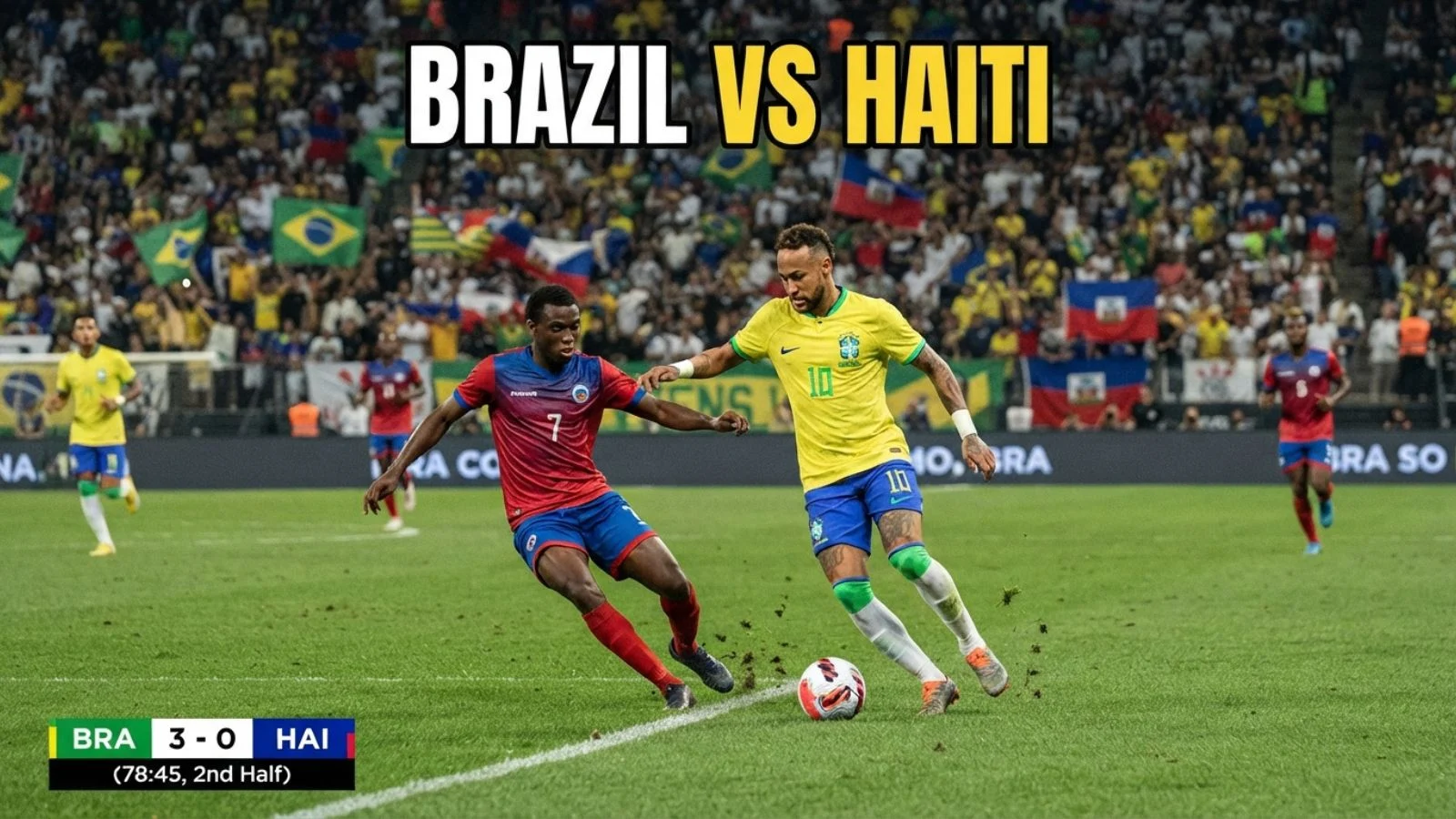
In 2026 the two finally met on the sport’s biggest stage. Haiti was back at the World Cup finals for the first time since 1974 after a 52-year absence. The Group C match was played in Philadelphia on June 19 and ended 3-0 to Brazil. Matheus Cunha scored the first two goals and the crowd of more than 68000 was mostly Brazilian fans. Vinícius Júnior added a third just before halftime. Haitian supporters danced and sang the team’s traditional battle cry throughout while Brazilians answered by reminding them of their five titles.
The result was lopsided and Haiti became the first team eliminated from the tournament while Brazil finished top of the group ahead of Morocco on goal difference. Yet the match said more than the scoreline. Football means something different in each country: identity and swagger for Brazil and pride, joy and a rare global spotlight for Haiti.
Brazil-Haiti Connections
Brazil and Haiti are linked by more than shared history. The strongest modern tie began in 2004 when Brazil took command of the military side of MINUSTAH, the UN stabilization mission sent after the collapse of President Jean-Bertrand Aristide’s government. Brazilian generals led the force for its entire run and thousands of Brazilian troops rotated through Haiti until the mission ended in 2017. It was one of Brazil’s largest overseas deployments since World War II and it fit the country’s ambition for a bigger role in world diplomacy.
The legacy is mixed. Supporters credit the mission with reducing gang violence in its early years and helping after the 2010 earthquake which killed 18 Brazilian peacekeepers along with Brazilian pediatrician Zilda Arns. Critics point to the cholera outbreak linked to UN personnel from another country, allegations of abuse by peacekeepers and the argument that the mission failed to build lasting institutions.
Human ties followed. Migration after 2010 connected the two countries more closely and Brazil’s humanitarian visa program for Haitians was among the most generous in the region though rules later tightened. Haitian communities in São Paulo Santa Catarina and Manaus now shape local life through churches, businesses and family networks.
There is also a deeper cultural bond. Candomblé Vodou capoeira and drumming traditions all trace back to shared West and Central African roots and the Haitian Revolution remains a symbol of Black freedom that resonates in Brazil’s Black movements.
Strengths Struggles and Lessons
Each country has strengths that statistics alone miss. Brazil offers scale natural wealth, a large and creative culture and a democracy that has survived dictatorship and crisis. Its music, football and cuisine shape global tastes. Haiti’s strengths are less visible but just as real: a proud revolutionary heritage, a vibrant artistic tradition and a language and culture that unite its people. Its diaspora also supports families at home and enriches cities from Miami to Montreal.
The struggles are just as real. Brazil grapples with severe inequality, urban violence and pressure on the Amazon. Haiti faces the far heavier burden of insecurity, weak institutions, poverty and repeated disasters. Neither country’s problems can be reduced to a single cause.
The comparison offers a few lessons. First history matters. Haiti began its independence carrying a punishing debt and international isolation while Brazil inherited a larger more resource-rich state. Second, geography and scale shape resilience but they do not decide everything. Third, strong institutions and stability make development far easier.
It is also worth avoiding the easy “rich versus poor” story. Brazil’s wealth hides deep divides while Haiti’s hardships sit alongside remarkable creativity and determination. Judging Haiti only by its crises would overlook a nation that overthrew slavery and changed world history.
Finally the two countries show that identity and prosperity are different things. Both carry the legacy of African resilience and both have shaped the wider Atlantic world in ways that outlast the headlines.
Conclusion
Brazil vs Haiti may look like a mismatch but the comparison reveals far more than the numbers suggest.
Brazil is a vast diverse economy with a resilient democracy and a culture that shapes the world.
Haiti is a small mountainous nation that carried out a revolution that changed history then faced debt occupation and instability for two centuries.
Along the way we saw how their paths crossed and diverged. Both were built on sugar coffee and slavery. Haiti broke free in 1804 while Brazil held on to slavery until 1888.
Today Brazil enjoys large resources and stronger institutions while Haiti struggles with insecurity and political uncertainty.
Yet the two share deep bonds in music, religion , food and football and modern ties from peacekeeping to migration have drawn them closer.
The match on the pitch in 2026 was a lopsided 3-0 but the bigger story is not who wins. It is what each nation carries: Brazil’s scale and swagger and Haiti’s pride and determination.