Picture two enormous birds each as tall as a grown adult or taller sprinting across open ground on powerful legs and neither able to fly.
That’s the emu and the ostrich and people mix them up all the time. The emu vs ostrich debate comes up in classrooms, zoos and online arguments alike and for good reason: both are huge, both are flightless and both look like they were assembled from spare parts.
Yet they’re very different animals. One is the largest bird alive native to the plains of Africa. The other is the second-tallest, a shaggy-feathered native of Australia with a surprising talent for swimming. They differ in size, speed , toes , eggs and even parenting style.
In this guide we’ll compare the two round by round from height and top speed to fighting ability and fun history before crowning a winner. Ready to find out which giant bird comes out on top?
Emu vs Ostrich at a Glance
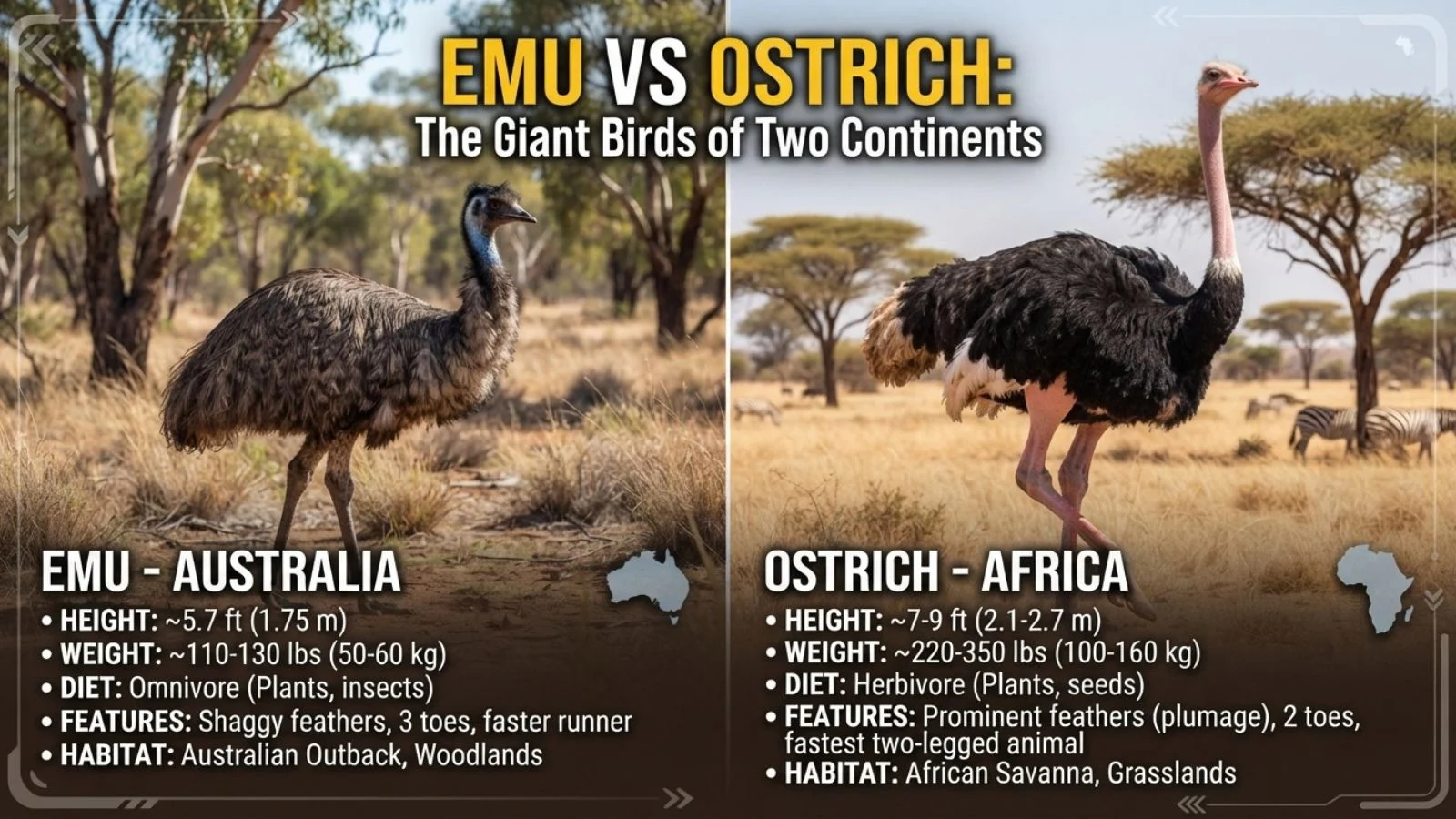
Before we dive into the details here’s a quick side-by-side snapshot of the two contenders. Skim the table for the key numbers then read on for the full story behind each one.
| Feature | Ostrich | Emu |
| Scientific name | Struthio camelus | Dromaius novaehollandiae |
| Native range | Africa | Australia |
| Height | Up to 2.7 m (9 ft) | 1.5-1.9 m (5-6 ft) |
| Weight | 100-156 kg (220-345 lb) | 30-60 kg (66-132 lb) |
| Top speed | About 70 km/h (45 mph) | About 50 km/h (30 mph) |
| Toes per foot | 2 | 3 |
| Feathers | Fluffy plumes; males black and white | Shaggy brown double-shafted |
| Egg | Largest of any bird about 1.4 kg creamy white | About 0.5-0.65 kg dark green |
| Incubation | About 42 days | About 56 days |
| Wild lifespan | About 30-40 years | About 10-20 years |
| Conservation status | Least Concern | Least Concern |
The quick takeaway: the ostrich wins on sheer size and speed while the emu stands out for its endurance and its devoted father-led approach to raising chicks. Both species are listed as Least Concern globally although some regional ostrich populations face real pressure from hunting and habitat loss.
Meet the Contenders
The Ostrich: Africa’s Heavyweight Champion
The ostrich (Struthio camelus) is the largest and heaviest bird alive today. It roams the savannas and semi-deserts of Africa where its height gives it a clear view of predators across the open plains. Males can stand up to 2.7 meters tall with striking black-and-white plumage while females are smaller and a duller grey-brown. Many experts now treat the Somali ostrich as its own separate species so the “common ostrich” is the one most people picture.
The Emu: Australia’s Shaggy Runner
The emu (Dromaius novaehollandiae) is the second-tallest bird in the world and the largest native bird in Australia. Its shaggy brown feathers, bluish neck and calm curious expression make it easy to recognize. Emus travel long distances across grasslands, scrubland and open forest following food and water after rains.
What Is a Ratite?
Both birds are ratites, a group of large flightless birds with flat breastbones that lack the keel where flight muscles attach. Other ratites include rheas cassowaries and kiwis plus the extinct moa and elephant birds.
The Evolution Twist
Here’s a surprise: the emu and ostrich aren’t each other’s closest relatives. Genetic studies suggest flightlessness evolved independently several times in different ratite lineages. The emu’s nearest relative is actually the cassowary while the ostrich sits on a more distant branch. Their similar looks are a case of shared lifestyle not shared recent ancestry.
Physical Differences
At a distance an emu and an ostrich can look alike. Up close the differences are easy to spot.
Size and Weight
The ostrich is the clear giant reaching up to 2.7 meters and well over 100 kg. The emu stands roughly 1.5 to 1.9 meters and weighs about 30 to 60 kg so it’s lighter and lower to the ground.
Feet and Toes
This is the best way to tell them apart. The ostrich has just two toes per foot which is unique among living birds. The emu has three toes each ending in a sharp claw.
Neck and Head
Ostriches have long almost bare necks and small flat heads. Emus have shorter feathered necks that look bluish where the skin shows through.
Feathers
Ostrich feathers are soft and fluffy and males stand out in black with white wing and tail plumes. Emu feathers are shaggy and hair-like with two shafts growing from each quill and both sexes wear a similar brown-grey coat.
Eyes and Wings
The ostrich has the largest eyes of any land vertebrate which helps it spot danger far away. Both birds have small vestigial wings. Ostriches use theirs for balance steering and courtship displays while the emu’s are tiny and nearly hidden.
Male vs. Female
Ostriches show obvious differences between the sexes since males are black and white and females are brown. Emus look much alike though females are usually a bit larger.
Habitat and Range
Where these birds live shapes almost everything about them from their long legs to their travel habits.
Ostrich Territory
Ostriches roam the open country of Africa favoring savannas grasslands the Sahel and semi-desert regions. They avoid dense forest since their height and speed only pay off when they can see far and run freely. Historically their range also reached into the Middle East but the Arabian ostrich was hunted to extinction in the 20th century. Today the Somali ostrich lives in the Horn of Africa while the common ostrich covers much of eastern and southern Africa.
Emu Territory
Emus are found across most of mainland Australia. They live in grasslands, open woodland scrub and coastal plains and they steer clear of dense rainforest and the driest desert interiors. They’re also nomadic and can walk hundreds of kilometers to follow rainfall and fresh food. Farmland with its cleared land and stock water has actually helped emus in some regions.
Vanished Island Emus
Emus once had smaller relatives on offshore islands. The King Island and Kangaroo Island emus disappeared in the early 1800s and the Tasmanian emu followed by the mid-1800s. Hunting and habitat change were the main causes.
Built for Open Country
Both birds prefer wide open spaces for the same reason: long legs, keen eyesight and endurance are their best defense against predators.
Diet and Digestion
Both birds are built to make a living from tough sparse food and their digestive systems show it.
What the Ostrich Eats
Ostriches are mostly plant eaters. They graze on grasses, leaves , seeds , roots and flowers and they’ll add insects, small reptiles and rodents when the chance comes along. They pick food with quick pecks gathering it in the throat before swallowing it down in a lump.
What the Emu Eats
Emus have a more varied menu that changes with the seasons. They eat seeds, fruit flowers and young shoots plus insects such as caterpillars, beetles and grasshoppers. On farmland they’ll also feed on crops which has caused conflict with farmers.
Pebbles in the Gizzard
Neither bird has teeth so both swallow stones. These pebbles sit in the muscular gizzard and grind tough plant material into digestible pieces. Ostriches can carry over a kilogram of stones and emus are known to swallow small stones and even bits of charcoal.
Water Needs
Ostriches are champions of dry countries. They can go long periods without drinking, getting most of their moisture from plants. Emus drink often when water is available and they’re also strong swimmers when they need to cross rivers.
An Ecological Role
Emus are important seed dispersers. They swallow large seeds whole and carry them for kilometers helping native Australian plants spread across the landscape.
Speed and Movement
When danger appears neither bird stands its ground for long. Both rely on speed but they run in different ways.
Ostrich: The Land Speed Champion
The ostrich is the fastest bird on land. It can sprint at about 70 km/h (45 mph) and hold a steady 50 km/h for a long stretch. A single stride can cover 3 to 5 meters so each step eats up ground. Its two-toed foot works like a hoof with the big toe bearing most of the weight and pushing off with each stride. That cuts down on the weight of the foot and helps the bird run efficiently.
Emu: The Endurance Traveler
The emu tops out at around 50 km/h (30 mph) which is slower than the ostrich but still faster than nearly any human. Its real strength is stamina. Emus can walk or trot for hours and cover huge distances in search of food and water. Their long strides at about 2.7 meters at a full run keep the effort low.
Turning and Dodging
Ostriches can zigzag while running using their wings as rudders to steer and brake. Emus are also agile and can change direction quickly.
Swimming
Here’s one edge for the emu: it’s a capable swimmer and can cross rivers and floodwater when needed.
Who Wins?
For a short sprint the ostrich takes the trophy. Over a long journey the emu holds its own.
Behavior and Social Life
Ostriches and emus have very different social styles.
Ostrich: Life in the Group
Outside breeding season ostriches often gather in flocks of a dozen or more and they sometimes travel alongside zebras and antelope. More eyes mean earlier warning of predators. In the breeding season dominant males claim territory and mate with a lead female and several others and the females lay their eggs in one shared nest.
Emu: Solo Traveler and Pair Bonds
Emus are more independent. They’re often seen alone or in pairs and they gather in larger groups mainly when moving toward food and water. During courtship females take the lead competing for males and sometimes mating with more than one partner.
Sounds and Calls
Male ostriches produce deep booming calls that sound surprisingly like a lion’s roar and they hiss when threatened. Emus grunt and drum and females make a resonant booming sound using an inflatable throat pouch.
Courtship Displays
The male ostrich performs a memorable dance. He drops to the ground, swings his wings from side to side and sways his neck in a rhythmic pattern. Emu courtship is quieter and centers on the female circling, calling and displaying to the male.
Temperament
Both birds are wary and prefer to flee. But an ostrich or emu cornered or defending a nest can turn aggressive fast so it’s best to keep a respectful distance.
Breeding and Parenting
Raising the next generation is where these two birds really show their personalities.
The Eggs
The ostrich lays the largest egg of any living bird. It weighs about 1.4 kg, roughly two dozen chicken eggs and has a thick creamy-white shell. The emu’s egg is smaller at about 0.5 to 0.65 kg but it has a striking dark green color and a slightly rough texture.
Nesting Style
Ostriches dig a shallow scrape in the ground. The dominant female and several other hens lay their eggs in the same nest which can hold 20 or more eggs. Emus make a simple platform of grass leaves and bark on the ground and a clutch usually holds 5 to 15 eggs.
Who Sits on the Eggs?
Ostrich parents share the job. The brown female sits during the day blending into the sand while the black-plumed male takes over at night. Incubation takes about 42 days.
Emu fathers do it all. The male sits on the nest for about eight weeks rarely eating or drinking and can lose a large share of his body weight.
The Chicks
Both species hatch striped camouflaged chicks that can walk and follow their parents within hours or days. Ostrich parents guard the chicks together. The emu father stays with his brood for several months defending them and teaching them where to find food.
Defense and Danger
Both birds prefer to run but they can fight back when they have to.
The Ostrich: A Kick That Can Kill
The ostrich delivers powerful forward kicks. Its bigger toe ends in a claw up to about 10 cm long and a well-placed blow can seriously injure or even kill a predator like a lion. Adults are also strong enough to seriously hurt a person which is why ostrich farmers treat them with caution.
The Emu: Slashing Feet
The emu kicks forward too using its three sharp-clawed toes to slash. Emus are strong enough to bend wire fences and injure people or dogs though they usually flee first.
Predators
Adult ostriches face lions, leopards , cheetahs , hyenas and wild dogs. Their eggs and chicks are also raided by jackals and vultures. Adult emus have few natural predators today but dingoes, wedge-tailed eagles and feral dogs and foxes threaten chicks and young birds while goannas raid nests.
Which One Is More Dangerous?
For sheer size and kicking power the ostrich takes it. Still neither is the most dangerous bird around: that title usually goes to the cassowary, the emu’s close relative.
Myth-Buster: The Head in the Sand
Ostriches don’t bury their heads in the sand. When threatened they may lie flat with their necks stretched along the ground or they lower their heads to turn eggs in the nest and from far away it just looks like they’ve hidden their heads.
Humans and Animals: Farming and Uses
People have used both birds for centuries and both are now farmed around the world.
Ostriches: Feathers Leather and Meat
Ostrich feathers were once worth a fortune. In the late 1800s and early 1900s fashion demand fueled a feather boom in South Africa especially around the town of Oudtshoorn. The market crashed around the First World War as tastes changed and cars replaced open carriages. Today farms raise ostriches mainly for meat, leather and feathers. Ostrich meat is lean red and similar in flavor to beef and the leather is prized for its distinctive bumpy quill-follicle pattern.
Emus: Meat Leather and Oil
Emus are farmed for lean meat and leather but their best-known product is emu oil rendered from fat. It’s used in skin and hair products and in traditional remedies though scientific evidence for its health benefits is limited. Aboriginal Australians have long used emu fat and other parts of the bird.
Challenges and Ethics
Both industries have seen booms and busts. Farming these large birds takes space, careful handling and specialist knowledge. Animal welfare including transport slaughter and living conditions remains a topic of debate.
Are They Good Pets?
Not really. Both birds need large secure spaces, specialized diets and experienced handlers and their powerful kicks make them risky in a backyard. Unless you have real farm experience it’s best to admire them from a distance at a zoo or wildlife park.
History and Culture
Both birds have left a strong mark on human stories, symbols and even the night sky.
The Emu in Australian Culture
The emu appears on the Australian coat of arms where it stands beside the kangaroo. Both animals were chosen partly because they seem to move forward and never backward. For many Aboriginal Australian groups the emu also appears in the night sky. The “Emu in the Sky” is a dark shape formed by dust clouds in the Milky Way and its changing position has traditionally signaled when it’s time to collect emu eggs.
The Great Emu War of 1932
This is the story everyone loves. In late 1932 thousands of emus moved into farming districts in Western Australia trampling crops and damaging fences. Soldiers armed with machine guns were sent to cull them. The emus scattered into small groups and proved hard to hit and the military withdrew though a bounty system later took over. It remains a famous and slightly comical chapter in Australian history.
The Ostrich in the Ancient World
In ancient Egypt the ostrich feather was linked to Ma’at the goddess of truth and order. Ostrich eggs were carved and used as decorated vessels and the Romans staged ostrich shows and served the birds at feasts.
Feathers and Fashion
Ostrich plumes decorated hats, fans and costumes for centuries from royal courts to Broadway stages.
Idioms and Misconceptions
The phrase “burying your head in the sand” comes from the ostrich myth though the bird doesn’t actually do it.
Conservation Status
Neither bird is in immediate danger globally but the details are more complicated than a single label suggests.
The Ostrich
The common ostrich is listed as Least Concern by the IUCN thanks to large widespread populations and farming has also taken pressure off wild birds. The picture is different in some regions. The Somali ostrich is now assessed as Vulnerable and the North African ostrich has declined sharply across the Sahel. Several of those wild populations are protected under CITES rules. The main threats are habitat loss hunting, egg collecting and competition with livestock for grazing land.
The Emu
The emu is also listed as Least Concern. Its numbers are large and stable across much of Australia and land clearing for farming has even created new watering points that suit it. Still some isolated populations are struggling. The emu population on the New South Wales north coast for instance is listed as endangered mainly because of habitat loss, road deaths and attacks on chicks by dogs and foxes.
A Cautionary Tale
The island emus of King Island Kangaroo Island and Tasmania vanished within a few decades of European settlement. Together with the Arabian ostrich which was hunted to extinction they show how quickly even large tough birds can disappear once their populations become small and isolated.
The Takeaway
Both species are doing well overall but local populations still need protection.
Head-to-Head Scoreboard
Time to tally the results. Here’s how the two giants stack up round by round.
| Round | Ostrich | Emu | Winner |
| Size and weight | Up to 2.7 m 100+ kg | 1.5-1.9 m 30-60 kg | Ostrich |
| Top speed | About 70 km/h | About 50 km/h | Ostrich |
| Endurance and swimming | Strong long-distance runner | Tireless walker and capable swimmer | Emu |
| Parenting | Shared nest shared duty | Dad incubates alone for about 8 weeks | Emu |
| Fighting ability | Powerful kick claw up to 10 cm | Slashing three-toed feet | Ostrich |
| Lifespan | About 30-40 years | About 10-20 years | Ostrich |
| Cultural fame | Ancient Egypt feather fashion | Coat of arms Emu in the Sky Great Emu War | Tie |
| Conservation | Least Concern with some at-risk subspecies | Least Concern with some at-risk populations | Tie |
Final Score
- Ostrich: 4 wins
- Emu: 2 wins
- Ties: 2
Reading the Results
The ostrich takes the points lead on raw power: it’s bigger, faster , stronger and longer-lived. But the emu’s two wins say a lot about its character. It’s the tougher traveler and the more devoted parent and it can hold its own in a cultural showdown.
Frequently Asked Questions
Can emus or ostriches fly?
No. Both are flightless ratites with flat breastbones and no keel to anchor flight muscles. Their wings are used for balance steering and display.
Which is bigger, an emu or an ostrich?
The ostrich. It’s the largest living bird reaching up to 2.7 meters and over 100 kg. The emu is the second tallest at roughly 1.5 to 1.9 meters.
Which is faster?
The ostrich at about 70 km/h. The emu reaches around 50 km/h but has excellent stamina.
Can emus and ostriches interbreed?
No. They’re separate species from different continents and different branches of the ratite family so they can’t produce offspring together.
Are they dangerous?
They can be. Both deliver powerful kicks that can seriously injure a person though they usually flee first. Keep your distance especially from nesting birds and cornered ones.
Can you eat their eggs?
Yes. Both eggs are edible. One ostrich egg equals roughly two dozen chicken eggs and emu eggs are rich and creamy. They’re a specialty item mostly available from farms.
How long do they live?
Ostriches live about 30 to 40 years and emus about 10 to 20 in the wild. Both can live a bit longer in captivity.
How can I tell them apart quickly?
Look at the feet and neck. Ostriches have two toes and a long bare neck. Emus have three toes and a shorter feathered bluish neck.
Conclusion
The emu vs ostrich match up comes down to power versus endurance the ostrich wins on size, speed and strength while the emu earns respect as a tireless travel er, a strong swimmer and a devoted father.
Two continents, two body plans, one shared talent for surviving in an open country without ever taking flight.
Whichever bird you’d back, both are remarkable animals worth admiring from a safe distance.
Who’s your pick? Share your vote in the comments and explore our other “vs” posts for more showdowns.