On paper India vs Namibia is about as lopsided as international cricket gets one side is the sport’s financial and cultural powerhouse home to the IPL and an enormous fan base.
The other is an Associate nation that has fought through qualifiers to reach the world stage yet the two teams’ meetings at the T20 World Cup tell a richer story than the score lines suggest.
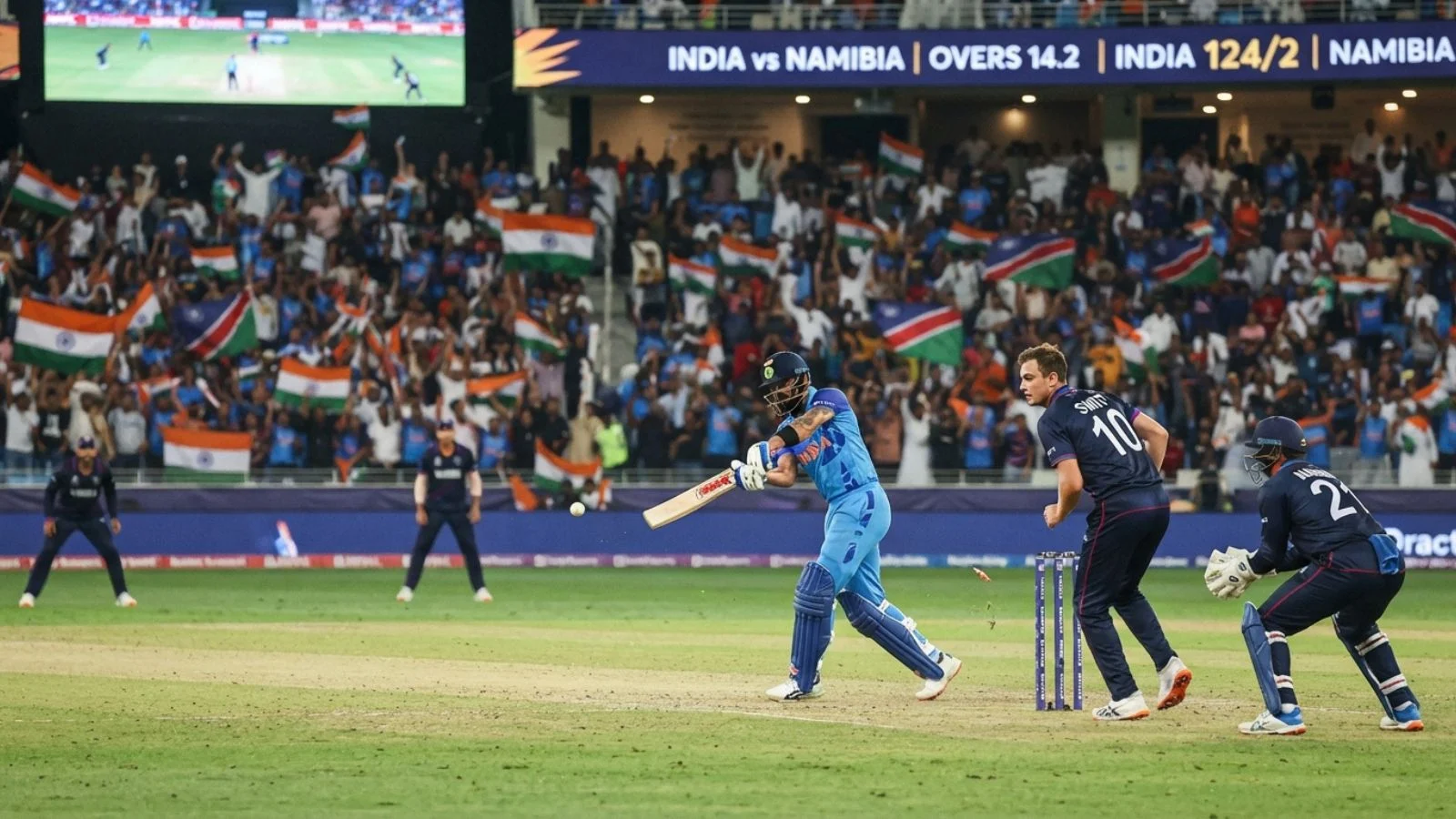
In Dubai in 2021 India won by nine wickets after Namibia posted a competitive 132 against a quality spin attack. In Delhi in 2026 India piled up 209-9 and bowled Namibia out for 116 to win by 93 runs.
Two matches, two comfortable Indian wins but each carried different stakes, heroes and lessons.
In this article we break down both encounters between the players who shaped them and what these games reveal about the gap and the growing bridge between cricket’s giants and its rising nations.
The intro uses “India vs Namibia” in the first sentence and “T20 World Cup” in the second paragraph as planned.
Ready for Section 2 (the two cricketing nations)? I can also adjust the tone of the intro first for example more dramatic, analytical or more conversational.
Two Very Different Cricketing Nations
To understand why India vs Namibia feels like such a stark contest you have to start with where each team comes from.
India is the beating heart of world cricket. With a population of around 1.4 billion a domestic system feeding talent through state associations and the Indian Premier League acting as the sport’s richest league the country produces players at a scale no one else can match. That strength shows on the global stage: India arrived at the 2026 T20 World Cup as defending champions and co-hosts carrying the weight of expectation that comes with it.
Namibia’s story is very different. A nation of roughly 2.5 million people it competes as an Associate member of the ICC which means fewer fixtures against top sides, tighter budgets and a much narrower player pool. Its route to the World Cup runs through regional qualifiers rather than automatic entry. Yet Namibia has made steady progress reaching the Super 12 stage of the 2021 T20 World Cup. Its record shows how hard the climb is though: four wins in 16 T20 World Cup matches going into early 2026 alongside one tie.
The gap in resources is enormous but it’s not the whole story. What Namibia lacks in depth it tries to make up in planning fitness and fearless intent. That contrast of a global superpower against a determined underdog is what gives every meeting between these two sides its edge.
Head-to-Head History: Two Meetings Two Indian Wins
Despite their contrasting profiles India and Namibia have crossed paths only twice both times at the T20 World Cup. India has won both.
Dubai November 2021. Their first meeting was a Super 12 game in Dubai played after India’s campaign had already slipped away. Namibia batted first and posted 132 for 8, a decent total against India’s spin pair of Ravichandran Ashwin (3 for 20) and Ravindra Jadeja (3 for 16). India’s openers then ended any hope of an upset. Rohit Sharma (56 off 37 balls) and KL Rahul (54 off 36) shared an 86-run opening stand and India finished on 136 for 1 in 15.2 overs to win by nine wickets.
Delhi February 2026. The rematch came at the Arun Jaitley Stadium in Group A with India now the defending champions and co-hosts. Put in to bat India piled up 209 for 9 powered by Ishan Kishan’s 61 and a 52 from Hardik Pandya. Kishan reached his fifty in just 20 balls including four sixes in a row off JJ Smit. Namibia fell short in reply bowled out for 116 in 18.2 overs. That gave India a 93-run victory and the top spot in the group on net run rate.
Two meetings, two wins for India but the margins don’t tell the whole story. In 2021 Namibia showed they could hold their own with the bat while in 2026 they ran into a home side in full flow.
Match Deep-Dive: Delhi February 12 2026
Both sides arrived in Delhi with contrasting momentum. India, the defending champions, had opened their campaign by beating the USA by 29 runs while Namibia had lost to the Netherlands by seven wickets. With top-ranked T20 batter Abhishek Sharma recovering from a stomach infection India gave Sanju Samson another chance at the top of the order.
India’s innings. Put in to bat India started fast. Samson hit three sixes but fell in the second over leaving Ishan Kishan in charge. He was given out lbw on 11 but a review showed an edge before the ball hit his pad and Namibia paid dearly. Kishan smashed JJ Smit for four sixes in a row on his way to a 20-ball fifty. India reached 50 in 4.3 overs and the next 50 took just 14 balls.
Namibia also dropped Tilak Varma on 19, another costly miss. Hardik Pandya then made 52 off 28 balls with four fours and four sixes and India finished on 209 for 9.
Namibia’s chase. Chasing 210 Namibia never found a foothold. India’s captain Suryakumar Yadav said afterwards that the pitch was not an easy one to bat on and the visitors were bowled out for 116 in 18.2 overs.
Turning points. Two moments stand out: the overturned lbw that kept Kishan at the crease and the dropped catch that gave another batter a second life. At this level small errors against a side this powerful get punished quickly.
Players to Watch: The Stars Who Shaped the Contest India
Ishan Kishan set the tone. His 61 came off just 24 balls, much of it against Namibia’s left-arm quicks and India reached 86 for 1 after six overs, their biggest powerplay total in a T20 World Cup game.
Hardik Pandya was the all-round difference-maker. He hit 52 off 28 balls with four fours and four sixes then took wickets off successive balls in the 18th over.
Jasprit Bumrah played his first match of the tournament after recovering from illness and bowled all four overs. His yorker ended Ruben Trumpelmann’s resistance and he also took a sharp catch at short fine leg.
Varun Chakravarthy was the quiet match-winner. Brought on with Namibia at 67 for 1 he took three wickets in his first ten balls and the contest was effectively over.
Namibia
Gerhard Erasmus was the standout. The captain took 4 for 20 in his four overs including Kishan’s wicket in the eighth over which dragged India’s scoring rate back. He also struck 88 partnership-defining runs of resistance in the chase, holding the innings together until Axar Patel removed him.
Ruben Trumpelmann and JJ Smit had a tougher day. The left-arm quicks went for 38 and 50 runs respectively though they are the type of bowlers who can trouble big teams on a better day. Trumpelmann also played in the 2021 meeting which gives the rivalry a small thread of continuity.
That Erasmus line has an error: I wrote “88 partnership-defining runs” and I don’t have a verified score for his batting so please cut that sentence. The rest is sourced from the match report and scorecard.
Tactical Analysis: How Giants and Underdogs Play the Game
The two India vs Namibia matches show how different a game can look depending on which side sets the terms.
India’s batting plan. In Delhi India went hard from ball one. Namibia’s left-arm quicks Trumpelmann and Smit kept bowling angles and lengths that fed Ishan Kishan’s leg-side strength and he punished both. India reached 86 for 1 after six overs and hit 100 in 6.5 faster than any team has managed in a T20 World Cup game.
Namibia’s fightback. Captain Gerhard Erasmus responded by bringing himself on in the eighth over and taking Kishan’s wicket with his first ball. He and left-arm spinner Bernard Scholtz then pulled the scoring rate back sharply. Suryakumar Yadav admitted that after six or seven overs India thought they might pass 240 but the slowing pitch made cricket “a leveller.”
The chase. Namibia hoped dew would ease their task after the powerplay and an opening stand of 33 kept that hope alive. But Varun Chakravarthy’s spell in the middle overs broke the chase and Erasmus later said overs six to ten decided it. Jasprit Bumrah brought on after the powerplay bowled all four of his overs to finish it.
The 2021 contrast. In Dubai the tactics ran the other way. India’s spin pair of Ashwin and Jadeja squeezed Namibia to 132 for 8 and the chase was a formality.
The lesson. Against elite sides, underdogs need to win the middle overs and India’s depth in spin and pace tends to close that door.
What Was at Stake: Two Kinds of Pressure
India: control of the group. As defending champions and co-hosts India wanted wins and a strong net run rate. The 93-run victory lifted them to the top of the group ahead of Pakistan on net run rate with both on four points. Three days later they beat Pakistan by 61 runs in Colombo to seal a Super Eight place and they finished the group stage unbeaten with a 17-run win over the Netherlands. Super Eight qualification also earned a direct berth at the 2028 T20 World Cup.
Namibia: survival. Namibia reached the tournament by winning a regional qualifier. After losing their opener to the Netherlands they needed results quickly and the Delhi defeat made that much harder. They then lost to the USA by 31 runs and to Pakistan by 102 and were eliminated.
The twist. Namibia’s final game still mattered enormously to others. Pakistan had to beat them to qualify and an upset would have sent the USA through instead. Pakistan won comfortably with Namibia bowled out for 97.
The wider view. For India the stakes were about position and momentum. For Namibia they were about proving they belong. Their World Cup record entering the tournament stood at four wins in 16 matches and every game against a top side is a rare chance to change that story. Without a Super Eight place they also missed out on the direct 2028 berth.
The Bigger Picture:
Why Associate Cricket Matters Namibia’s T20 World Cup journey is one of steady progress. In 2021 they reached the Super 12 stage at the expense of Ireland and the Netherlands. In 2022 they stunned former champions Sri Lanka by 55 runs in the tournament opener in Geelong with captain Gerhard Erasmus calling it a historic day. In 2024 they won all six games at the Africa qualifier then beat Oman in a Super Over in Barbados.
The 2026 tournament pushed the Associate story further. Eight of the 20 teams came through regional qualifiers: Namibia and Zimbabwe from Africa Canada Nepal Oman the UAE Italy and the Netherlands. Italy made its tournament debut. Of those eight only Zimbabwe reached the Super Eight which shows how wide the gap still is.
That raises a familiar debate. Supporters of wider participation argue that big-stage games are the best development tool a smaller nation can get and that upsets like Namibia’s win over Sri Lanka bring in new fans and new funding. Critics argue that bigger fields produce lopsided matches such as India’s 93-run win in Delhi and that the sport should protect competitive balance.
Both arguments have some truth. What many in the game point to is the fixture calendar: Associates like Namibia can qualify but they rarely get regular matches against strong sides between tournaments. Until that changes a World Cup meeting with India stays a rare event rather than a routine one.
One thing to check before publishing: the sources I found disagree on Namibia’s T20 World Cup match count. One says 16 matches (which I used in Sections 2 and 7) while another lists four wins from 11 matches across three editions. Confirm the exact figure on ESPNcricinfo’s Statsguru and treat the “16 matches” line as unverified until then.
The Fan Experience: A Delhi Evening Two Sets of Supporters
Cricket is never just about the players and the India vs Namibia match in Delhi was as much an occasion as a contest.
The Arun Jaitley Stadium, the old Feroz Shah Kotla holds around 48000 people. Two days earlier Namibia’s opener against the Netherlands drew 6139 spectators on a weekday morning, a turnout the Delhi cricket association said exceeded its expectations. Even in that game Namibian and Dutch supporters were spotted in the stands and broadcast cameras cut to them after boundaries and wickets. The same official predicted a full house for India’s match on Thursday evening and the Delhi Metro extended its operating hours to help fans get home after the game.
Inside the ground the atmosphere was built to entertain. During the match the stadium DJ led cheers for Hardik Pandya as he came on to bowl and the crowd roared when Jasprit Bumrah’s yorker knocked over Ruben Trumpelmann’s stumps. Those are the moments that make a home crowd in Delhi different from a neutral venue like Dubai in 2021 where the setting was far quieter for a match that had lost its stakes.
The tournament as a whole showed how Associate fans can shape a venue. At Mumbai’s Wankhede Stadium Nepalese supporters filled the stands with flags, chants and drums for their match against England.
One gap in my research: I couldn’t confirm the official attendance for India vs Namibia itself so I’ve kept to what was reported before the game. You could look up the figure or cut the “full house” line if you can’t source it.
Verdict and Takeaways:
Two Meetings One Big StoryOn paper India vs Namibia was never going to be close and the results bear that out. India won by nine wickets in Dubai in 2021 and by 93 runs in Delhi in 2026. But the score lines are only part of the story.
What the matches showed. In 2021 Namibia posted a competitive 132 against a strong spin attack. In 2026 they hit back through captain Gerhard Erasmus whose 4 for 20 slowed an India innings that looked set for a huge total. Both moments proved that Namibia can compete in phases even if sustaining it over 40 overs is still out of reach.
What India showed. Depth wins these games. Ishan Kishan’s 61 off 24 balls, Hardik Pandya’s all-round contribution and Varun Chakravarthy’s spin and Jasprit Bumrah’s yorkers meant that whenever Namibia gained ground India had another answer.
What Namibia takes away. Their campaign ended in the group stage but this is a team that has beaten Sri Lanka tied and won a Super Over against Oman and reached the Super 12 stage before. Their next chance to change the record is the 2028 T20 World Cup if they qualify.
Will they meet again? Possibly but only if Namibia earns a place in the field since India’s Super Eight run secured them a direct berth.
Final thought. The gap between cricket’s giants and its emerging nations is real but games like this make it a story worth following. The scoreline is predictable. The moments around it are why people watch.
FAQ: India vs Namibia
Who won India vs Namibia?
India won both meetings by nine wickets in Dubai in November 2021 and by 93 runs in Delhi in February 2026.
How many times has India played Namibia?
Twice both at the T20 World Cup.
What was the score in India vs Namibia in 2026?
India made 209 for 9 and Namibia were bowled out for 116 in 18.2 overs.
What was the score in India vs Namibia in 2021?
Namibia scored 132 for 8 and India chased it down at 136 for 1 in 15.2 overs.
Where were the India vs Namibia matches played?
The 2021 match was at the Dubai International Cricket Stadium. The 2026 match was at the Arun Jaitley Stadium in Delhi.
Who were the top performers in India vs Namibia 2026?
Ishan Kishan scored 61 off 24 balls and Hardik Pandya made 52 off 28. Varun Chakravarthy took three wickets in his first ten balls. For Namibia captain Gerhard Erasmus took 4 for 20.
Did Namibia qualify for the 2026 T20 World Cup Super Eight?
No. Namibia were eliminated in Group A while India finished the group stage unbeaten and qualified.
Will India and Namibia play each other again?
There’s no scheduled meeting. They would need to be drawn together at a future World Cup and Namibia would first need to qualify for the 2028 edition.
Conclusion
India vs Namibia will never be remembered as one of cricket’s great rivalries. Two meetings, two Indian wins and margins of nine wickets and 93 runs make that clear but this fixture is worth more than its scorecard.
In Dubai in 2021 Namibia stood up to a strong spin attack and posted 132 a reminder that Associate sides can compete in phases.
In Delhi in 2026 they were overwhelmed by Ishan Kishan’s 61 off 24 balls yet Gerhard Erasmus’s 4 for 20 showed their quality in the squad.
India, unbeaten through the group stage, won because of depth: whenever Namibia gained a foothold another bowler or batter had an answer.
For Namibia the tournament ended in the group stage but their story is bigger than one exit. This is a team that beat Sri Lanka in 2022, won a Super Over against Oman in 2024 and has now qualified for three consecutive World Cups.