You check out at the register or you scroll past a headline about new import duties on steel and the same word keeps surfacing: tax.
But is a tariff really the same thing as a tax or is something different going on? The short answer is that a tariff is a type of tax but it works in ways that set it apart from the income tax on your paycheck or the sales tax on your receipt.
It’s collected at a different point aimed at a different goal and its true cost lands on people in a far less obvious way Tariff vs. Tax.
Understanding the difference between tariff and tax matters now more than ever as trade policy shapes everything from grocery prices to global supply chains.
This article breaks down what each one is, how they compare who actually pays for them and why the distinction shapes both your wallet and the wider economy.
Understanding Taxes
A tax is a compulsory payment collected by a government from individuals, businesses or transactions with no direct service exchanged in return. Taxes fund the backbone of public life: roads, schools , healthcare , defense and social programs. Without them most modern governments simply couldn’t function.
Taxes generally fall into two broad categories. Direct taxes are charged on income or wealth such as income tax corporate tax property tax and inheritance tax. These are paid straight to the government by the person or entity earning or holding the asset. Indirect taxes on the other hand are added to transactions like sales tax value-added tax (VAT) and excise duties on goods such as fuel or tobacco. These are collected by a business but ultimately passed on to the buyer through the price.
Tax authorities such as the IRS in the United States or the FBR in Pakistan are responsible for enforcing collection auditing compliance and setting rules around deductions and exemptions.
Good tax systems are usually judged against a few core principles: fairness meaning people with a greater ability to pay contribute more; efficiency meaning the tax doesn’t distort economic decisions more than necessary; and simplicity meaning the system is easy to understand and administer.
Taxes touch nearly every financial decision a person or business makes from how much of a paycheck reaches a bank account to how much a bag of groceries costs. This foundation sets up a useful comparison: how does a tariff itself, a kind of tax, fit into this picture?
Understanding Tariffs
A tariff is a tax imposed specifically on goods crossing an international border most commonly on imports though export tariffs exist too. Unlike income or sales tax a tariff isn’t tied to earning or general spending; it’s triggered the moment a product enters a country.
Tariffs come in a few forms. An ad valorem tariff is charged as a percentage of the good’s value so a costlier shipment pays more. A specific tariff is a fixed fee per unit such as a set amount per ton of steel regardless of price. A compound tariff blends the two. Some countries also use tariff-rate quotas which apply a lower rate up to a certain import volume and a higher rate beyond it.
In practice tariffs are collected by customs agencies rather than domestic tax authorities. When a shipment arrives customs officials assess its value, classify it using standardized product codes and calculate the duty owed before the goods are released. The importer, not the foreign manufacturer, is legally responsible for paying this amount upfront.
It’s worth distinguishing tariffs from related trade tools. Quotas limit the quantity of a good that can be imported subsidies support domestic producers directly and anti-dumping or countervailing duties target specific unfair trade practices rather than applying broadly.
In short, a tariff is a border tax with its own mechanics, its own collecting authority and its own set of policy goals which sets the stage for comparing it head-to-head with the taxes people encounter domestically.
Tariff vs Tax: A Head-to-Head Comparison
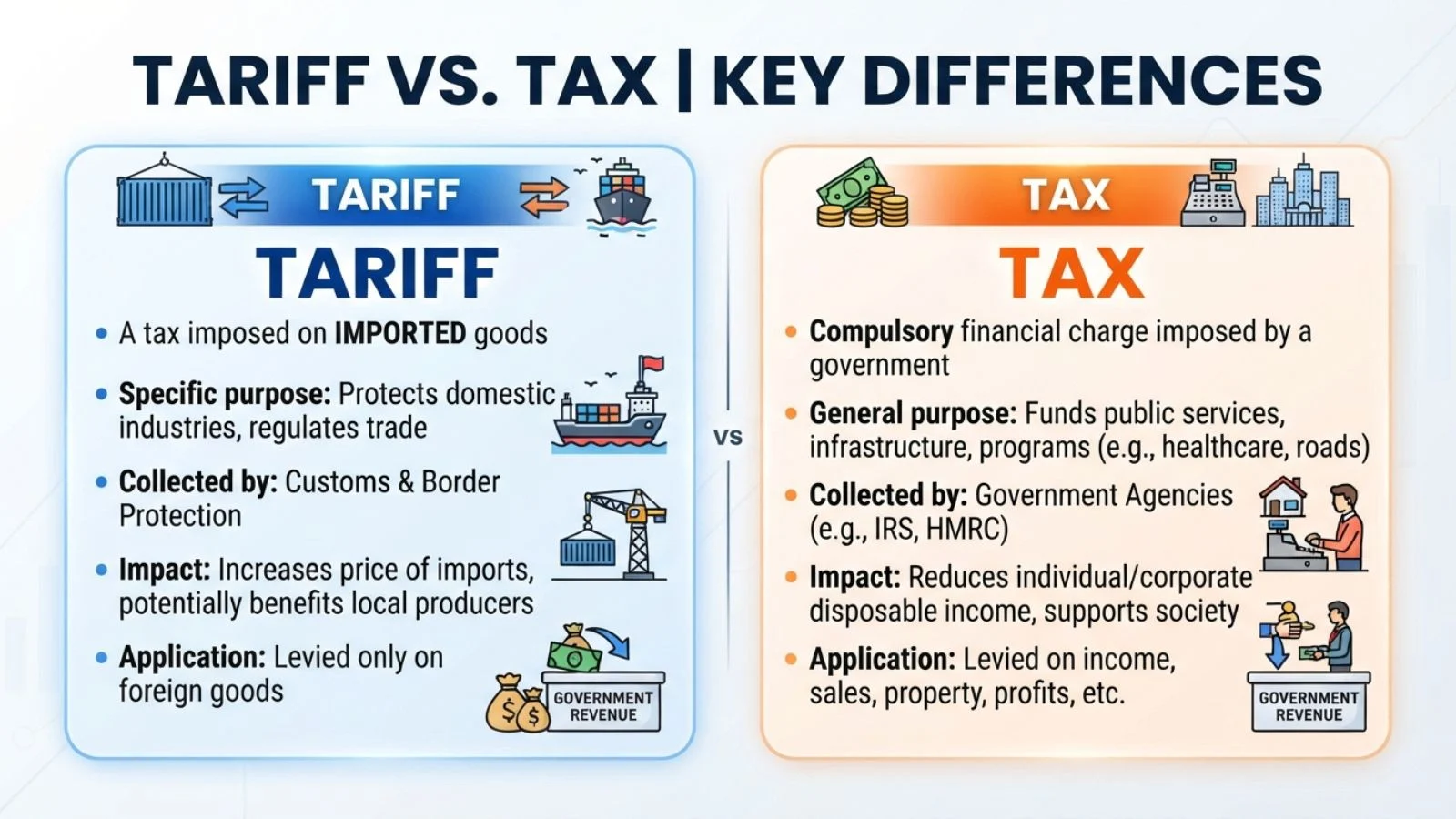
Placed side by side the differences between tariffs and taxes become much clearer. Both extract revenue for the government but nearly everything else about them diverges.
A tax applies broadly to income sales or property while a tariff applies narrowly to goods crossing a border. Taxes are collected by a domestic tax authority whereas tariffs are collected by customs agencies at ports, airports and border crossings. The party paying upfront differs too: individuals and businesses pay taxes directly while importers pay tariffs before goods ever reach a store shelf.
Purpose is another key divide. Taxes primarily raise revenue and can redistribute wealth through progressive rates. Tariffs, while they do raise some revenue, are more often used to protect domestic industries, respond to unfair trade practices or give a government leverage in negotiations.
Visibility matters as well. A sales tax shows up as a clear line on a receipt so consumers know exactly what they’re paying. A tariff by contrast is usually baked into the shelf price before a customer ever sees it making its cost far less obvious.
Finally who sets the rate differs. Taxes are typically set by a legislature through ordinary lawmaking. Tariff rates can also be set by a legislature but many countries allow the executive branch to adjust them and they’re additionally shaped by international trade agreements and organizations like the WTO.
| Factor | Tax | Tariff |
| Applied to | Income sales property | Imported goods |
| Collected by | Tax authority | Customs authority |
| Paid upfront by | Individuals businesses | Importers |
| Primary purpose | Revenue redistribution | Protection leverage |
| Visibility | Clear on receipts | Hidden in prices |
Who Actually Pays? (Tax Incidence)
Here’s where things get genuinely interesting. Who legally owns a tariff and who actually bears its cost are two very different questions a concept economists call tax incidence.
Legally the importer pays a tariff the moment goods cross the border. But that cost rarely stops there. It typically ripples through a supply chain split among several parties: the importer may absorb part of it to stay competitive, retailers may pass some along through higher prices and consumers often end up paying more at checkout. In some cases foreign exporters lower their prices to keep their goods attractive, effectively absorbing a share of the cost themselves.
How that burden gets divided depends heavily on elasticity meaning how sensitive buyers and sellers are to price changes. If consumers have no good substitute for a tariffed product they’ll likely absorb most of the cost. If cheaper alternatives exist retailers and importers may eat more of it to avoid losing customers.
This mirrors how sales tax incidence works in some respects since a seller can’t always pass 100% of a tax onto the buyer either. But tariffs add extra complexity because international competition and currency effects come into play too.
Empirical research on recent trade disputes has generally found that a large share of tariff costs get passed through to domestic consumers and businesses rather than absorbed by foreign exporters though the exact split varies by product country and time period. This is precisely the point most political debates gloss over.
Economic Effects of Tariffs
Tariffs ripple through an economy in ways that go well beyond the price tag on one product.
For consumers the most direct effect is higher prices. When an import becomes more expensive domestic alternatives often raise their prices too since they face less competitive pressure. Consumers also lose some choice as certain foreign goods may become too costly to justify importing at all.
For domestic producers competing with imports, tariffs can offer real relief, shielding them from cheaper foreign competition and helping preserve jobs in that industry. But producers who rely on imported materials face the opposite problem: a tariff on steel for example raises costs for every domestic manufacturer that builds with steel from carmakers to appliance makers squeezing their margins or forcing them to raise prices too.
Government revenue tariffs can bring in meaningful income though usually far less than broad-based taxes like income or sales tax in developed economies. In some developing nations tariffs remain a much larger share of total government revenue.
Trade flows shift as well. Tariffs can cause trade diversion where buyers switch to suppliers in countries without tariffs and trade destruction where some transactions simply stop happening because they’re no longer profitable.
Beyond individual markets tariffs can influence exchange rates and contribute to inflationary pressure economy-wide. And they rarely happen in isolation: trade partners often retaliate with their own tariffs risking an escalating trade war that harms exporters on both sides.
Economic Effects of Taxes
Taxes shape economic behavior just as much as tariffs do though the mechanisms differ.
On work and investment taxes influence incentives at the margin. High income tax rates can in theory discourage extra work or overtime while high corporate tax rates can push businesses to invest less domestically or shift profits to lower-tax jurisdictions. Capital gains taxes similarly affect decisions about when to sell an asset or reinvest earnings.
Economists also talk about deadweight loss, the efficiency cost that occurs when a tax discourages a transaction that would otherwise have benefited both buyer and seller. Nearly every tax creates some deadweight loss though the size varies depending on how sensitive behavior is to the tax.
Tax design also matters for fairness. A progressive tax like most income tax systems takes a larger percentage from higher earners. A regressive tax takes a larger relative share from lower-income households which is a common criticism of flat sales taxes and excise duties since necessities eat up a bigger portion of a low earner’s budget.
On the positive side, taxes fund the public goods a market alone can’t efficiently provide: infrastructure, public education, healthcare systems and social safety nets. Without this revenue many services people rely on daily simply wouldn’t exist.
This sets up a useful parallel with tariffs: both tariffs and consumption-based taxes can be regressive since lower-income households tend to spend a larger share of their income on goods whether taxed at checkout or embedded in import prices.
The Case For Tariffs
Supporters of tariffs point to several practical and strategic benefits that go beyond simple protectionism.
One classic argument is protecting infant industries. A new domestic industry may struggle to compete against established foreign producers with decades of scale and expertise. A temporary tariff can give that industry breathing room to grow, invest and eventually compete on its own footing.
National security is another major justification. Relying heavily on foreign suppliers for critical goods like semiconductors, pharmaceuticals or defense-related materials creates vulnerability if relationships sour or supply chains break down. Tariffs can incentivize domestic production of goods considered too important to source entirely from abroad.
Tariffs are also used to respond to unfair trade practices. If a foreign government subsidizes its exports or allows companies to sell below cost known as dumping a tariff can level the playing field and prevent that country from undercutting domestic producers through practices most trade rules consider unfair.
Beyond economics tariffs serve as a bargaining chip. Threatening or imposing tariffs gives a government leverage in trade negotiations pressuring other countries to lower their own barriers or address specific grievances.
Domestic tariffs are often framed as job protection since shielding an industry from foreign competition can help preserve employment in that sector at least in the short term.
Finally, especially in developing economies with limited tax infrastructure, tariffs can serve as a relatively simple and enforceable way to raise government revenue compared to building out a complex domestic tax system.
The Case Against Tariffs
Critics of tariffs argue that their costs frequently outweigh their benefits both economically and politically.
The most immediate concern is higher costs for consumers and businesses. As covered earlier tariff costs often get passed through the supply chain landing on everyday shoppers and companies that rely on imported materials sometimes eroding the very savings a tariff was meant to protect.
Retaliation is a persistent risk. When one country imposes tariffs trade partners frequently respond in kind targeting the first country’s exporters. This tit-for-tat dynamic can escalate into a full trade war where multiple industries on both sides suffer and diplomatic relationships strain further.
Tariffs can also reduce efficiency and competition. By shielding domestic producers from foreign rivals, tariffs remove some of the pressure that drives innovation quality improvements and lower prices. Protected industries can become complacent and less competitive globally over time rather than stronger.
Supply chains, many of which span multiple countries, can be seriously disrupted. A single tariff on one component can ripple through complex manufacturing processes raising costs at every stage and creating uncertainty that makes long-term business planning harder.
Economists frequently point out that the cost of protecting each job through tariffs often exceeds the wages that job pays once higher consumer prices are factored in making tariffs an inefficient tool for preserving employment.
Finally tariffs can invite favoritism and lobbying as specific industries push for protection that serves narrow interests rather than the broader economy raising questions about how fairly these policies get decided.
Taxes as the Alternative: The Case For and Against
If tariffs come with so many drawbacks why not just use taxes and subsidies instead to achieve the same goals? This question sits at the heart of a long-running policy debate.
Proponents of using direct taxes and targeted subsidies argue they’re simply more precise tools. Rather than taxing an entire category of imported goods and hoping the benefits land where intended, a government can subsidize a specific struggling industry directly or offer tax credits for domestic manufacturing research or job creation. This approach avoids raising prices for unrelated products and doesn’t invite the same risk of foreign retaliation. It’s also more transparent: taxpayers can see exactly how much a subsidy costs and debate whether it’s worth it whereas tariff costs are often hidden inside everyday prices.
However taxes and subsidies aren’t free of drawbacks either. Higher taxes particularly on income or corporate profits can reduce incentives to work, save or invest the same deadweight loss problem discussed earlier. Subsidies require the government to correctly pick which industries deserve support, a process vulnerable to political influence inefficiency and wasted spending on industries that never become competitive.
In practice the right tool often depends on the specific goal. If the aim is protecting a strategic industry from foreign competition a temporary tariff may act faster. If the goal is encouraging long-term domestic investment a targeted tax incentive may achieve the same result with less collateral damage to consumers and international relationships.
Legal and Political Dimensions
Who has the authority to impose a tariff or a tax differs in important ways and that difference shapes how quickly and unpredictably each can change.
In most democracies taxes require a legislature to pass a law, a process that involves debate committee review and public scrutiny. This makes major tax changes relatively slow and predictable even if the underlying politics are contentious.
Tariffs can work differently. While legislatures often set baseline tariff policy, many countries grant the executive branch power to adjust tariff rates more quickly, particularly for national security or emergency purposes. This means tariffs can sometimes be imposed, raised or removed with far less deliberation than a typical tax change which is part of why they’re often used as a fast-moving policy tool in trade disputes.
International rules add another layer. The World Trade Organization sets “bound rates” or the maximum tariff a member country has agreed not to exceed on a given product. Countries can still set tariffs below that ceiling and many maintain lower preferential tariffs with specific trading partners through free trade agreements. Disputes over whether a tariff violates these commitments can be challenged through WTO dispute settlement processes.
Politically tariffs and taxes are also framed very differently to the public. Tariffs are frequently presented as a way to make foreign countries or foreign companies pay even though domestic importers technically owe the cost. Taxes by contrast are understood as a direct burden on the taxpayer. This framing difference shapes public opinion and makes tariffs rightly or wrongly an easier sell politically.
Real-World Case Studies
Three recent examples show how tariffs play out in practice beyond the theory.
The 2025 US steel and aluminum tariffs. In February 2025 the US president signed proclamations reinstating a 25% tariff on steel imports and raising aluminum tariffs to 25% from nearly all countries under national security authority. These took effect on March 12 2025 and by June the rate on both metals had been doubled to 50%. The Commerce Department later expanded the list of covered products by more than 400 codes in August 2025 and by April 2026 tariffs applied to the full value of goods rather than just their metal content with new reduced rates carved out for certain derivatives. The episode shows how quickly executive tariff authority can shift and how tariff design itself keeps evolving in response to industry pressure.
The April 2025 “reciprocal tariffs.” On April 2 2025 the US president invoked emergency economic powers to impose reciprocal tariffs on nearly every country in the world which took effect April 5. This case illustrates tariffs used as a broad fast-moving negotiating tool rather than a narrow industry protection.
Canada’s retaliatory response. When Ontario imposed a surcharge on electricity exports to the US the US responded by threatening even higher 50% tariffs on Canadian steel and aluminium double the rate applied to other trading partners. This shows how quickly retaliation can escalate between even close trading partners.
Worked Example: One Product Two Systems
Consider a mid-range imported bicycle that costs a US retailer $200 to bring in from overseas before any government charges.
With no tariff: The retailer pays $200 adds a markup and sells the bike for around $350.
With a 25% tariff: Customs collects $50 (25% of $200) from the importer the moment the bike crosses the border raising the importer’s cost to $250. If the retailer passes the full cost through keeping the same markup percentage the shelf price rises to roughly $435 an increase of about $85 more than the tariff itself once the markup is recalculated on the higher base cost. In practice the retailer might instead absorb part of that cost to stay price-competitive, landing the final price somewhere between $350 and $435 depending on how much of the burden gets shared.
With a 10% sales tax instead: If the same $350 bike is simply taxed at checkout the customer pays $350 plus $35 in sales tax a separate clearly itemized $35 at the register visible and easy to understand.
The contrast is telling. The tariff’s cost is invisible baked into the shelf price before the customer even sees the bike and its exact size depends on how much of it retailers importers or foreign manufacturers choose to absorb. The sales tax by comparison is transparent, fixed and entirely predictable for the buyer.
Common Misconceptions
Despite how often tariffs make headlines several myths persist about how they actually work.
“Foreign countries pay the tariff.” This is perhaps the most widespread misconception. Legally and practically the importer a domestic company pays the tariff to customs when goods cross the border. Foreign exporters may absorb some cost indirectly by lowering their prices to stay competitive but they don’t write a check to the government. The phrase “China pays the tariff” or similar framing is a political simplification not an economic reality.
“A tariff is not really a tax.” As this article has shown, a tariff is a tax just one applied specifically to imported goods rather than income or general sales. Calling it something else doesn’t change its underlying mechanics or its effect on prices.
“Tariffs always protect jobs.” While tariffs can preserve jobs in the specific industry being shielded, they often raise costs for other industries that rely on the tariffed goods as inputs, potentially costing jobs elsewhere in the supply chain. The net effect on total employment is frequently smaller or even negative once these ripple effects are counted.
“Free trade means no rules or taxes at all.” Free trade agreements don’t eliminate taxation entirely; they typically reduce or eliminate tariffs between specific partner countries while domestic taxes like income and sales tax remain fully in place.
“Tariffs and taxes only affect the wealthy or only the people .” In reality both can be regressive in certain forms since necessities make up a larger share of a lower-income household’s spending whether taxed at checkout or embedded in the price of an imported good.
What This Means for Different Readers
Understanding tariffs and taxes isn’t just academic. Here’s how the distinction plays out for different groups.
Consumers. The next time a favorite imported product creeps up in price it’s worth asking whether a tariff might be behind it. Since tariff costs are baked into shelf prices rather than itemized, tracking price trends on specific imported categories like electronics clothing or cars can reveal patterns tied to trade policy shifts rather than simple inflation.
Small businesses and importers. For companies that source materials or finished goods internationally tariffs are a direct line-item cost that can shift quickly with little warning. Diversifying suppliers across multiple countries monitoring proposed tariff changes and building flexibility into pricing and contracts can help cushion the impact when rates change.
Exporters. Businesses that sell goods abroad face a different risk: retaliation. If a home country imposes tariffs on another nation that country may respond with tariffs targeting the first country’s exporters. Companies with significant export revenue should watch trade tensions closely since their market access can shift for reasons entirely outside their own industry’s control.
Students and general readers. For anyone trying to make sense of trade policy news the key skill is looking past the political framing. Asking who technically pays a tariff who likely bears the real cost and what the stated goal is whether revenue protection or leverage turns a confusing headline into something genuinely understandable.
Conclusion
So is a tariff just a tax? Technically yes but treating the two as interchangeable misses what makes each one distinct.
A tax draws broadly from income sales and property to fund public life collected transparently and debated openly through the legislative process.
A tariff narrows in on goods crossing a border collected by customs rather than a tax authority and aimed as much at protecting industries or gaining leverage as at raising revenue.
The most important takeaway may be about who really pays. While an importer legally owes a tariff the cost typically ripples outward.
Shared among importers, retailers , consumers and sometimes foreign exporters in ways that are far less visible than the tax line on a receipt.
That invisibility is precisely why tariffs make such convenient political tools: they can be framed as making someone else pay even when the truth is more complicated.