Picture this: your favorite website suddenly refuses to load. Is it a server glitch or something more sinister? Often the culprit is a denial-of-service attack, a deliberate attempt to knock a system offline by overwhelming it with traffic.
But not all denial-of-service attacks are created equal. Two terms get thrown around constantly, often interchangeably: DoS and DDoS.
While they share a common goal disrupting availability the way they’re executed their scale and the damage they cause differ dramatically.
Understanding this distinction isn’t just technical trivia. For businesses IT professionals and everyday internet users knowing how these attacks work is the first step toward recognizing threats and building real defenses.
In this article we’ll break down what separates a DoS attack from a DDoS attack, explore how each one operates and look at real-world examples that show why the difference matters more than ever.
Foundational Concepts
Before diving into the differences between DoS and DDoS attacks it helps to understand what “denial of service” actually means. In cybersecurity professionals often reference the CIA triad Confidentiality Integrity and Availability as the three pillars that protect digital systems. While many cyberattacks focus on stealing data (confidentiality) or tampering with it (integrity) denial-of-service attacks target the third pillar: availability. The goal isn’t to steal or corrupt information but to make a system service or network completely inaccessible to its legitimate users.
To understand how this happens it’s worth knowing how servers handle everyday traffic. Every time you visit a website your device sends a request that consumes a small amount of the server’s resources bandwidth processing power (CPU) memory and open connections. Under normal conditions servers are built to handle a reasonable volume of these requests simultaneously. Denial-of-service attacks exploit this system by intentionally flooding a target with far more requests than it can handle, exhausting its resources until it slows to a crawl or crashes entirely.
This is the foundation both DoS and DDoS attacks build on. The core difference lies in how that flood of traffic is generated whether it comes from a single source or an army of distributed devices. Understanding this baseline mechanism makes it much easier to grasp why DDoS attacks in particular have become one of the most feared weapons in a cybercriminal’s arsenal.
DoS Attacks in Depth
A Denial-of-Service (DoS) attack is the simplest form of this threat: a single attacker using a single device and internet connection floods a target with an overwhelming volume of traffic or requests. The intent is straightforward: exhaust the target’s bandwidth memory or processing power until legitimate users can no longer access the service.
DoS attacks generally fall into a few categories. Volume-based attacks like the classic ping flood bombard a server with excessive ICMP packets consuming bandwidth until the system can’t respond to real traffic. Protocol attacks exploit weaknesses in network protocols themselves; a SYN flood for example sends a barrage of connection requests but never completes the handshake leaving the server holding countless half-open connections until it runs out of resources. The Smurf attack takes a similar approach exploiting IP broadcast addressing to amplify traffic toward a victim.
Then there are application-layer attacks such as Slowloris which target web servers directly by opening multiple connections and keeping them alive with minimal data slowly starving the server of available connections.
Historically tools like LOIC (Low Orbit Ion Cannon) made launching basic DoS attacks accessible even to non-technical users contributing to their early popularity.
The upside for defenders is that because DoS attacks originate from a single identifiable source they’re comparatively easier to detect and blocking a firewall rule or IP ban can often neutralize the threat quickly. This single point of origin is precisely what separates DoS from its far more dangerous cousin: DDoS.
DDoS Attacks in Depth
A Distributed Denial-of-Service (DDoS) attack takes the same core idea as a DoS attack overwhelming a target until it can’t function but multiplies its power by launching the assault from many sources simultaneously. Instead of one device attackers harness thousands, sometimes millions of compromised machines to flood a target at once.
This army of devices is known as a botnet. Botnets are built by infecting vulnerable devices with malware often without the owner’s knowledge. Increasingly attackers target Internet of Things (IoT) devices routers cameras smart home gadgets which frequently ship with weak default security. Once infected these devices become “bots” silently awaiting instructions from a command-and-control (C2) server that coordinates the attack.
Like DoS attacks DDoS attacks fall into several categories but at a much larger scale. Volumetric attacks overwhelm bandwidth directly, often using amplification or reflection techniques; for example, a DNS amplification attack exploits misconfigured DNS servers to send disproportionately large responses to a spoofed victim address. Protocol attacks exploit the same weaknesses as DoS attacks but at a massive scale. Application-layer DDoS attacks like HTTP floods mimic legitimate user traffic making them especially hard to distinguish from real visitors.
Head-to-Head Comparison
While DoS and DDoS attacks share the same end goal, laying their characteristics side by side reveals just how differently they operate.
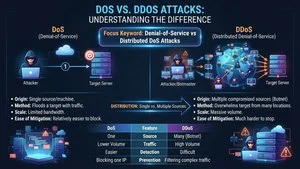
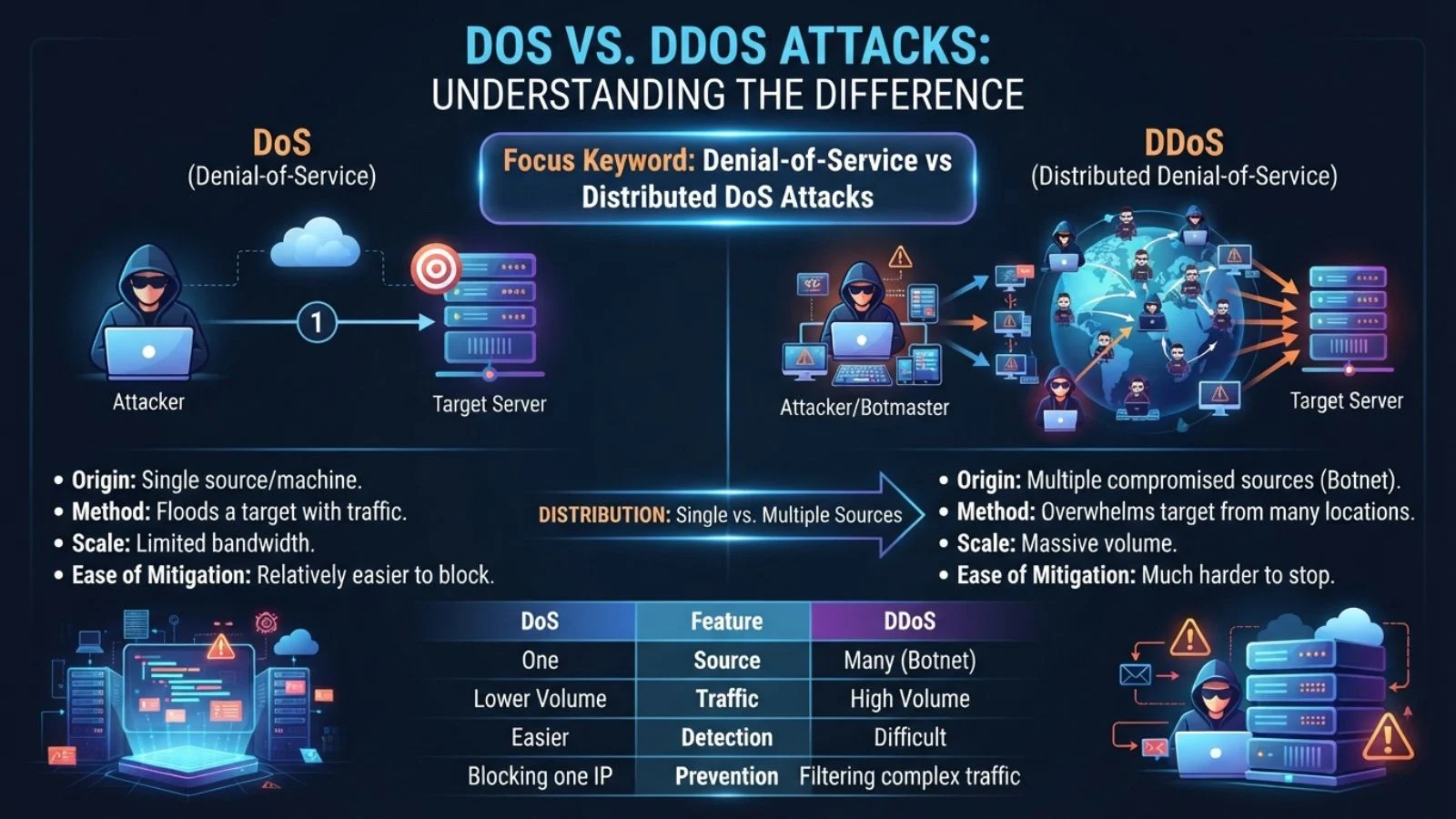
Source of traffic is the most fundamental distinction: a DoS attack originates from a single device and IP address while a DDoS attack is launched from a distributed network of devices often scattered across the globe.
Scale follows naturally from this. A DoS attack is limited by the bandwidth and processing power of one machine whereas a DDoS attack can generate traffic measured in hundreds of gigabits or even terabits per second since it pools the combined power of an entire botnet.
Complexity to launch also differs. A basic DoS attack can be carried out with minimal technical skill and freely available tools. A DDoS attack by contrast typically requires building or renting a botnet along with command-and-control infrastructure though DDoS-for-hire services have lowered this barrier significantly.
Detection difficulty favors defenders when it comes to DoS: a single source is relatively easy to identify and block. DDoS traffic however often blends in with legitimate visitors making it far harder to distinguish malicious requests from real ones.
Mitigation difficulty compounds this problem: blocking one IP address is simple but filtering out thousands of distributed sources without also blocking real users requires specialized infrastructure.
Finally, attacker motivation and profile often diverge: DoS attacks are frequently opportunistic or personal while DDoS attacks are more commonly tied to organized extortion, hacktivism or competitive sabotage.
Real-World Case Studies
Examining real incidents brings the theoretical differences between DoS and DDoS into sharp focus.
One of the earliest widely publicized denial-of-service incidents occurred in 2000 when a Canadian teenager known online as “Mafiaboy” launched attacks against major sites including Yahoo eBay and CNN. While later attacks would be distributed these early incidents demonstrated how even a single determined attacker with modest resources could disrupt major online services and shook the industry’s confidence in internet infrastructure.
The modern era of DDoS threats however is defined by the Mirai botnet. In 2016 Mirai infected hundreds of thousands of insecure IoT devices, cameras , routers and DVRs and used them to launch a massive DDoS attack against Dyn, a major DNS provider. The attack disrupted access to platforms like Twitter Netflix Reddit and Spotify across the U.S. illustrating how vulnerable everyday smart devices could become weapons.
In 2018 GitHub was hit by one of the largest DDoS attacks recorded at the time peaking at 1.35 terabits per second. Notably this attack used a memcached amplification technique requiring no botnet at all, just misconfigured servers exploited at scale.
More recently cloud security providers have reported mitigating attacks exceeding several terabits per second reflecting the escalating arms race between attackers and defenders.
Detection Techniques
Spotting a denial-of-service attack before it causes major damage requires knowing what to look for and having systems in place that can tell the difference between a genuine traffic surge and a malicious one.
Traffic pattern analysis is the first line of defense. Security tools continuously monitor incoming traffic to establish a baseline of “normal” behavior. When traffic suddenly spikes far beyond typical patterns, deviates in geographic origin or shows unusual request types it raises a red flag worth investigating.
Anomaly detection builds on this baseline by using statistical models or machine learning to flag deviations automatically rather than relying solely on manual review. This is especially useful for catching subtle application-layer attacks that mimic legitimate user behavior.
Rate limiting and threshold alerts help by setting boundaries on how many requests a single source or the system as a whole can make within a given timeframe. When those thresholds are exceeded automated alerts or blocks can kick in before resources are fully exhausted.
Log analysis and monitoring tools provide the forensic backbone of detection allowing security teams to trace request origins, identify repeated patterns from the same sources and correlate spikes with known attack signatures.
Finally distinguishing a legitimate traffic spike like a viral marketing campaign or product launch from an actual attack is critical. Key indicators include unusually uniform request patterns traffic from suspicious or unexpected regions and requests that don’t behave like typical human browsing sessions.
Mitigation and Defense Strategies
Defending against denial-of-service attacks requires different tools depending on the scale and nature of the threat.
For DoS attacks defense is relatively straightforward. Firewalls configured with strict rules can block traffic from suspicious or known-malicious IP addresses. IP blocklisting allows administrators to manually or automatically ban offending sources once identified. Rate limiting caps the number of requests any single source can make in a given period preventing one device from monopolizing server resources.
DDoS attacks demand more robust distributed defenses. Content Delivery Networks (CDNs) spread traffic across multiple servers worldwide absorbing and diluting attack volume before it reaches the origin server. Traffic scrubbing centers analyze incoming traffic in real time filtering out malicious packets while allowing legitimate requests through. Anycast routing distributes traffic across multiple data centers simultaneously preventing any single point from becoming overwhelmed. Load balancing further ensures no individual server bears the full brunt of an attack by distributing requests evenly across available infrastructure.
Many organizations also turn to specialized cloud-based DDoS protection services which offer scalable always-on defenses capable of absorbing attacks measured in terabits per second resources far beyond what most individual companies could maintain in-house.
Beyond technical tools, incident response planning is essential. Having a documented runbook ensures teams know exactly how to respond when an attack begins minimizing downtime and confusion.
Legal and Ethical Dimensions
Beyond the technical battle between attackers and defenders lies a serious legal reality: launching a DoS or DDoS attack is a criminal act in most countries around the world.
In the United States the primary law governing these offenses is the Computer Fraud and Abuse Act (CFAA) which criminalizes unauthorized access to computer systems and the intentional disruption of their normal operation. Individuals convicted under the CFAA for launching denial-of-service attacks can face substantial fines and lengthy prison sentences particularly when the attack causes significant financial damage or targets critical infrastructure. Similar laws exist internationally; the UK’s Computer Misuse Act and various cybercrime statutes across the EU impose comparable penalties reflecting a global consensus that these attacks constitute serious criminal offenses rather than harmless pranks.
Law enforcement agencies have increasingly prioritized dismantling DDoS-for-hire services with international operations targeting booter and stresser platforms that make attack capabilities available to anyone willing to pay.
However not all simulated denial-of-service activity is illegal. Ethical hacking and authorized penetration testing occupy an important legitimate space in cybersecurity. Organizations often hire security professionals to conduct controlled stress tests on their own systems deliberately simulating attack conditions to identify vulnerabilities before real attackers can exploit them. The critical distinction lies in authorization: explicit documented permission from the system owner transforms what would otherwise be a crime into a valuable security practice helping organizations strengthen their defenses proactively.
Emerging Trends
The denial-of-service threat landscape continues to evolve rapidly, driven largely by two converging forces: an ever-expanding attack surface and increasingly sophisticated technology on both sides of the fight.
The proliferation of Internet of Things (IoT) devices has dramatically expanded opportunities for attackers. Smart cameras, routers , thermostats and countless other connected devices often ship with weak default credentials and infrequent security updates making them easy targets for botnet recruitment. As the number of connected devices worldwide continues to climb into the tens of billions, security researchers warn that the pool of potential bots available to attackers will only grow fueling larger and more frequent DDoS campaigns.
Artificial intelligence and machine learning are reshaping both offense and defense. On the attacking side AI can help identify vulnerable targets faster, optimize botnet coordination and generate traffic patterns that more convincingly mimic legitimate users making detection harder. On the defensive side the same technologies power increasingly sophisticated anomaly detection systems capable of identifying subtle attack signatures in real time and adapting to new tactics far faster than manual monitoring ever could.
Perhaps most striking is the sheer growth in attack scale. Industry reports from major cloud security providers have documented a consistent year-over-year increase in both the frequency and peak volume of DDoS attacks with record-breaking incidents becoming increasingly common. This escalating arms race suggests that as defensive technology improves attackers continue finding new methods and resources to push past previous limits.
FAQ
Can a DoS attack turn into a DDoS attack?
Not directly the two are distinct by definition based on the number of sources involved. However an attacker could escalate a campaign by recruiting additional devices effectively shifting from a single-source DoS attack to a distributed DDoS attack as more compromised machines join the assault.
Is DDoS illegal?
Yes. In most countries launching a DDoS attack is a criminal offense. In the United States it falls under the Computer Fraud and Abuse Act carrying penalties that can include significant fines and imprisonment. Similar laws exist internationally and law enforcement agencies actively pursue both attackers and the operators of DDoS-for-hire platforms.
How long do DDoS attacks typically last?
Duration varies widely; some attacks last only minutes designed as quick disruptions or distractions while others persist for hours or even days particularly when attackers are pursuing extortion or sustained sabotage.
Can individuals protect personal devices from being used in a DDoS botnet?
Yes. Changing default passwords, keeping firmware updated, disabling unnecessary remote access features and using a firewall can significantly reduce the risk of IoT devices being hijacked for botnet use.
Are small businesses at risk or only large organizations?
Small businesses are increasingly targeted partly because they often have weaker defenses than large enterprises making them attractive lower-effort targets for attackers seeking easy disruption or extortion opportunities.
Conclusion
At their core DoS and DDoS attacks share a single objective: denying legitimate users access to a system service or network.
But as this article has shown, the way they achieve that goal and the level of threat they pose differs enormously.
A DoS attack is the work of one attacker, one device and a limited pool of resources making it relatively contained and comparatively easy to detect and block.
A DDoS attack by contrast harnesses the combined power of thousands or even millions of compromised devices creating a distributed assault that can overwhelm even well-defended systems and is far harder to trace back to its source.
Understanding this distinction is more than an academic exercise. As IoT adoption accelerates and attack tools become more accessible through underground services the potential scale and frequency of these attacks will only continue to grow.
For businesses IT professionals and everyday internet users alike preparedness is no longer optional it’s essential.