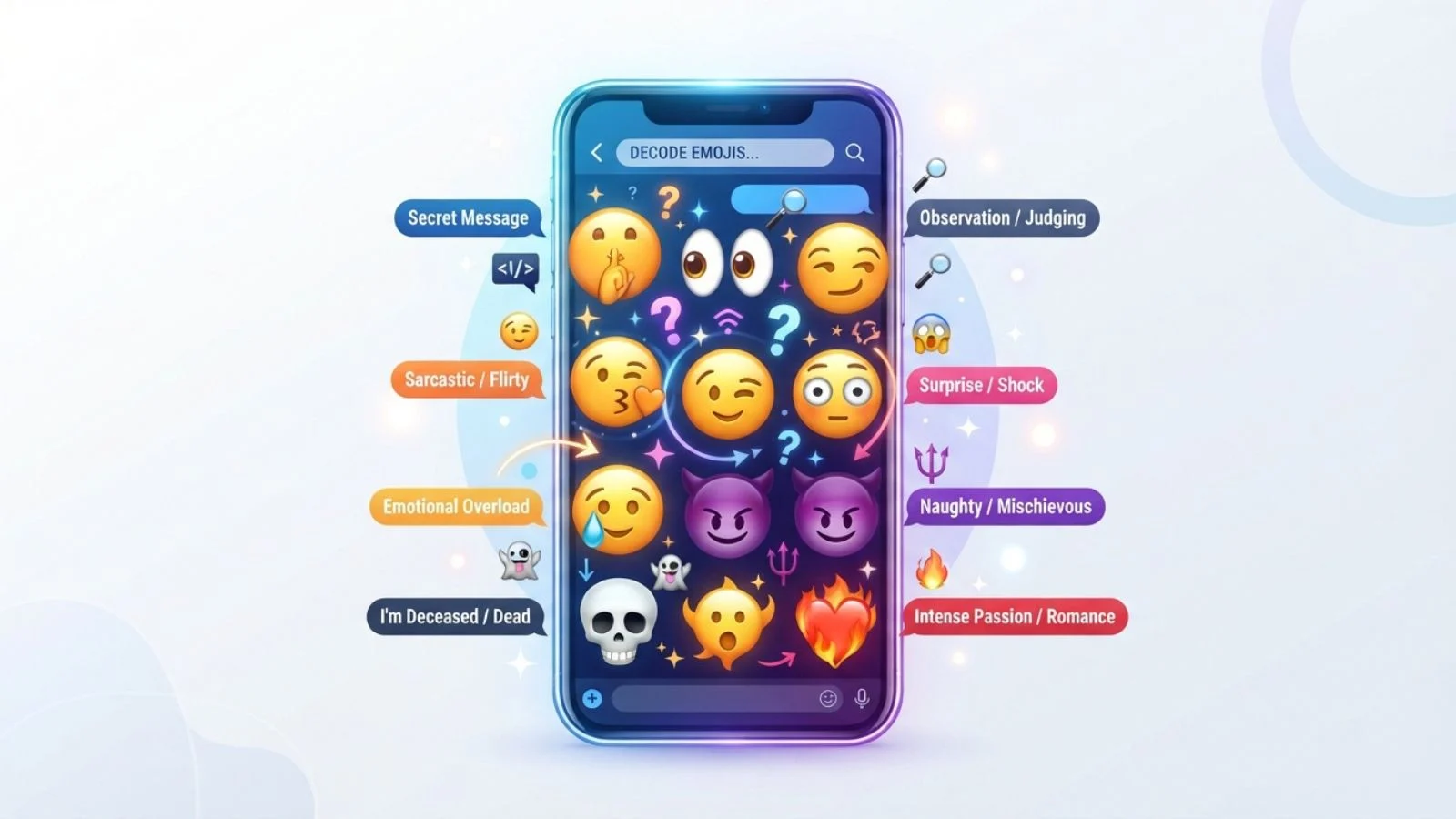
You’ve probably sent a 🍆 or 🌽 emoji without a second thought but somewhere someone read it completely differently than you intended.
Emojis were designed to be simple universal shortcuts for emotion and meaning. Instead they’ve evolved into a coded language layered with slang innuendo and in-group signals that shift depending on who’s texting whom on which platform and even which country they’re in.
What looks like an innocent skull emoji might mean “I’m dying of laughter.” A peach isn’t always about fruit.
And some emojis exist purely to slip past content moderation filters carrying meanings platforms would otherwise flag.
If you’re a parent trying to decode your teen’s texts, a dater navigating flirty subtext or just someone who wants to avoid an awkward miscommunication understanding these hidden meanings matters more than ever. This guide breaks down exactly what’s really being said one emoji at a time.
Why Emojis Develop Hidden Meanings
Emojis were never meant to carry double meanings. They were built as a simple visual shorthand: a red heart for love, a laughing face for humor. So how did a fruit emoji end up meaning something else entirely? The answer lies in how language itself evolves just accelerated by internet culture.
First there’s visual resemblance. Some emojis simply look like something other than their literal design and once one person makes that connection publicly it spreads. Second, slang evolution plays a huge role. Each generation reshapes existing symbols to fit new in-jokes and attitudes the same way words like “slay” or “salty” picked up new meanings over time.
Third and increasingly important is algospeak: coded language designed to slip past content moderation. When platforms flag certain words or phrases users substitute emojis to say the same thing without tripping filters. This has created an entire shadow vocabulary of symbols that mean something very different from their literal image.
Fourth in-group signaling matters. Subcultures, fandoms and dating communities often adopt specific emojis as shorthand only insiders recognize. Finally memes accelerate everything. One viral post can permanently attach a new meaning to an emoji overnight and regional or cultural differences mean the same symbol can carry completely different weight depending on where you live.
Sexual & Romantic Innuendo Emojis
Some of the most widely recognized “hidden” emoji meanings fall into innuendo territory symbols that look completely innocent on the surface but carry a suggestive undertone in casual texting culture. The eggplant (🍆) and peach (🍑) are the most famous examples so widely understood this way that some platforms have specifically restricted their use in advertising. Their shape-based resemblance made the association almost inevitable once it caught on.
Other fruits and food emojis carry similar undertones depending on context the taco (🌮) and cherries (🍒) are sometimes used the same way though less universally recognized than the eggplant or peach.
Beyond food certain expressive emojis pick up suggestive meaning through repeated use in flirty or romantic conversations. Sweat droplets (💦) can signal something other than literal sweat depending on context. The tongue (👅) and the “fingers touching” gesture (👉👈) often appear in flirtatious exchanges sometimes signaling nervousness or shy interest rather than anything explicit.
Context is everything here. A peach emoji in a recipe conversation means exactly what it looks like. The same peach in a flirty DM thread likely doesn’t. Tone surrounding text relationship between the people texting and even punctuation (like an added winky face) all shift the interpretation.
Understanding these meanings isn’t about assuming the worst in every text, it’s about recognizing when an emoji is doing more conversational work than its literal image suggests, especially in dating or flirty contexts.
Slang & Attitude Emojis
Beyond innuendo a whole category of emojis has taken on slang meanings completely disconnected from their literal image shaped almost entirely by internet culture and generational shorthand.
The skull emoji (💀) is a prime example. Rather than signaling death it’s become shorthand for “I’m dead” from laughing used constantly to react to something hilarious. Similarly the cap emoji (🧢) and its counterpart “no cap” (🚫🧢) reference honesty: capping means lying while no cap means telling the truth.
The ice cube (🧊) often signals a cold detached or emotionally unbothered attitude someone being “icy” toward another person. The snake (🐍) carries an almost universal meaning of betrayal or fake friendship regardless of platform or age group.
Corn (🌽) took on an unexpected second life after a 2023 meme moment becoming shorthand for something “corny” or embarrassingly cheesy. The 100 emoji (💯) remains a strong agreement marker often paired with other emojis to emphasize sincerity or hype.
The moai statue emoji (🗿) has become popular for signaling deadpan seriousness or a “based ” unbothered stance especially in meme-heavy online spaces. Meanwhile the clown emoji (🤡) is frequently self-deprecating used when someone admits they made a foolish mistake or got played.
What ties these together is that none of their slang meanings are obvious from the image alone. You either know the reference or you don’t, which is exactly what makes this category so generationally divided.
Coded/Algospeak Emojis (Platform Moderation Workarounds)
As social platforms have ramped up content moderation users have developed an entire shadow vocabulary of emojis designed to say things without triggering automated filters. This practice often called “algospeak ” relies on emojis standing in for words or topics that platforms flag demonetize or shadowban.
The logic is simple: if a word gets a post suppressed, replacing it with a visually or phonetically related emoji lets the message survive moderation while still being understood by the intended audience. Certain fruits and vegetables like cucumbers (🥒) or donuts (🍩) have been adopted as substitutes for topics platforms restrict though the exact meaning often shifts depending on the community using them and evolves as platforms catch on and adjust their filters.
This creates a kind of arms race: once a moderation system learns to flag a particular emoji code users pivot to a new one and the cycle continues. It’s part of why algospeak emoji meanings can feel especially fluid and hard to pin down compared to more stable slang emojis.
Creators use this coded language for practical reasons avoiding reduced reach, demonetization or outright bans while still being able to discourage sensitive or restricted topics with their audience. For everyday users, recognizing that this layer of coded communication exists is a useful context even without memorizing every specific substitution since the codes themselves change frequently and vary by platform and community.
Drug & Substance-Related Hidden Meanings
One of the more serious categories of hidden emoji meanings involves coded references to drugs and substances. Law enforcement agencies including the DEA have published guides for parents specifically because certain emoji combinations have become recognizable shorthand in illicit online sales and conversations.
Common examples include snowflakes or snow (❄️) referencing cocaine a maple leaf (🍁) sometimes referencing marijuana and pills (💊) representing prescription drugs used recreationally or sold illegally. A green herb or leaf (🌿) can also reference marijuana in casual conversation.
As with algospeak more broadly these meanings depend heavily on context. A snowflake emoji in a winter-themed conversation means exactly what it looks like; the same emoji paired with pricing language quantity references or accompanying certain other symbols raises a different possibility.
This matters most for parents and educators trying to understand what’s happening in a child’s or student’s text conversations since these codes are specifically designed to look innocent to anyone unfamiliar with them. Recognizing that this category of coded communication exists without assuming every use is sinister is the practical takeaway.
If you’re a parent concerned about a pattern of emoji use in a child’s messages, treating it as one data point among several (paired with changes in behavior secrecy or new contacts) is more useful than reacting to a single emoji in isolation.
Warning Signs & Safety-Related Emoji Codes
Beyond slang and drug references there’s a more sensitive category worth acknowledging: emojis that have been documented in predatory or grooming contexts targeting minors online. Child safety organizations and law enforcement have noted that certain emoji patterns can appear in conversations where an adult is attempting to build trust by isolating or manipulating a young person.
Rather than listing specific codes which risks functioning as a how-to reference rather than a safety resource the more useful takeaway for parents and educators is behavioral: watch for secrecy around a device a child suddenly deleting message threads resistance to sharing who they’re talking to or a shift toward isolating language (“don’t tell your parents ” “this is our secret”). Emoji use is one small signal among many and it’s rarely meaningful on its own.
If you’re a parent or educator wanting to go deeper on this topic organizations like the National Center for Missing & Exploited Children (NCMEC) and the DEA publish updated vetted guides specifically for identifying concerning patterns these are better kept current than a blog post since coded language shifts constantly to stay ahead of parental awareness.
The responsible framing for this section is protective not exhaustive: know that this category exists, know the general behavioral red flags and lean on dedicated child-safety resources for specifics.
Flirting & Dating App Emoji Signals
Dating apps and flirty texting have developed their own emoji shorthand where certain symbols carry meaning well beyond their literal image. Learning to read these signals can clear up a lot of “wait were they flirting?” confusion.
The eye emoji (👀) is one of the most versatile flirty signals. It can mean interest, playful suspicion or simply “I see you” in a teasing way often dropped as a comment on an attractive photo. The fishing rod or hook emoji sometimes appears in captions to call out “fishing for compliments ” usually good-naturedly.
Fire (🔥) remains one of the most direct attraction signals commonly used to comment on someone’s photo or describe someone as “hot ” both literally and in personality. The smirking face (😏) carries an unmistakable flirty or suggestive undertone often signaling playful teasing or subtle interest rather than straightforward friendliness.
Combinations matter here too; a fire emoji paired with the eyes emoji or a smirk followed by a winking face tends to intensify the flirtatious read compared to either symbol alone.
Dating apps have accelerated and standardized a lot of this shorthand since profile bios and opening messages often rely on emoji to convey personality or interest quickly. Someone unfamiliar with these patterns might miss the subtext entirely while someone fluent in dating-app culture reads them almost like a second language.
Emoji Combos & Chains
Individual emojis carry meaning on their own but stacking them together creates an entirely different layer of communication, one where order repetition and combination change the message as much as the emojis themselves.
Take 🔥💯 as an example: paired together they intensify each other signaling strong approval or excitement rather than just “this is good.” Compare that to 😭✋ which typically reads as “I can’t stop” a mix of overwhelmed laughter and a request to pause often used when something is almost too funny or too relatable to handle.
The fingers-touching combo (👉👈) usually signals shyness nervousness or a hesitant confession especially in romantic or vulnerable conversations. Repetition also changes intensity one 💀 might mean mild amusement while 💀💀💀 signals something genuinely hilarious or shocking.
Order matters too. Leading with a laughing emoji before a serious statement can soften bad news or signal sarcasm while the same emoji placed at the end often just punctuates humor. Chains can also tell a mini-story: 😩➡️🔥➡️💯 might narrate a journey from struggle to triumph within a single message.
Because chains are so context- and community-dependent they’re one of the fastest-evolving areas of emoji language; new combinations emerge constantly on TikTok and X before spreading elsewhere. Understanding the individual emojis is only half the puzzle; reading the combination as its own unit is where the real meaning often lives. (For a deeper breakdown of specific chains see our companion piece on Emoji Chain Meaning.)
Emojis With Region/Culture-Specific Meanings
Emoji meanings aren’t universal; they shift significantly depending on cultural context and assuming a symbol means the same thing everywhere can lead to real miscommunication, especially for global brands.
The praying hands emoji (🙏) is a good example. In Western usage it’s often read as “please” or “thank you ” , sometimes even a prayer request. In Japan however it more directly represents a literal gesture of bowing or requesting something respectfully tied closely to its origin as a physical gesture rather than a symbolic one.
The thumbs up emoji (👍) carries an even starker divide. While it reads as positive agreement or approval across most Western platforms the equivalent physical gesture is considered offensive in parts of the Middle East and West Africa and some users in those regions carry that association into digital communication as well.
Even the innuendo-heavy emojis covered earlier aren’t universally understood the same way the eggplant and peach associations are largely an English-language Western internet phenomenon and their suggestive meaning doesn’t necessarily translate the same way in other linguistic or cultural contexts.
This regional variation is exactly why global brands run into trouble when they deploy emoji-heavy marketing campaigns without localizing first. What reads as playful and universal in one market can come across as confusing, meaningless or outright offensive in another. Understanding this variation matters not just for casual users navigating international friendships but for anyone communicating with mixed audiences at scale.
Emojis That Changed Meaning Over Time
Emoji meanings aren’t fixed; they shift and drift the same way spoken slang does, often reshaped entirely by a single viral moment or generational reinterpretation.
The corn emoji (🌽) is the clearest recent example. For most of its existence it simply meant corn, maybe a barbecue reference or a farming context. Then a 2023 viral moment turned it into internet shorthand for something “corny ” cheesy or embarrassingly earnest and that meaning spread so fast it largely overtook the literal one in casual online use.
Older emojis have gone through similar shifts. The skull emoji (💀) started as a fairly literal symbol tied to death or danger warnings but younger users repurposed it entirely to mean “I’m dead” from laughter a meaning so dominant now that the original literal use feels almost secondary in casual texting.
Platform redesigns can also nudge meaning. When an emoji’s visual design changes across an update different shading a redrawn expression a new color it can subtly shift how people interpret its tone even if the underlying concept stays the same.
What drives most of these shifts is meme culture’s speed. A single trending video tweet or TikTok sound can permanently attach a new association to an emoji within days and unlike traditional slang which spreads more slowly through speech emoji meaning shifts propagate almost instantly through visual shareable content. This is part of why staying “fluent” in emoji meaning requires ongoing attention rather than a one-time reference guide.
Emoji Meanings in Professional/Workplace Context
Emojis that read as harmless or even standard in casual texting can land very differently in a professional setting where tone hierarchy and written formality all shift the interpretation.
On platforms like Slack a simple thumbs up (👍) usually signals quick acknowledgment “got it” or “sounds good.” But the same emoji in a longer email thread can occasionally read as dismissive or curt if it’s the only response to a detailed message since email carries more formal weight than instant messaging.
The skull emoji (💀) or crying-laughing face both common in text-based humor are largely absent from workplace communication not because they’re inappropriate exactly but because their casual meme-driven tone doesn’t match the register most workplaces expect especially in messages to clients or leadership.
Emojis with romantic or flirty undertones like the smirking face (😏) or fire (🔥) carry obvious risk in any workplace context since even lighthearted intent can be misread given power dynamics or simply the wrong audience.
On the safer end emojis like ✅ 🎉 and 👏 have become fairly standard in workplace chat tools for marking task completion celebrating wins or acknowledging good work largely because their meanings are literal and low-risk.
The general rule for professional settings: match the emoji formality to the platform (Slack allows more casual use than email) , consider the audience (peer vs. client vs. leadership) and when in doubt default to text or the most universally understood literal-meaning emojis.
How Brands and Marketers Should Navigate This
For brands emoji use isn’t just a stylistic choice it’s a potential liability if hidden meanings go unnoticed before a campaign goes live. What looks like a fun relatable emoji choice to a marketing team can carry an entirely different connotation to the audience actually reading it.
The most common risk is unintentional innuendo. A food or product campaign built around a peach or eggplant emoji without accounting for its widely recognized suggestive meaning can shift a brand’s tone from playful to awkward almost overnight especially once social media users start pointing it out publicly.
Slang emojis carry a different risk: dating badly. An emoji tied to a specific meme moment (like the corn emoji’s 2023 spike) can make a campaign feel current at launch but oddly outdated within months since meme-driven meanings move faster than most marketing production timelines.
Regional and cultural variation adds another layer of risk for brands operating internationally. An emoji that reads as universally positive in one market like a thumbs up can carry an entirely different even offensive connotation elsewhere making localization review essential before any emoji-heavy campaign goes global.
The practical fix is straightforward: build an emoji audit into the campaign approval process. Before publishing, check any emoji against current slang dictionaries (Emojipedia is a reliable starting point) , run copy past team members from different generations and consult regional teams for markets outside the campaign’s home country. A five-minute check can prevent a costly public misstep.
How to Decode Hidden Emoji Meanings Yourself
With emoji meanings shifting constantly the goal isn’t memorizing every possible interpretation, it’s building a quick mental checklist for decoding an unfamiliar or ambiguous emoji in the moment.
Start with context clues. Who sent it and what’s your relationship with them? A peach emoji from a close friend teasing you about a crush reads differently than the same emoji in a work email. Where did a private DM, a public comment, and a dating app bio appear? Platform and setting shape meaning as much as the emoji itself.
Next look at the surrounding text and tone. An emoji rarely stands alone in a real conversation; the words around it usually confirm whether it’s literal or coded. A skull emoji after “that meeting was so boring” clearly means “I’m dead” from boredom, not anything literal.
Repetition and combination matter too. One instance of an emoji often carries less weight than a chain or pairing which tends to intensify or clarify the intended meaning.
When context isn’t enough, lean on resources built for this. Emojipedia tracks official meanings and usage trends. Urban Dictionary, while less reliable for anything formal, often catches slang meanings early. Generational surveys and trend reports (frequently covered by outlets tracking internet culture) can confirm whether a meaning is widespread or niche.
Finally when the stakes are high enough a confusing text from a partner or a concerning message from a child the simplest and most reliable method is still just asking directly rather than guessing from an emoji alone.
Conclusion
Emojis were designed to simplify communication but as this guide shows they’ve evolved into something far more complex: a living , constantly shifting language shaped by slang culture platform moderation and viral moments.
What looks like a straightforward fruit animal or facial expression can carry layers of meaning depending on who’s using it where and why.
From innuendo-heavy classics like the eggplant and peach to slang shorthand like the skull and cap emojis to the more serious world of algospeak and coded drug references, hidden emoji meanings span everything from lighthearted internet humor to genuine safety concerns.
Regional differences and workplace norms add even more nuance proving that there’s rarely a single “correct” interpretation, only the one that fits the specific context.