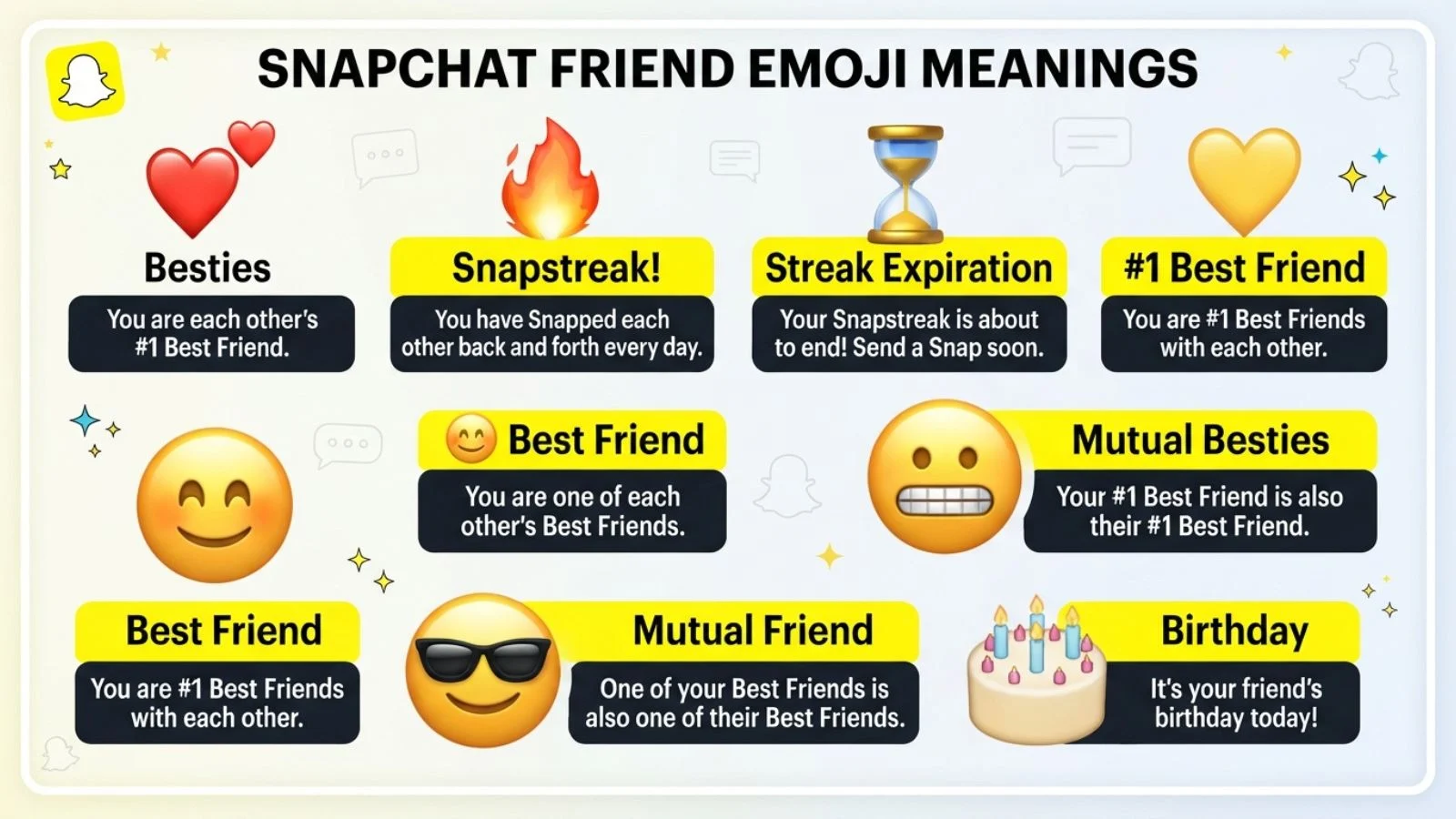
Ever glanced at your Snapchat friends list and noticed a tiny emoji sitting right next to someone’s name then wondered what on earth it actually means? You’re not alone.
Snapchat’s emoji system is one of the app’s most talked-about (and most misunderstood) features quietly tracking your friendships behind the scenes without ever explaining itself in plain language.
These little icons aren’t random decorations. Each one is Snapchat’s way of signalling something specific about your relationship with that person: how often you snap each other, how long you’ve been close, whether you share a streak and even if your “best friend” status is mutual.
In this guide we’re breaking down every Snapchat emoji and exactly what it means, how the underlying algorithm works, why your emojis might suddenly change and how you can customise them yourself. By the end you’ll never have to wonder again.
The History & Origin of Snapchat’s Emoji System
Snapchat’s friend emojis aren’t a recent add-on; they’ve been part of the app’s identity since the earliest days of its “Best Friends” feature. When Snapchat first introduced the concept it was a simple way to show users who they interacted with most displayed originally as a ranked list of usernames rather than emojis. This early version actually caused some controversy since it publicly revealed a user’s top contacts to anyone who viewed their profile leading to real-world social drama and jealousy among friend groups.
In response Snapchat evolved the feature into something more private and symbolic: instead of exposing a visible ranked list the app began assigning emojis next to each friend’s name visible only to the account holder. This shift transformed a semi-public popularity ranking into a personal discreet indicator of relationship dynamics.
Over the years Snapchat has refined the algorithm and expanded the emoji set adding new icons for streaks birthdays and mutual friend overlaps as the platform grew more sophisticated. The company has never published the exact formula behind the rankings, keeping the system intentionally mysterious, which is part of why so many users turn to guides like this one to decode it.
The broader reasoning behind the feature ties into Snapchat’s core philosophy: gamifying communication. By turning ordinary interactions into something with visible “status” and rewards (streaks hearts milestones) Snapchat encourages users to keep coming back and engaging daily reinforcing the habits that make the platform sticky.
How the Snapchat Emoji Algorithm Actually Works
At the core of every friend emoji is Snapchat’s “Best Friends” algorithm, a private ever-shifting calculation that ranks your relationships based on real interaction data. While Snapchat has never released the exact formula years of user observation and app analysis point to a few key factors driving the rankings.
The biggest signal is snap frequency: how often you and another person exchange snaps, not just messages or story views. Recency matters too; recent activity is weighted more heavily than snaps from weeks ago meaning your emoji tier can shift quickly if your habits change. The algorithm also appears to factor in mutual interaction meaning it’s not just about how much you snap someone but how much they snap back.
One of the most confusing aspects for users is that these rankings are one-directional. Your “Best Friend” emoji for someone doesn’t guarantee they’ve assigned you the same status. It’s entirely possible to be someone’s #1 Best Friend while they’re only a “Good Friend” on your list simply because your snapping habits with them differ from theirs with you.
The algorithm also recalculates continuously in the background not on a fixed schedule which is why emojis can update seemingly at random. And importantly all of this is private no one else can see the emoji you’ve assigned them nor can they see your full list of rankings. It’s a personalized one-way mirror into your own snapping behavior.
Full List of Snapchat Emojis & Meanings
Snapchat’s emoji system uses a tiered set of icons each signaling a different stage or type of relationship. Here’s a full breakdown.
Friendship-tier emojis track how close you are with someone. 😀 Grinning Face marks a Good Friend, someone you snap somewhat regularly but who hasn’t cracked your inner circle. 😊 Smiling Face means they’re one of your Best Friends. 😍 Heart Eyes signals your #1 Best Friend and it’s mutual you’re each other’s top snap partner. 💛 Yellow Heart appears when you’ve both just become #1 Best Friends. 💕 Two Pink Hearts show you’ve held that mutual #1 spot for two consecutive months upgrading to 💞 Rotating Hearts beyond that and eventually 💓 Beating Heart after six-plus months of consistency.
Streak and milestone emojis revolve around Snapstreaks. 🔥 Fire indicates an active streak paired with a number showing your day count. ⏳ Hourglass warns that a streak is about to expire. Hitting 💯 marks a 100-day streak milestone.
Social-status emojis reveal other dynamics. 👶 Baby flags a newly added friend. 😎 Sunglasses means you share a mutual best friend with that person. 😬 Grimace pops up in an awkward overlap your #1 best friend’s #1 is someone else close to you.
Streaks Explained in Depth
Snapstreaks are one of the most iconic and addictive parts of Snapchat’s emoji system so it’s worth understanding exactly how they work beyond the basic fire emoji.
A streak begins when you and a friend send each other snaps (not chat messages, not stickers, not story posts) within a 24-hour window and it continues as long as both of you keep the exchange going daily. Miss that 24-hour window even by minutes and the streak resets to zero. This is one of the most common points of confusion: many users assume any interaction counts but only direct snaps between the two of you keep the streak alive.
Snapchat does offer some flexibility through a “Streak Restore” option which appears if a streak breaks unexpectedly allowing users to request it back within a short grace period sometimes for a small fee.
There are also myths worth debunking. Chat messages, voice notes and even opening a friend’s story do not maintain a streak. Only actual snaps (photo or video) sent back and forth count.
Beyond the mechanics, streaks carry real emotional weight for many users. Long streaks can create a sense of obligation or “streak anxiety” where people feel pressured to keep sending snaps daily just to avoid losing progress even when the relationship itself has cooled. This social dynamic is part of why Snapchat’s streak feature is both loved and criticized.
What It Means When an Emoji Changes or Disappears
One of the more emotionally loaded aspects of Snapchat’s emoji system is watching a familiar icon shift or vanish entirely and wondering what it says about the relationship behind it.
A downgrade like seeing 😍 Heart Eyes replace itself with 😊 Smiling Face usually means your snap frequency with that person has dropped relative to your other friends. Since the algorithm ranks relationships comparatively this doesn’t necessarily mean you’re snapping less overall it can also happen because you’ve started snapping someone else more pushing your previous #1 down a tier. The same logic applies to hearts disappearing after months of consistency; a gap in mutual #1 status even temporarily can reset the streak toward Beating Heart or Rotating Hearts status.
A complete disappearance of an emoji is more significant: it typically means that person has dropped out of your Best Friends list altogether which requires a substantial and sustained drop in interaction.
It’s easy to over-interpret these shifts as reflections of how someone feels about you but real-world reasons are usually more mundane. People get busy switching primary communication apps, start dating someone new who takes up their snapping time or simply change habits temporarily during travel exams or work stress. A best friend introducing a new person into their top ranks doesn’t necessarily signal anything about your actual friendship; it often just reflects a temporary shift in daily habits.
Are Snapchat Emojis Visible to Others?
A common misconception about Snapchat’s emoji system is that it works like a public display of your friendships similar to a “close friends” list on other platforms. In reality the opposite is true: the emojis you see next to each friend’s name are entirely private and visible only to you.
This means the emoji you’ve assigned to a particular friend whether it’s 😍 Heart Eyes or 😀 Grinning Face cannot be seen by that person nor by anyone else who might view your account. Snapchat designed the system this way specifically to avoid the drama and hurt feelings that came from its earlier more public ranking system which openly displayed a user’s top contacts for anyone to see.
A frequent question that follows is whether the other person can “guess” their status based on the emoji they see for you. The answer is technically yes but only indirectly if they see 💛 Yellow Heart next to your name they know you’ve both just become mutual #1 Best Friends since that particular emoji only appears when the ranking is reciprocal. However one-sided emojis like Smiling Face or Grinning Face reveal nothing about how the other person ranks you since those are calculated independently for each user.
How to Customize Snapchat Emojis
While Snapchat’s core emoji system is automated the platform does give users some control over how these relationship tiers are visually represented letting you personalize the experience rather than relying solely on Snapchat’s defaults.
To customize your friend emojis open Snapchat and tap your profile icon in the top-left corner to access Settings. From there scroll down to the “Additional Services” section and select “Friend Emojis” (sometimes labeled “Friend Solar System” or similar depending on your app version). This menu displays every emoji category currently in use Best Friends #1 Best Friend Mutual Best Friends and more each with an editable slot next to it.
Tapping any category opens a full emoji keyboard allowing you to swap Snapchat’s default icon for any emoji of your choice. For example you could replace the default 😍 Heart Eyes for your #1 Best Friend with a custom emoji like 🥇 or ❤️🔥 that feels more personal to you.
It’s worth noting that not every emoji slot is customizable. Certain status indicators particularly ones tied to streak mechanics like 🔥 Fire and ⏳ Hourglass remain fixed and cannot be changed since they’re tied to core app functionality rather than purely cosmetic ranking.
If you ever want to revert to Snapchat’s original icons the same Friend Emojis menu includes a reset option restoring all categories to their default emoji set with a single tap.
Snapchat Emojis on Different Platforms/Versions
Since Snapchat operates across multiple operating systems it’s natural to wonder whether the emoji experience differs depending on whether you’re using an iPhone or an Android device and the answer involves a few nuances worth understanding.
The underlying emoji system, the categories algorithm and meanings remain identical across platforms. Whether you’re on iOS or Android the same friendship tiers, streak indicators and customization options apply equally since these are controlled by Snapchat’s own servers rather than the device itself.
However the visual appearance of the emojis can differ. Emoji rendering is handled by each operating system’s own emoji set rather than Snapchat itself meaning an emoji like 😍 Heart Eyes may look slightly different on an iPhone compared to a Samsung or Google Pixel device. This is the same reason emojis look different across texting apps in general Apple, Google and Samsung each maintain their own emoji designs based on the shared Unicode standard but with distinct artistic styles.
As for app updates Snapchat does periodically revise its emoji list occasionally introducing new icons or retiring old ones as part of broader feature updates. These changes typically roll out simultaneously across iOS and Android rather than favoring one platform since Snapchat aims for a consistent experience regardless of device.
One practical takeaway: if you’re troubleshooting an emoji that “looks wrong” or unfamiliar it’s often simply a rendering difference between devices rather than an actual meaning change within Snapchat’s system.
Common Misconceptions & Myths
With a feature as widely discussed as Snapchat’s emoji system it’s no surprise that plenty of myths have taken root, some harmless, others genuinely misleading about how the app actually works.
One of the most persistent myths is that the emoji system reveals who you have a “crush” on or who has a crush on you. In reality the algorithm has nothing to do with romantic interest; it’s purely a reflection of snap frequency and interaction patterns. Two people can rank as each other’s #1 Best Friend simply because they text through Snapchat more than other apps regardless of the nature of their relationship.
Another common confusion is conflating friend emojis with the separate “Snapchat Score” a numerical value tied to how many snaps you’ve sent and received overall. While related in spirit both reward frequent app usage the Score is a cumulative lifetime number whereas emojis reflect current comparative rankings among your specific friends. A high overall Score doesn’t guarantee any particular emoji status with an individual friend.
There’s also a widespread belief that emoji tiers are directly tied to who appears at the top of your Snapchat feed or Chat list. While there’s some overlap since both are influenced by recent activity they aren’t the same system and a friend’s position in your chat list doesn’t necessarily match their emoji tier.
FAQ Section
Why is there no emoji next to some friends?
Emojis only appear once a friendship crosses a certain interaction threshold. If you’ve only recently added someone or rarely snap them, Snapchat may not assign any emoji yet since there isn’t enough activity data to rank them.
Why did my best friend’s emoji suddenly change?
Sudden changes usually reflect a shift in relative snap frequency either when you’ve started snapping someone else more or the other person’s snapping habits with you have dropped even temporarily.
Do group chats or Snapchat stories have their own emojis?
No. The emoji system applies exclusively to one-on-one friend relationships based on direct snap exchanges. Group chat activity and story views aren’t factored into individual friend emoji rankings.
Can you have multiple #1 Best Friends?
No by definition only one friend can hold the #1 spot on your list at any given time since it represents your single most-snapped contact.
Does Snapchat+ affect emojis or unlock extra ones?
Snapchat+ (the paid subscription) offers additional features like enhanced Snapchat Score details and exclusive badges but it doesn’t fundamentally change the core friend emoji system or unlock new ranking emojis.
How do I know how many days are left on a streak?
Tap into the chat with that friend the streak count appears next to the fire emoji and Snapchat will display the hourglass warning once the streak is close to expiring.
Conclusion
Snapchat’s emoji system may look like a small playful detail at first glance but as this guide has shown it’s actually a surprisingly layered reflection of your digital friendships.
From the simple 😀 Grinning Face marking a casual connection to the hard-earned 💓 Beating Heart representing six-plus months of consistent closeness every icon tells a small story about how you and another person interact on the app.
Understanding the mechanics behind these emojis, the algorithm’s reliance on snap frequency and recency, the one-directional nature of rankings and the privacy built into the system helps demystify a feature that often causes more confusion (and occasional anxiety) than it should.
Streak hearts and status emojis are ultimately designed to reward engagement and add a layer of fun to everyday communication not to serve as a definitive measure of how much someone values a friendship.