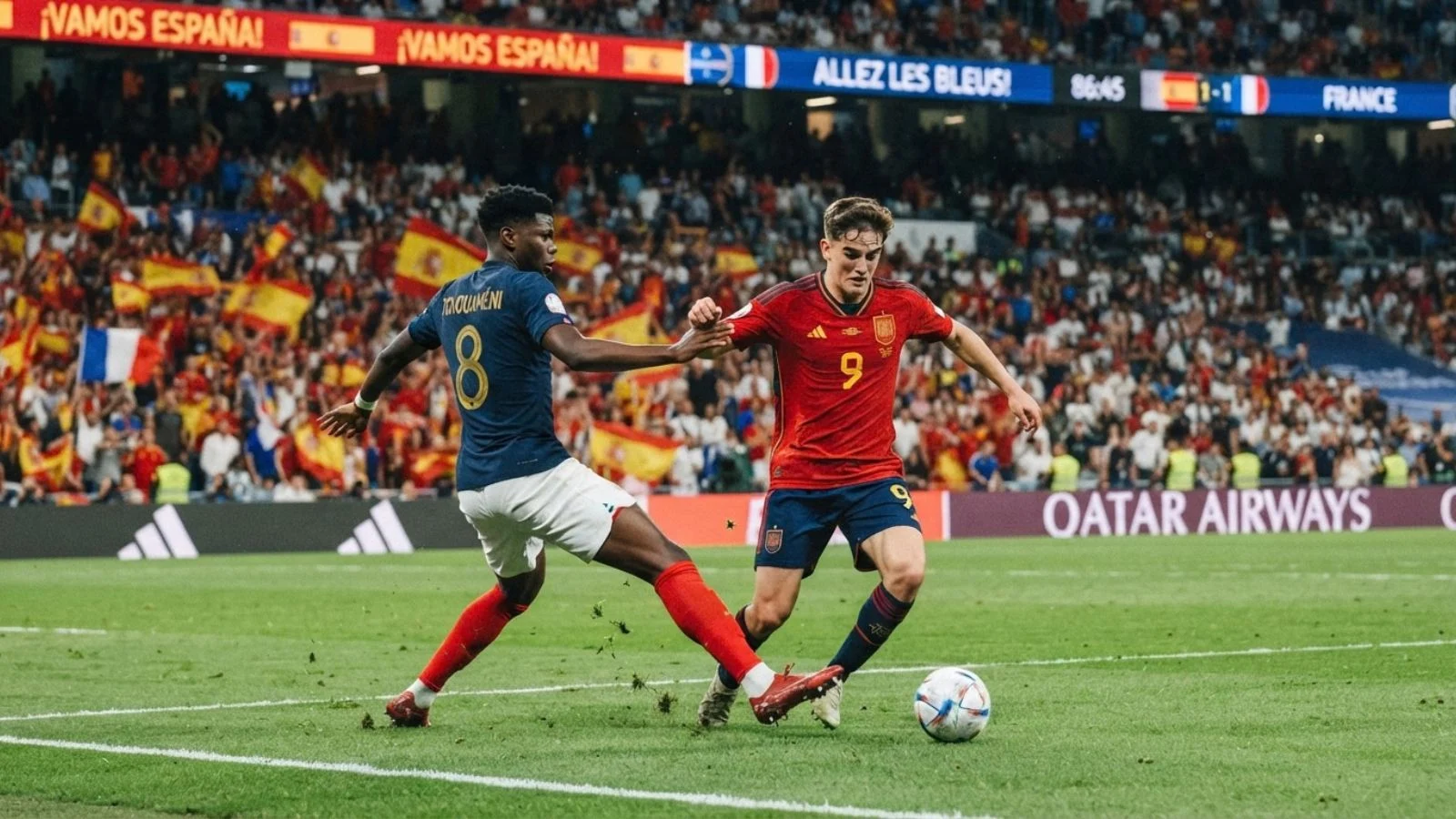
On a July afternoon in Arlington Texas two of football’s biggest powers met with a World Cup final place at stake.
Spain won 2-0 at AT&T Stadium with goals from Michel Orizaba and Pedro Porto and kept Lilian Mbabane, Housman December and Michael Oise largely under control.
It sent La Roja to their first World Cup final since 2010. But the scoreline tells only part of the story.
Spain vs France is more than a fixture. It is a clash of footballing philosophies. Spain builds everything on possession, patience and technical precision.
France counters with pace, power and an endless supply of individual brilliance. One team tries to control the game; the other waits to break it open.
So which approach is truly better? In this article we compare the two nations’ playing styles, youth academies head-to-head history tactics and star players then deliver a verdict on who holds the edge.
Two Footballing Identities
Spain: The Art of Control
Spain’s identity grew out of the possession-based ideas of Johan Cruyff’s Barcelona and reached its peak between 2008 and 2012 when La Roja won two European Championships and a World Cup with tiki-taka. The principle is simple: if you have the ball your opponent can’t hurt you. Short passes, constant movement and positional play pull defences apart while an immediate press after losing possession keeps the pressure on.
Under Luis de la Fuente that DNA remains but has evolved. Spain now combines its passing patterns with direct wing play from Lamine Yamal and Nico Williams plus greater defensive discipline. The side that won Euro 2024 and beat France this summer is more balanced than the tiki-taka teams of old.
France: The Power of Adaptability
France’s identity is harder to sum up in a phrase and that is the point. Les Bleus are pragmatic, adjusting their shape and approach to the opponent in front of them. Their strengths are athleticism, speed in transition, defensive solidity and a squad so deep that world-class players compete for every spot.
Didier Deschamps’ teams prioritised results over aesthetics winning the 2018 World Cup and reaching the 2022 final. With Kylian Mbappé, Ousmane Dembélé and Michael Olise, France can be lethal on the counter.
Philosophy Not Just Tactics
The contrast runs deeper than formations. Spain asks “How do we control the game?” France asks “How do we win it?”
Talent Development Systems
Spain: Technical Education from the Start
Spain’s style doesn’t appear by accident. It is taught. At Barcelona’s La Masia players learn positional play, passing angles and decision-making under pressure from a young age and the club’s academy has shaped generations of Spanish internationals. Lamine Yamal who tormented France this summer is the latest graduate to arrive at the top level as a teenager.
Real Madrid’s La Fábrica and the academies at Athletic Bilbao Villarreal and Valencia add to the pipeline. Across these clubs the emphasis is consistent: technique first, physical development second. The result is a national team whose players share a common footballing language before they ever pull on the shirt.
France: A Deep and Diverse Talent Pool
France’s system is built differently. The national academy at Clairefontaine brings together the country’s best young prospects while regional training centres and club academies at Lyon Monaco Rennes and Paris Saint-Germain feed the pipeline. Kylian Mbappé came through this route developing at Clairefontaine and Monaco.
France’s greatest advantage is its sheer talent pool. The Paris suburbs and other diverse communities produce athletic technically gifted players in extraordinary numbers, many of whom then move to Europe’s biggest clubs.
Different Systems Different Players
Spain’s academies tend to produce cohesive technically refined players who fit a collective system. France produces explosive individuals who can decide matches alone. Neither model is superior but they explain why the two teams play the way they do.
Head-to-Head History
This rivalry stretches back more than a century. The first meeting came in 1922 a 4-0 Spain win in a friendly and Spain lead the all-time series with 19 wins to France’s 13 plus seven draws. But much of that lead was built early because the first 61 years of the fixture were all friendly.
The rivalry only became truly competitive in 1984 when France beat Spain 2-0 in the European Championship final and won their first major trophy. France also took the Euro 2000 quarter-final 2-1 and the 2006 World Cup round of 16 by 3-1 with Zinedine Zidane inspiring an ageing side.
Then the balance shifted. Spain’s golden generation beat France 2-0 in the Euro 2012 quarter-final and the pattern has largely held since. France won the 2021 Nations League final 2-1 but Spain have taken four of the last five meetings including a 2-1 comeback in the Euro 2024 semi-final and a 5-4 thriller in the 2025 Nations League semi-final. Then came this summer’s 2-0 World Cup semi-final, only the second World Cup meeting between the nations. Spain went on to lift the trophy.
Tactical Breakdown
Formations. Spain lined up in a 4-2-3-1 in the semi-final with Rodri and Fabián Ruiz in the pivot, Dani Olmo behind the striker and Lamine Yamal and Álex Baena on the wings. France also used a 4-2-3-1 with Kylian Mbappé leading the line but it rarely functioned as a connected unit.
The midfield battle. This is where the match was won. Rodri stayed central instead of chasing the ball while Ruiz and Olmo narrowed the pitch around Tchouaméni and Rabiot. In possession Spain flowed into a 2-3-5 shape with the left-back and midfielder swapping roles to create overloads.
Attack. Modern Spain is more direct than the tiki-taka side of old. Quicker vertical transitions let wingers like Yamal isolate defenders one-on-one. France relied on individual quality from Mbappé Dembélé and Olise but Spain compressed the space around Olise and France didn’t manage a shot on target until stoppage time.
Defence. Out of possession Spain pressed in a 4-4-2 shape that shut down the passing lanes. France’s defensive plans also suffered when Saliba lasted only 30 minutes with an injury and they never seemed to recover.
Goalkeepers. Unai Simón’s sweeping cleaned up France’s attempts to get in behind while Mike Maignan’s poor passing hampered France’s build-up against Spain’s organised press.
The takeaway. Spain won through structure: short distances, compact spacing and clear roles. France had the individual talent but not the collective shape to use it.
Key Players and Rivalries
Mbappé vs Yamal: the headline duel. Kylian Mbappé finished as the tournament’s top scorer with 10 goals becoming the first player to win the Golden Boot twice and extending his World Cup scoring record to 22. Yet in the semi-final Spain largely silenced him. Lamine Yamal by contrast won the foul that led to Spain’s opening penalty and before that match had made more shot-ending carries than any other forward at the tournament.
Rodri: the conductor. Rodri was named the tournament’s best player and took home the Golden Ball. Against France he held the centre and let the game come to him with the discipline that defines Spain’s midfield.
The last line of defence. Goalkeeper Unai Simón conceded just one goal all tournament and set a World Cup record of 650 consecutive minutes without conceding. In front of him centre-back Pau Cubarsí was named Best Young Player beating teammate Yamal to the award.
France’s supporting cast. Ousmane Dembélé scored six goals and gave France a dangerous second threat. Michael Olise however underwhelmed in the semi-final and was substituted after 72 minutes one of several French attackers who never found space against Spain’s compact shape.
The next generation. Both teams are young and deep. Yamal and Cubarsí are only at the beginning of their careers while France has Olise Bradley Barcola and Désiré Doué coming through. That suggests this rivalry will keep producing headline duels.
Tournament Records and Major Honours
On the honours board the two nations are remarkably close.
| World Cup | European Championship | Nations League | |
| Spain | 2 (2010 2026) | 4 (1964 2008 2012 2024) | 1 (2023) |
| France | 2 (1998 2018) | 2 (1984 2000) | 1 (2021) |
Spain: dominant peaks, perfect finals. This summer’s triumph gave Spain a second World Cup sixteen years after their first and both World Cup finals they have reached ended in victory. Their four European titles are the most of any nation. Euro 2024 showed that the golden era of 2008-2012 was no one-off.
France: sustained excellence. France have played in four World Cup finals (1998 2006 2018 2022) winning two. That consistency across different generations is one of the great achievements in modern football. This summer though they finished fourth beaten by Spain in the semi-final and then by England in the third-place match.
How to read the numbers. The trophy count is level at the World Cup and the Nations League and Spain lead in European titles. Spain’s story is one of peaks. They win big when they arrive and they arrive rarely. France’s is one of endurance with repeated deep runs. Which matters more depends on what you value: trophies or consistency.
The current picture. Right now Spain holds both the European and world titles and the momentum is with them.
Club Football Influence
Spain: built in Barcelona. Spain’s squad is overwhelmingly rooted in domestic football: 17 of the 26 players play in La Liga with seven in the Premier League and one each in the Bundesliga and Ligue 1. Barcelona supplied by far the most players including Yamal Cubarsí Pedri and Olmo. That matters because many of them already share the same patterns of play from their club which reinforces the national team’s style. It was also the first World Cup in which Spain had no Real Madrid players with de la Fuente picking on form rather than club allegiance. Spain National Team 2026: All 26 World Cup Players And Club Teams +2
France: a league-spanning squad. France’s talent is spread more widely. The squad included seven Premier League players and five from Paris Saint-Germain among them Dembélé Doué and Barcola. Others play for Real Madrid (Mbappé Tchouaméni) Bayern Munich (Olise Upamecano) AC Milan (Maignan Rabiot) and clubs in Turkey and Saudi Arabia. World Cup PassHEAVY
What it means. This helps explain the two teams’ identities. Spain’s players arrive with a shared football language which produces cohesion. France’s players bring varied experience from many leagues which produces individual strength but as the semi-final showed sometimes less collective rhythm.
The pipeline. Spain’s pipeline runs from academy to La Liga to the national team, a closed loop that reproduces its style. France exports talent across Europe’s biggest leagues which keeps its supply of stars diverse and deep.
Culture and Fan Perspective
Spain: pride in the way they win. Spanish football culture prizes style as much as results and this summer showed how far that pride runs. After the World Cup triumph officials estimated around 1.8 million people turned out in Madrid for an open-top bus parade. Around 120000 gathered at Cibeles Square for the main celebration. Prime Minister Pedro Sánchez thanked the squad for its style of play as well as its victory. After the semi-final win over France a young fan told reporters that many people had written Spain off before the match.
France: the burden of expectation. French supporters expect greatness. Les Bleus arrived ranked third in the world and were seen as pre-tournament favourites so a semi-final exit and fourth-place finish felt like falling short. It also marked the end of an era since Didier Deschamps was leaving after 14 years in charge.
Two national narratives. In Spain football is a source of shared identity, the story of a team playing the “right way” and winning with it. In France the culture is more results-driven and pragmatic: trophies matter most and individual stars carry the hopes of the nation. Neither view is better but they shape how each country judges its team and even how it defines success.
The rivalry today. After a run of Spanish wins the old question of style versus substance has moved in Spain’s favour.
The Verdict
Weighing the evidence Spain holds the edge today though not by as much as the 2-0 scoreline suggests.
Why Spain won the present. They are the reigning world and European champions and they have taken four of the last five meetings between the two sides. Their World Cup run was built on control: Unai Simón conceded just one goal all tournament. Rodri set the tempo and the semi-final showed a team that had solved France’s attack through structure and discipline. Their system from the Barcelona-heavy squad to the academy pipeline is designed to reproduce this style.
Why does France stay dangerous? Talent is never France’s problem. Mbappé won the Golden Boot with 10 goals and Dembélé, Olise Doué and Barcola give them pace and depth that few nations can match. The honours record is level at the World Cup and their sustained excellence across generations is remarkable. The question is collective shape and it will come with a change of manager since Deschamps was leaving after 14 years.
Looking ahead. Over the next five to ten years I’d still learn Spain largely because of the age and cohesion of their core. Cubarsí was named Best Young Player and Yamal is still only at the beginning of his career. But France’s talent supply is so reliable that a strong new coach could close the gap quickly.
The final call: Spain won on style and the current moment France on depth and consistency. For now control has beaten chaos but not for good.
FAQ: Spain vs France
Who is better, Spain or France?
Right now Spain. They are the reigning world and European champions and have won four of the last five meetings. Over the long run though the two nations are level with two World Cups each and France’s talent pipeline keeps them a constant threat.
What is the all-time head-to-head record?
Across 39 meetings Spain have won 19 France 13 and seven ended in draws.
What was the score in the 2026 World Cup semi-final?
Spain won 2-0 at AT&T Stadium in Arlington on July 14 with goals from Mikel Oyarzabal in the 22nd minute and Pedro Porro in the 58th.
Why did Spain beat France?
Spain’s compact structure did the damage. Rodri held the centre while Fabián Ruiz and Dani Olmo squeezed the space around France’s midfield leaving Mbappé Dembélé and Olise isolated. France didn’t manage a shot on target until stoppage time.
Who won the 2026 World Cup?
Spain beat Argentina 1-0 after extra time in the final with Ferran Torres scoring the winner.
Which is the better style: Spain’s tiki-taka or France’s counter-attack?
It depends on what you value. This summer favoured Spain’s controlled possession-based approach but France’s adaptability and pace have won two World Cups of their own.
Conclusion:
Spain vs France has always been more than a fixture. This summer it became a statement. In Arlington Spain beat France 2-0 with goals from Orizaba and Porto then went on to win the World Cup taking the final 1-0 after extra time.
Rodri collected the Golden Ball Unai Simón conceded just once all tournament and Pau Cubarsí was named Best Young Player.
France meanwhile still had the tournament’s top scorer in Kylian Mbappé who finished with 10 goals.
That is the heart of this rivalry: Spain wins through structure, cohesion and control while France wins through pace, power and individual brilliance.
The numbers tell the same story of balance. Spain lead the all-time series 19 wins to 13 across 39 meetings and they have taken four of the last five.
Yet the two nations are level on World Cups and France’s talent pipeline shows no sign of slowing down.