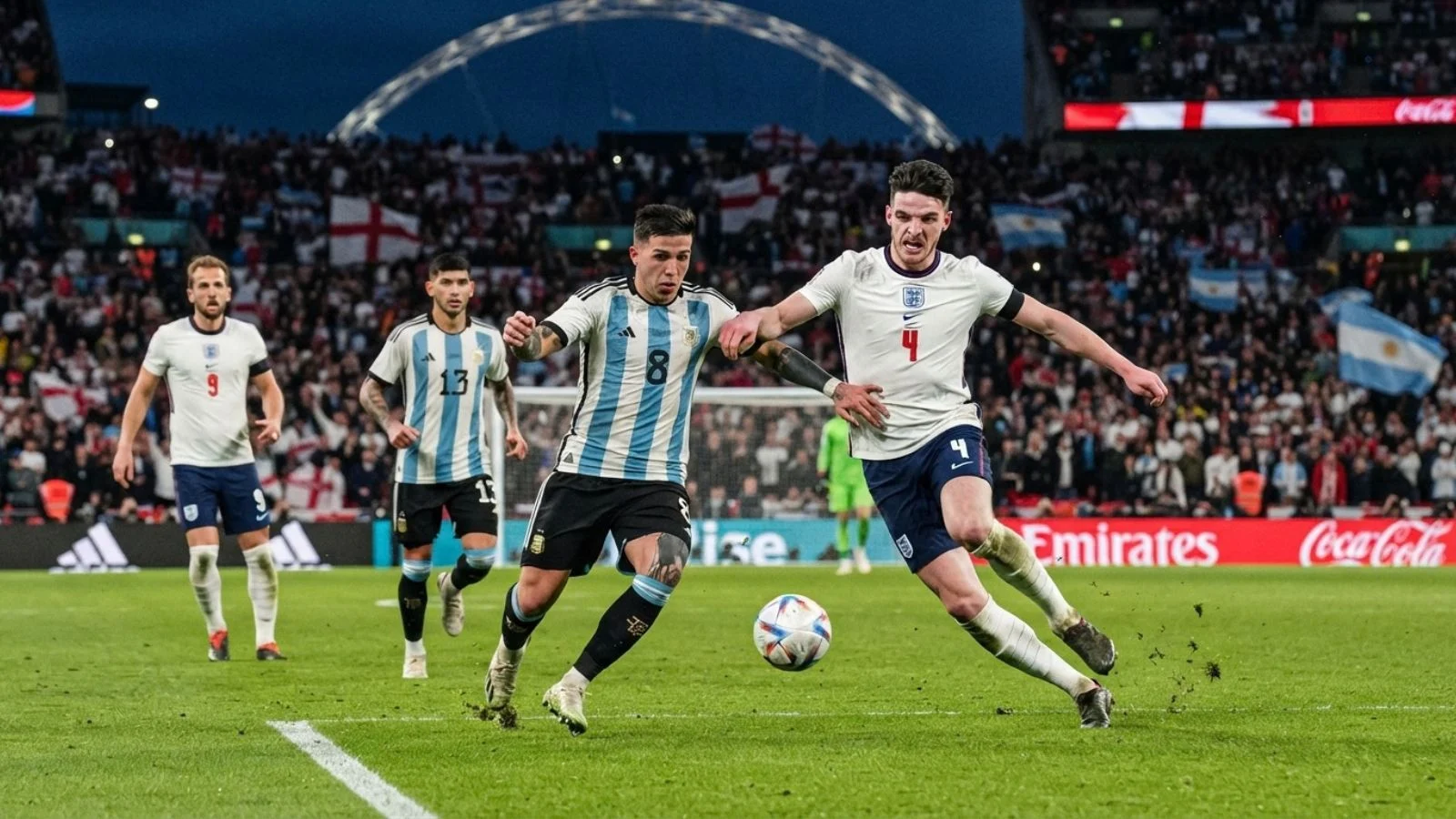
Mexico City 22 June 1986. Six minutes into the second half Diego Maradona leaps beside England goalkeeper Peter Shilton and steers the ball into the net with his hand. The referee allows it.
Four minutes later he dribbles past half the England team to score what many still call the greatest goal ever seen. Two goals one afternoon and a rivalry that has never truly cooled.
England vs Argentina is more than a football fixture. It is a story of controversy at Emblem in 1966, a war that cast a shadow over the game in 1982, a red card that broke English hearts in 1998 and a penalty that healed them in 2002. Each meeting adds a new chapter and each carries the weight of the last.
In this article we trace the history of the England Argentina rivalry from its early roots to its most explosive moments and ask why it still matters today.
Setting the Stage: Two Football Cultures
Before the goals, red cards and headlines there are two nations that see football in very different ways.
England likes to say it gave the game to the world. The Football Association was founded in 1863 a rulebook followed and English railway workers, sailors and merchants carried the sport far beyond Britain’s shores including to Buenos Aires. At home football is a matter of heritage: Wembley’s famous arch, the FA Cup and a fan culture that sings about the game “coming home” whenever a major tournament begins. Yet England has won just one World Cup in 1966 and that single triumph casts a long shadow over every generation since.
Argentina took the game it was handed and made it its own. Played on rough neighbourhood pitches known as potreros Argentine football prized dribbling improvisation and cunning a quality often described as viveza criolla or street smarts. The country reveres the número 10, the playmaker who carries the team’s imagination from Maradona to Messi. World Cup wins in 1978 1986 and 2022 have made football close to a national religion.
Each side sees the other through its own lens. England admires Argentine flair but distrusts the theatrics. Argentina respects English history but bristles at what it sees as arrogance. Put those two views on the same pitch and the tension is already there before a ball is kicked.
The Early Meetings
The rivalry did not begin with fury. In its earliest chapters England vs Argentina felt more like a lesson than a feud. British railway workers, sailors and expatriates had helped spread football across Argentina in the late nineteenth century so early meetings carried the feeling of a student facing the teacher.
The first official match came at Wembley on 9 May 1951 as part of the Festival of Britain celebrations. England won 2-1 but the occasion mattered for more than the score. It gave English supporters a rare close look at a South American side and the visitors’ technical confidence drew attention.
Two years later the return fixture in Buenos Aires ended in farce. A violent storm turned the pitch into a swamp and the match was abandoned at 0-0 after only 21 minutes. It was hardly the dramatic clash the two nations would later become known for.
The next significant meeting came at the 1962 World Cup in Chile. England won 3-1 in the group stage a result that helped carry them into the quarter-finals while Argentina went home early. It was a competitive game but not a bitter one.
Through all of these encounters the mood stayed largely respectful. The crowds were curious, the football was decent and the hostility was still to come. That changed at Wembley in 1966.
1966: Where the Bad Blood Began
Everything changed on 23 July 1966. England and Argentina met in the World Cup quarter-final at Wembley and what should have been a football match became a flashpoint that both nations still remember.
The trouble started early. In the 35th minute Argentina’s captain Antonio Rattín was sent off by West German referee Rudolf Kreitlein reportedly for dissent. Rattín, who spoke no German and wanted an interpreter, refused to go. The game stopped for several minutes as he argued and he finally left the pitch only after a long defiant walk that included sitting on the royal red carpet at the side of the field.
England, playing against ten men, struggled to break through until the 78th minute when Geoff Hurst headed in a Martin Peters cross to win 1-0. England went on to lift the trophy but the manner of the victory left a sour taste.
After the final whistle manager Alf Ramsey stopped his players from swapping shirts with the Argentines and called the opposition “animals” a remark that was widely reported and never forgotten. In Argentina the match was framed as a robbery and the sense of injustice took root.
The Political Backdrop: The 1982 Falklands/Malvinas War
Football rarely exists apart from the world around it and the England Argentina rivalry cannot be told honestly without the events of 1982.
On 2 April Argentina’s military government sent forces to seize the Falkland Islands known in Argentina as the Islas Malvinas. Britain responded by sending a naval task force across the Atlantic. The conflict lasted just over ten weeks and ended with Argentina’s surrender on 14 June. Around 255 British service personnel and about 650 Argentine personnel died along with three Falkland Islanders. Both nations still carry the memory of those losses and this article treats them with respect.
The war added a new emotional layer to football. A fixture that had once been about tactics and the occasional bad tackle now carried echoes of a real conflict. Fans, the press and even players began to see each meeting as more than sport.
The effects reached English football directly. Argentine stars Ossie Ardiles and Ricardo Villa were playing for Tottenham Hotspur when the war began. Ardiles left on loan to Paris Saint-Germain while the fighting continued and both men faced an uncomfortable period far from home.
Neither side met the other at the 1982 World Cup but the shadow of the war stretched forward. When England and Argentina finally faced each other again in a major tournament in Mexico City in 1986 the atmosphere was very different from anything that came before.
1986: The Match of Two Goals
On 22 June 1986 England and Argentina met in the World Cup quarter-final at Mexico City’s Estadio Azteca four years after the Falklands War. Both camps played down the politics beforehand but the tension was impossible to miss.
The first half was tight and goalless. Then in the 51st minute came the moment that made history. Steve Hodge’s miscued clearance looped back towards the England box and Diego Maradona barely 5ft 5in rose beside Peter Shilton and punched the ball into the net. The Tunisian referee Ali Bin Nasser and his linesman missed it and the goal stood. Afterwards Maradona said it was scored “a little with the head of Maradona and a little with the hand of God”. The name stuck.
Four minutes later he produced something entirely different. Picking up the ball in his own half Maradona ran around 60 yards weaving past Beardsley Reid Butcher and Fenwick before rounding Shilton to score. In 2002 a FIFA poll named it the Goal of the Century.
England hit back late. Substitute John Barnes created a chance for Gary Lineker who headed home but it was not enough. Argentina won 2-1 and went on to lift the trophy while Lineker finished as the tournament’s top scorer with six goals.
The 1990s: Wembley Friendlies and a Fragile Calm
After the drama of Mexico the rivalry settled into a quieter chapter. No major tournament draw put the two nations together and the years that followed were marked more by rebuilding than by rage.
Both teams had enjoyed strong runs at Italia 90. Argentina led by Maradona reached the final and lost to West Germany while England finished fourth after a semi-final penalty shootout defeat to the same opponents. Each nation left Italy believing its best years were still ahead.
The two met again at Wembley on 25 May 1991 in a friendly that ended 2-2. With no trophy at stake the atmosphere was lighter than in 1986 though the history hung over the stadium anyway. It showed that England and Argentina had become football’s most emotionally loaded opponents even when the result meant little.
Elsewhere their paths diverged. Argentina won the Copa América in 1991 and 1993 but Maradona’s career unravelled after a failed drugs test at the 1994 World Cup. England missed that tournament altogether then rebuilt as hosts of Euro 96 where they reached the semi-finals.
By the late 1990s a fresh generation was emerging: Batistuta Simeone and Zanetti for Argentina and Shearer Beckham and a young Michael Owen for England. Few could have guessed how quickly the two sides would collide again or how dramatic it would be.
1998: Saint-Étienne
England and Argentina met again at the 1998 World Cup in France in a round-of-16 tie at Saint-Étienne on 30 June. It became one of the most thrilling and painful matches in England’s history.
The action began at breakneck pace. Gabriel Batistuta scored a penalty in the sixth minute and Alan Shearer levelled from the spot minutes later. Then came the goal that made a star. Michael Owen, just 18, collected the ball in midfield, raced past two defenders and fired into the top corner. Just before half-time Javier Zanetti equalised from a free-kick routine and the sides went in at 2-2.
The turning point came shortly after the restart. Diego Simeone fouled David Beckham and Beckham lying on the ground flicked a foot at him. Simeone fell and Danish referee Kim Milton Nielsen showed Beckham a red card.
Ten-man England defended bravely through extra time. Sol Campbell headed in what looked like a winner but it was ruled out for a foul by Shearer. The tie went to penalties. David Seaman saved from Hernán Crespo but Paul Ince and David Batty were both denied by Carlos Roa and Argentina won the shootout 4-3.
Beckham took the blame. He was jeered at grounds across England, attacked in the tabloids and even hanged in effigy outside a London pub. It was a lesson in how quickly a hero can become a villain in English football.
2002: Redemption in Sapporo
Four years after Saint-Étienne, England and Argentina were drawn together again, this time in Group F at the 2002 World Cup in Japan. Newspapers called it the “group of death” with Sweden and Nigeria also in the mix and this match was the one everyone wanted to see.
It took place at the Sapporo Dome on 7 June. Argentina coached by Marcelo Bielsa arrived as one of the tournament favourites with Batistuta Crespo Verón and Ortega in their squad. England led by Sven-Göran Eriksson were widely seen as the underdogs.
For David Beckham the game was personal. He had spent four years as a target for English tabloids and fans and he had only just recovered from a broken bone in his foot which had put his World Cup place in doubt. Now he was England’s captain.
The decisive moment came just before half-time. Michael Owen ran into the box and Mauricio Pochettino brought him down. Italian referee Pierluigi Collina pointed to the spot. Beckham placed the ball, stepped up and drove it past goalkeeper Pablo Cavallero in the 44th minute. He wheeled away with his hands and lifted the weight of 1998 lifted.
England held on to win 1-0. Argentina then drew with Sweden and were eliminated in the group stage, one of the biggest shocks of the tournament. For Beckham it was redemption. For Argentina it was a painful end.
Later Meetings and the Modern Era
After Sapporo the rivalry drifted back into friendlies. The highest-scoring meeting was a 3-2 England win on 12 November 2005 but matches like that carried little weight. Overall the two sides have met 15 times with England holding a narrow edge in official wins six to four. WikipediaWikipedia
Then in 2026 the rivalry returned to the biggest stage. England and Argentina met in the World Cup semi-final at Atlanta’s Mercedes-Benz Stadium on 15 July with a place in the final at stake. Sofascore
The first half was cagey and goalless. Anthony Gordon gave England the lead early in the second half and Alexis Mac Allister then hit the post with a header as Argentina pressed for an equaliser. England held firm until the 85th minute when Enzo Fernández levelled with a strike from distance created by Lionel Messi. Deep into stoppage time substitute Lautaro Martínez headed in the winner again from a Messi cross. England 1 – 2 Argentina – Match Report & Highlights +3
Argentina, the defending champions, advanced to a final against Spain while England dropped into the third-place play-off against France. It was the third time Argentina had knocked England out of a World Cup after 1986 and 1998.
The Players Who Crossed Over
For all the tension between the national teams football has a way of dissolving borders at club level. Over the decades Argentine players have become some of the best-loved figures in English football.
The story starts with Ossie Ardiles and Ricky Villa who joined Tottenham Hotspur in 1978 when very few overseas players had ever played in England. Villa scored one of the most celebrated goals in FA Cup history in the 1981 final replay, a slaloming run past several defenders against Manchester City. Ardiles meanwhile became a Tottenham great.
Later generations followed. Carlos Tevez became a cult hero at Manchester United and then Manchester City. Javier Mascherano brought steel to Liverpool’s midfield. Pablo Zabaleta earned near-legendary status at City for his fearless defending and his teammate Sergio Agüero wrote himself into history in May 2012 when a stoppage-time goal against QPR clinched City’s first Premier League title.
More recently Argentine players such as Alexis Mac Allister Enzo Fernández Cristian Romero and Emiliano Martínez have played in the Premier League and English fans have cheered them week after week.
There is even a coaching link. Mauricio Pochettino whose foul on Michael Owen led to Beckham’s penalty in 2002 later managed both Tottenham and Chelsea.
Fans Media and Culture
Away from the pitch the England Argentina rivalry lives in stadium songs, tabloid headlines and the stories each country tells itself.
In England the press has long framed the fixture in the language of battle. Headlines after 1986 raged about cheating while the aftermath of 1998 turned David Beckham into a national villain almost overnight. Argentine media by contrast celebrate the same matches with pride. “La Mano de Dios” and “el Gol del Siglo” are treated as pieces of national folklore and Maradona’s nickname “El Pibe de Oro” (the Golden Boy) sits comfortably beside England’s “Three Lions” in the shared vocabulary of football.
Supporters shape the mood too. Argentine fans are famous for travelling in huge numbers and singing through entire matches while England’s followers bring their own noise humour and a long memory for past defeats. Both sets of fans know exactly which moments to bring up when the two teams meet.
Objects from these matches have become cultural treasures. Steve Hodge’s shirt swapped with Maradona after the 1986 quarter-final sold at auction in 2022 for around £7 million a sign of how valuable the memory of that afternoon remains.
Social media has added a new layer turning old clips and grudges into memes within seconds. Yet the tone is often more playful than hostile. For most fans today the rivalry is a mixture of banter and deep respect with just enough edge to keep it alive.
The Tactical Contrast
Beyond the drama, England and Argentina have long approached football in different ways and those differences help explain why their matches are so hard to call.
Traditionally England favoured pace, width and directness. The classic English side played a 4-4-2 delivered crosses from the flanks and won the ball back with physical commitment. Argentina, shaped by generations of dribbling on cramped neighbourhood pitches, valued technique, close control and a creative playmaker at the heart of the team.
Argentina’s own tactical debate added another layer. Two schools of thought menottismo after César Luis Menotti who won the 1978 World Cup and bilardismo after Carlos Bilardo who won in 1986 argued over whether the team should play with flair or with discipline. Bilardo’s 1986 side blended both pairing a well-organised defence with Maradona’s brilliance.
Over time the two styles have moved closer together. English coaches have embraced possession play and pressing while Argentina under Lionel Scaloni has become compact, flexible and difficult to break down without losing its creativity.
The 2026 semi-final showed the contrast in action. After Gordon’s opener England sat deep to protect their lead. Argentina still created far more with an expected-goals total of 1.84 from 15 attempts against England’s 0.53 from five shots. Messi set up both of Argentina’s goals and patience eventually beat pragmatism.
The Rivalry in Numbers
Statistics can’t capture the drama of England vs Argentina but they show how evenly matched the two sides have been.
| Category | Record |
| First meeting | 9 May 1951 England 2-1 Argentina (friendly) |
| Total meetings | 15 |
| Official wins | England 6 Argentina 4 |
| World Cup wins | England 3 (1962 1966 2002); Argentina 3 (1986 1998 on penalties 2026) |
| Knockout ties | Argentina leads 3-1 |
| Top scorer | Michael Owen (3 goals) |
| Biggest wins | England 3-1 (1962 and 1980) |
| Highest-scoring game | Argentina 2-3 England (2005) |
Two things stand out. England hold the overall edge in official matches yet the World Cup record is perfectly level at three wins each. The real difference appears in the knockout rounds. Argentina have eliminated England from the World Cup in 1986 1998 and 2026 while England have done the same to Argentina only once in 1966.
What the Rivalry Means Now
If anyone thought time had softened England vs Argentina the 2026 semi-final proved otherwise. It had a cagey opening and England lead flashpoints between the two sides late on and a stoppage-time winner. Fans will retell it for decades. ESPN
For England the defeat stung in a particular way. A win would have sent them to their first World Cup final since 1966. Instead they were left to wonder again why Argentina so often seems to stand between them and history. Manager Thomas Tuchel has confirmed he will stay on for Euro 2028 which England will co-host giving the squad a chance to answer. Sky SportsSky Sports
For Argentina the result extended a remarkable run sending them to a second consecutive World Cup final. It also confirmed a familiar pattern: when the stakes are highest they find a way often through Messi. CNN
That may be what keeps the rivalry alive. Each side gets something from the other. England gets a measuring stick and a reminder of what it takes to win when it matters. Argentina gets an opponent that pushes it to its limits and gives its victories extra meaning.
The two nations may never agree on 1966 or 1986. But every new meeting adds another layer and the next one whenever it comes will carry more history than almost any other fixture in football.
That imbalance helps explain the tone of the rivalry. England’s wins have tended to come in group games and friendlies while Argentina’s have arrived in the moments that define tournaments and those are the ones that are remembered.
Conclusion
Go back to Mexico City 1986. A hand a run and two goals that split an afternoon between cheating and genius.
Four decades on that moment is still the first thing many fans think of when they hear “England vs Argentina.”
But the rivalry has never belonged to a single match. It began with a red carpet and a refusal to leave the pitch in 1966.
It gained a heavier meaning after the Falklands War in 1982. It gave us a teenage Michael Owen a red card that broke English hearts in 1998 a Beckham penalty that mended them in 2002 and a stoppage-time header in Atlanta in 2026 that sent Argentina to another final.
Along the way the rivalry has taught both nations something. England has learned how thin the line is between glory and heartbreak.
Argentina has shown how belief, cunning and a great number 10 can carry a team through the hardest moments. Off the pitch players like Ardiles Agüero and Mac Allister prove that respect can grow even between fierce opponents.