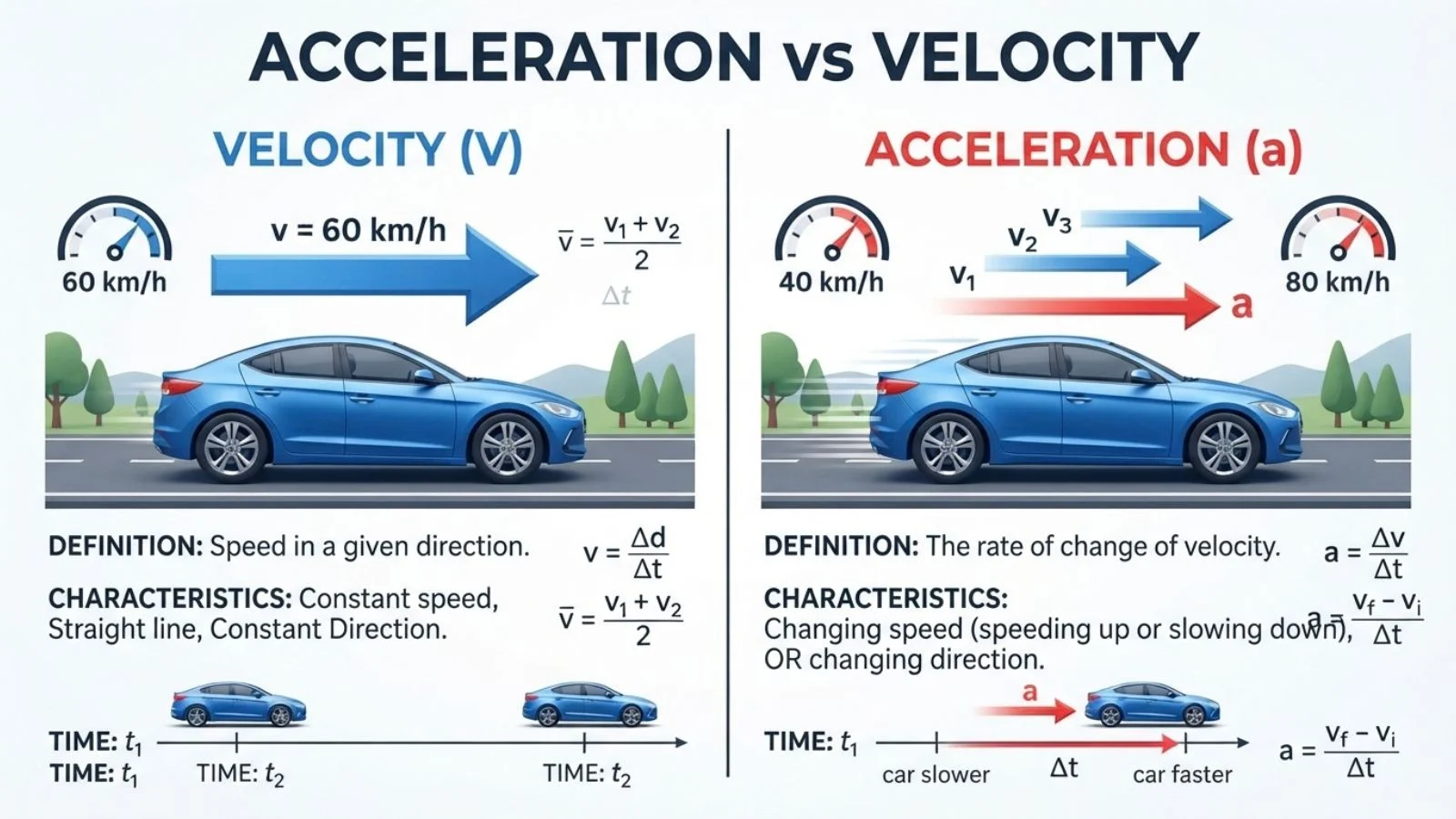
Velocity measures how fast an object moves in a specific direction, expressed in meters per second (m/s).
Acceleration measures how quickly that velocity changes over time, expressed in meters per second squared (m/s²). I
n short: velocity tells you how fast you’re going, while acceleration tells you how fast your speed or direction is changing.
Key Takeaways
- Velocity is a rate of change of position (speed with direction).
- Acceleration is a rate of change of velocity.
- Both are vector quantities; they depend on direction, not just size.
- An object can move at constant velocity with zero acceleration.
- An object can have acceleration even while momentarily at rest (like a ball at the top of a throw).
What Is Velocity?
Velocity describes how fast an object’s position changes over time, and in which direction it’s moving. It’s not the same as speed. Speed only tells you how fast something is going. Velocity tells you how fast and which way.
A car traveling 60 mph north has a different velocity than a car traveling 60 mph south, even though both have the same speed.
Velocity Formula
Velocity (v) is calculated as:
v = Δd / Δt
Where Δd is the change in displacement (position) and Δt is the change in time.
Units of Velocity
Velocity is measured in meters per second (m/s) in the metric system, or miles per hour (mph) in everyday U.S. usage.
What Is Acceleration?
Acceleration describes how quickly velocity changes whether an object is speeding up, slowing down, or changing direction. If velocity stays exactly the same, acceleration is zero, no matter how fast the object is moving.
This is the part people often find confusing: acceleration isn’t about speed itself. It’s about change in speed or direction.
Acceleration Formula
Acceleration (a) is calculated as:
a = Δv / Δt
Where Δv is the change in velocity and Δt is the change in time.
Units of Acceleration
Acceleration is measured in meters per second squared (m/s²), because it describes a change in velocity (m/s) over time (s).
Acceleration vs Velocity: The Key Difference
The simplest way to remember the difference: velocity measures motion, acceleration measures the change in motion.
| Feature | Velocity | Acceleration |
| What it measures | How fast and in what direction an object moves | How fast velocity is changing |
| Formula | v = Δd / Δt | a = Δv / Δt |
| Units | m/s | m/s² |
| Type of quantity | Vector | Vector |
| Can it be zero while moving? | No (zero velocity means not moving) | Yes (constant speed = zero acceleration) |
| Can it be zero while still? | Yes (object at rest) | Yes, or non-zero if forces are acting |
Can You Have Velocity Without Acceleration?
Yes. If an object moves at a constant speed in a straight line, its velocity is non-zero, but its acceleration is zero, because velocity isn’t changing. A car on cruise control on a straight, flat highway is a good real-world example.
Can You Have Acceleration Without Velocity?
Yes, this one surprises a lot of people. Throw a ball straight up in the air. At the very top of its path, its velocity is momentarily zero; it’s not moving up or down. But gravity is still pulling on it, so acceleration is still acting on it (about -9.8 m/s² on Earth). The ball is about to start moving again because of that acceleration, even though its velocity was zero for an instant.
Real-Life Examples
- Velocity example: A train moving at a steady 80 mph east has constant velocity and zero acceleration.
- Acceleration example: A car speeding up from 0 to 60 mph in 6 seconds has a high acceleration, even though it started at zero velocity.
- Both changing: A roller coaster speeding up on a drop and slowing down on a curve has constantly changing velocity, which means it has acceleration throughout the ride.
- Direction change: A car turning a corner at a steady speed is still accelerating, because its direction and therefore its velocity is changing, even if its speed stays the same.
What Is Negative Acceleration (Deceleration)?
When an object slows down, it has negative acceleration, sometimes called deceleration. This simply means the acceleration is acting in the opposite direction to the velocity. A car braking from 60 mph to 0 mph has negative acceleration relative to its direction of travel.
Common Mistakes People Make
- Treating speed and velocity as identical. Speed has no direction; velocity does.
- Assuming acceleration only means “speeding up.” Slowing down, or simply changing direction at a constant speed, both count as acceleration.
- Assuming zero velocity means zero acceleration. As shown with the thrown ball, an object can be momentarily still and still be accelerating.
- Mixing up units. Velocity is in m/s; acceleration is in m/s². Dropping the “squared” is a common error in homework and test answers.
FAQs
What is the main difference between velocity and acceleration?
Velocity measures how fast and in what direction an object is moving. Acceleration measures how quickly that velocity is changing, whether in speed, direction, or both.
Is acceleration a vector or a scalar?
Acceleration is a vector quantity, meaning it has both magnitude and direction, just like velocity.
What is negative acceleration called?
Negative acceleration is often called deceleration. It means the object’s velocity is decreasing, or its acceleration points opposite to its motion.
How do you calculate acceleration from velocity?
Subtract the initial velocity from the final velocity, then divide by the time it took for that change to happen: a = (final velocity − initial velocity) / time.
Can speed and velocity ever be the same number?
Yes, when an object moves in a straight line without changing direction, its speed and the magnitude of its velocity will be the same number.
Conclusion
Velocity and acceleration are both about motion, but they answer different questions. Velocity tells you how fast something is moving and in which direction.
Acceleration tells you how quickly that velocity is changing if the object is speeding up, slowing down, or turning.
An object can have velocity with zero acceleration (steady speed in a straight line), and it can even have acceleration with zero velocity for an instant (like a ball at the top of its arc).
Keeping this distinction clear makes it much easier to understand motion, whether you’re studying for a physics exam or just trying to explain why a car “speeding up” and a car “cruising” behave so differently.