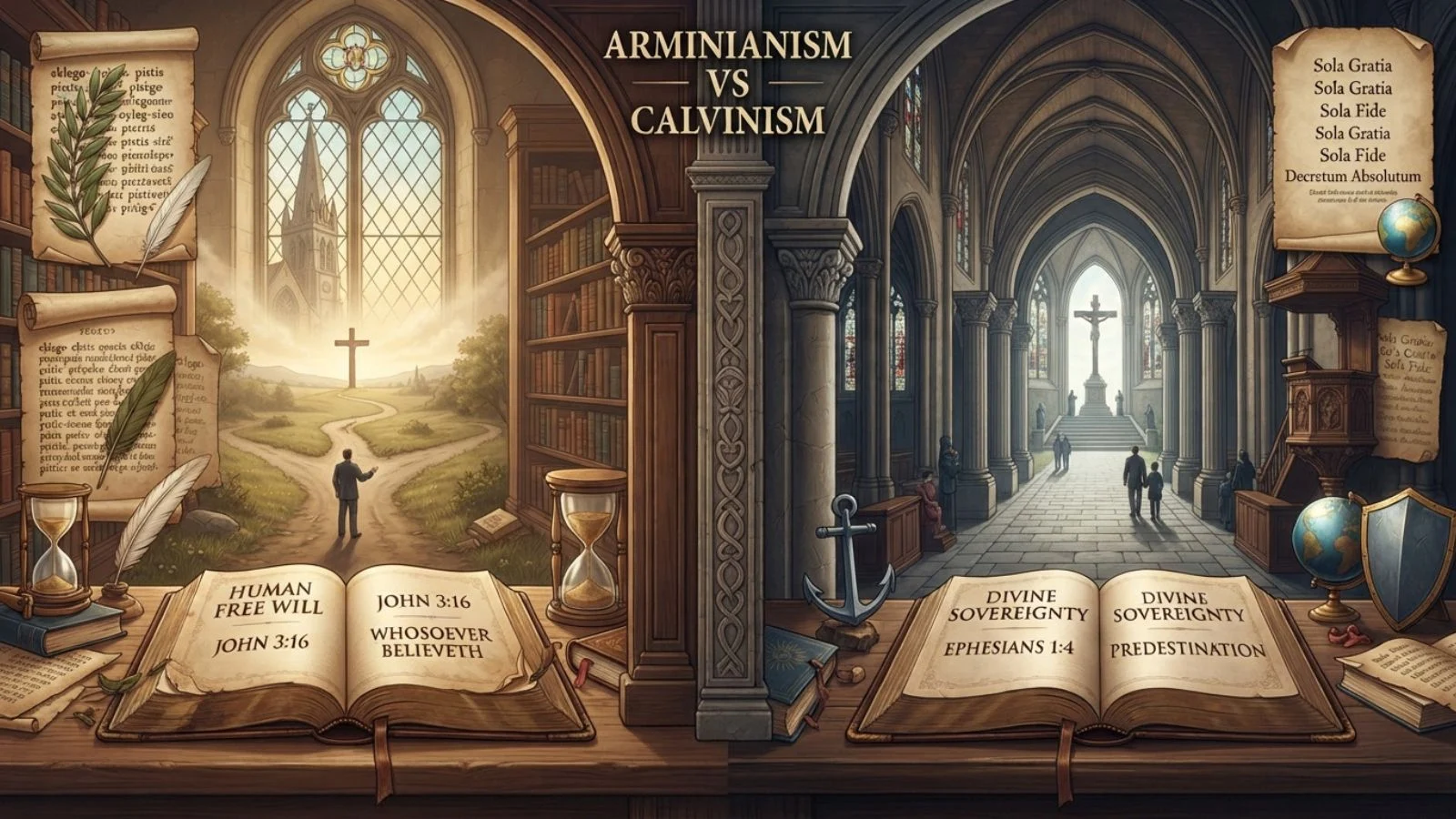
Calvinism and Arminianism are two Protestant views on salvation. Calvinism teaches that God alone chooses who is saved, and His grace cannot be resisted.
Arminianism teaches that God offers salvation to everyone, but each person must freely choose to accept or reject it.
The core disagreement is over how much control God versus human free will has in salvation.
Key Takeaways
- Calvinism follows John Calvin; Arminianism follows Jacobus Arminius, a former Calvinist who broke away in the early 1600s.
- The five-point comparison is often remembered by the acronym TULIP (the Calvinist side).
- The biggest split is over election: does God choose people unconditionally, or does He choose based on foreseen faith?
- Reformed, Presbyterian, and many Reformed Baptist churches lean Calvinist; Methodist, Wesleyan, Nazarene, and most Pentecostal churches lean Arminian.
- Both sides agree Jesus is the only way to salvation; they disagree on how that salvation is applied to individuals.
Where Calvinism and Arminianism Come From
Calvinism takes its name from John Calvin, a 16th-century French reformer whose teachings shaped Reformed theology. Arminianism is named after Jacobus Arminius, a Dutch theologian who studied under Calvinist teachers but came to disagree with parts of their system.
After Arminius died, his followers wrote down their objections in a document called the Remonstrance. In response, Reformed church leaders gathered at the Synod of Dort (1618–1619) and issued five official rulings against the Arminian position. Those five rulings later got rearranged into the acronym TULIP, which is why most comparisons of the two views still use five points today.
The Core Disagreement: Who Decides Salvation?
Strip away the theological vocabulary, and the debate comes down to one question: when a person is saved, who made the decisive choice: God or the person?
Calvinists say salvation starts and ends with God’s choice. He selects who will be saved, and His grace works in that person’s heart so they willingly and certainly come to faith. Arminians agree that salvation begins with God’s grace, but they say God’s grace makes faith possible for everyone, and each individual still has to freely respond to it. God doesn’t force the outcome either way.
That one difference in emphasis on God’s sovereign control versus human free response shapes every other point of disagreement between the two systems.
The 5 Key Differences (TULIP vs the Arminian View)
1. Total Depravity vs Partial Depravity
Both sides agree humans are sinful from birth and cannot save themselves. Calvinists call this total depravity: sin affects every part of a person, including the will, so people cannot choose God on their own without God first changing their heart.
Most Arminians actually hold a similar view of depravity; they just add a next step called preventative grace. This is grace they believe God gives to everyone, which restores just enough ability for a person to freely respond to the gospel when they hear it.
2. Unconditional Election vs Conditional Election
This is usually considered the sharpest divide. Calvinists teach unconditional election: God chose specific individuals to be saved before the world began, based on His own will, not on anything He foresaw them doing.
Arminians teach conditional election: God looks ahead in time, sees who will freely choose to believe, and elects those people on the basis of that foreseen faith.
3. Limited Atonement vs Unlimited Atonement
Calvinists hold that Christ died specifically to guarantee salvation for the elect those God had already chosen. This is sometimes called particular redemption rather than “limited,” since Calvinists see it as focused, not restricted in power.
Arminians hold that Christ died for every person, making salvation genuinely available to all, though it only becomes effective for those who believe.
4. Irresistible Grace vs Resistible Grace
In Calvinism, when God decides to save someone, His grace cannot ultimately be turned down; it effectively draws that person to faith. In Arminianism, God’s grace can be resisted. A person can hear the gospel, feel God’s call, and still choose to reject it.
5. Perseverance of the Saints vs Conditional Security
Calvinists believe that anyone truly saved by God will never fully and finally fall away. God preserves them to the end. Arminian views vary here. Classical Arminianism leaves the question somewhat open, while many modern Arminians (including most Wesleyans) teach that a believer can walk away from faith and lose their salvation.
Arminianism vs Calvinism at a Glance
| Point | Calvinism | Arminianism |
| Depravity | Total; humans cannot choose God unaided | Depraved, but prevenient grace enables a free response |
| Election | Unconditional, based on God’s will alone | Conditional, based on foreseen faith |
| Atonement | Limited to the elect | Unlimited; offered to all |
| Grace | Irresistible for the elect | Can be resisted |
| Security | Perseverance guaranteed by God | Often considered conditional; can be lost |
| Key figure | John Calvin | Jacobus Arminius |
Which Churches Are Calvinist and Which Are Arminian?
Calvinist theology is common in Presbyterian, Reformed, and many Reformed Baptist and non-denominational churches. Arminian theology shows up strongly in Methodist, Wesleyan, Nazarene, Free Will Baptist, and most Pentecostal and charismatic churches. Many evangelical and non-denominational churches blend elements of both, or simply avoid taking an official position.
Is One View “More Biblical”?
Both sides build their case from Scripture, not tradition alone. Calvinists point to passages like Romans 9 and Ephesians 1 to argue for God’s sovereign choice. Arminians point to passages like John 3:16 and 2 Peter 3:9 to argue that God desires and offers salvation to everyone. Christians who are serious about the Bible land on both sides of this debate, which is why it has continued for over 400 years without a final resolution. It’s best understood as a disagreement between genuine believers over how to explain a real biblical tension, not a case of one side being “orthodox” and the other not.
FAQs
What is the main difference between Calvinism and Arminianism?
Calvinism teaches God unconditionally chooses who is saved and His grace cannot be resisted. Arminianism teaches God offers salvation to everyone through grace, but each person must freely choose to accept it, and that choice can be resisted or, in some views, later reversed.
What does TULIP stand for in Calvinism?
TULIP stands for Total depravity, Unconditional election, Limited atonement, Irresistible grace, and Perseverance of the saints the five points formalized at the Synod of Dort in response to Arminian objections.
Can you lose your salvation in Arminianism?
It depends on the tradition. Classical Arminianism is largely silent on the question, but many modern Arminian churches, especially Wesleyan and Methodist ones, teach that a believer can turn away from faith and lose their salvation.
Is Arminianism considered a heresy?
No. Mainstream Arminianism is considered a legitimate, historic Protestant position, not a heresy. Both Calvinism and Arminianism are held by orthodox, Bible-believing Christians; the disagreement is over how salvation works, not over core doctrines like the deity of Christ or the resurrection.
Conclusion
Arminianism and Calvinism agree on far more than they disagree on both affirm human sinfulness, God’s grace, and salvation through Christ alone.
Where they part ways is over how that grace operates: as God’s sovereign, unconditional choice, or as a genuine offer that people must freely accept.
Understanding the five-point comparison gives you a clear framework for recognizing which view a church, pastor, or author holds and for thinking through where you land yourself.