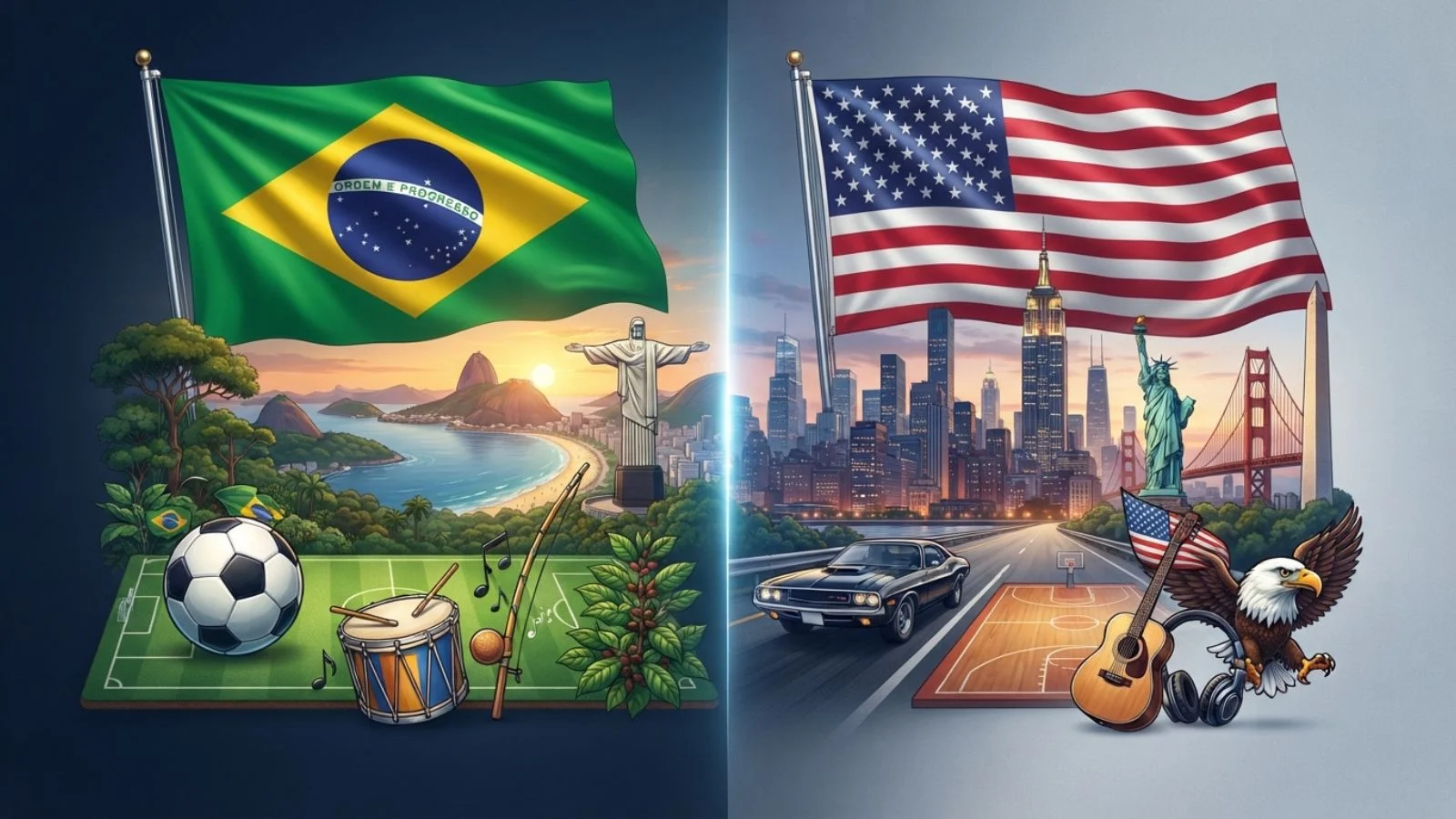
Brazil and the USA are both massive, diverse nations in the Americas, but they differ sharply in scale and wealth.
The USA is larger, wealthier, and more urbanized, with a GDP over ten times Brazil’s.
Brazil is more culturally uniform (mostly Portuguese-speaking), has a lower cost of living, and is home to the Amazon rainforest.
Key Takeaways
- The USA is about 15% larger in land area, but Brazil is the bigger country in South America and the fifth-largest in the world.
- The USA has roughly 344 million people; Brazil has about 213 million.
- The US economy is over ten times the size of Brazil’s, and average income is roughly five times higher.
- Brazil generally has a much lower cost of living, especially outside São Paulo and Rio de Janeiro.
- Both are federal, presidential democracies, but their histories, immigration patterns, and cultures differ widely.
- Portuguese is Brazil’s official language; the USA has no official language, though English dominates.
Brazil vs USA at a Glance
| Category | Brazil | USA |
| Population | ~213 million | ~344 million |
| Land area | 3.29 million sq mi | 3.80 million sq mi |
| GDP (2024) | $2.19 trillion | $28.8 trillion |
| GDP per capita | ~$10,300 | ~$84,500 |
| Life expectancy | 76.4 years | 79.8 years |
| Official language | Portuguese | None (English dominant) |
| Government | Federal presidential republic | Federal presidential republic |
| Currency | Brazilian real (BRL) | US dollar (USD) |
Size and Geography
The United States and Brazil are two of the largest countries on Earth, but people often assume Brazil is bigger than it actually is. The US covers about 3.80 million square miles, ranking third worldwide. Brazil covers approximately 8.5 million square kilometers, making it the fifth largest country in the world, at roughly 3.29 million square miles. So the US is larger by land area, though not by a huge margin about 15% more territory.
Geographically, the two countries look very different. The US spans multiple climate zones, from Arctic Alaska to tropical Florida, and includes the Rocky Mountains, Great Plains, and Mississippi River basin. Brazil sits almost entirely in the tropics and subtropics, dominated by the Amazon Basin. The Amazon Rainforest covers roughly 60% of Brazil’s territory and is a critical ecological resource for the entire planet.
Population and Demographics
Brazil has a population of about 213.8 million, ranking 7th in the world, compared with about 344 million in the United States, which ranks 3rd. That makes the US population roughly 1.6 times larger than Brazil’s.
Population density tells a different story. Brazil’s population is concentrated along its coast and in a handful of massive cities like São Paulo and Rio de Janeiro, leaving the vast interior much of its Amazon rainforest sparsely populated. The US population is more evenly distributed, though it too clusters heavily in coastal and metro areas.
Median age also differs: Brazil’s median age is 35.4 years versus 39.3 years in the US, meaning Brazil has a somewhat younger population on average.
Economy and Cost of Living
This is where the two countries diverge the most. Brazil’s GDP was about $2.19 trillion in 2024, while the US economy was roughly $28.8 trillion more than ten times larger. The US isn’t just bigger in absolute terms; it’s also far wealthier per person. GDP per capita in Brazil was around $10,311, compared to $84,534 in the US.
Wages and Income
The income gap is significant and shapes everyday life in both countries. Average take-home pay in the US is several times higher than in Brazil, which affects everything from housing budgets to discretionary spending. Brazil’s economy leans heavily on agriculture (soybeans, coffee, sugar), mining, and energy, while the US economy is driven by technology, finance, healthcare, and advanced manufacturing.
Cost of Living
Lower wages in Brazil come with a lower cost of living. Rent, groceries, dining out, and domestic services (like housekeeping or childcare) generally cost a fraction of what they do in major US cities. That said, imported goods, electronics, and cars tend to be more expensive in Brazil due to high import taxes. Someone earning a US salary and spending it in Brazil can often live comfortably; someone earning a Brazilian salary faces a much tighter budget, especially in expensive cities like São Paulo.
Government and Political System
Both countries are federal, presidential republics with a separation of powers between executive, legislative, and judicial branches, and both hold regular elections for president and a bicameral national legislature. The US system dates back to 1776 and has one of the world’s oldest continuously operating constitutions. Brazil became independent from Portugal in 1822 and has gone through several political transitions since, including a return to democracy in the late 1980s after a period of military rule. Today both nations function as multiparty democracies, though party structures and coalition politics work quite differently in each.
Culture, Language, and Religion
Brazil is linguistically and culturally more unified than the US. Portuguese is the official language nationwide, and while regional accents and dialects vary, there’s a shared national culture built around samba, Carnival, and a strong sense of collective identity. Brazilian culture blends Indigenous, African, and Portuguese influences, especially visible in music, dance, food, and religious traditions in regions like Bahia.
The US has no official language at the federal level, though English is dominant and Spanish is widely spoken. American culture is shaped by centuries of immigration from nearly every part of the world, producing a more patchwork national identity that varies significantly by region and city.
Religion plays a major role in both societies. Christianity remains the dominant religion in both countries, though the US has a larger and growing share of people who identify as religiously unaffiliated, while Brazil, while still majority Catholic and evangelical Christian has seen rapid growth in evangelical Protestantism over the past few decades.
Family structure also differs. Extended families tend to stay more closely connected in Brazil, with multiple generations often living nearby and playing an active role in daily life, whereas nuclear-family living arrangements are more common in the US.
Quality of Life and Healthcare
Life expectancy is 76.4 years in Brazil compared to 79.8 years in the US, a gap mostly explained by differences in income, healthcare access, and public safety.
Brazil has a universal public healthcare system (SUS) that provides free care to all citizens, though wait times and resource shortages are common, pushing many middle- and upper-income Brazilians toward private insurance. The US healthcare system is largely private and employer-based, offering high-quality care but at a much higher direct cost, and without universal coverage.
Public safety is another point of contrast. Brazil has higher rates of violent crime in many urban areas compared to the US average, which is a real consideration for anyone comparing the two countries for travel or relocation, even though both countries have areas that are notably safer or more dangerous than their national average.
Brazil vs USA: Which Is Better to Visit or Live In?
There’s no single right answer; it depends on priorities.
- Choose the USA if you value higher wages, extensive infrastructure, top-tier healthcare access (assuming good insurance), and a huge range of climates and landscapes in one country.
- Choose Brazil if you want a lower cost of living, warm-weather living year-round in much of the country, vibrant cultural traditions, and access to unmatched natural biodiversity like the Amazon and its coastline.
Many travelers and expats end up splitting time between the two, drawn to the US for career opportunities and to Brazil for affordability, climate, and culture.
Frequently Asked Questions
Is Brazil bigger than the USA?
No. The US is about 15% larger by land area, covering roughly 3.80 million square miles versus Brazil’s 3.29 million square miles. Brazil is still the fifth-largest country in the world and the largest in South America.
Is it cheaper to live in Brazil than the USA?
Generally, yes. Rent, food, and services cost significantly less in Brazil than in most US cities, though electronics, cars, and imported goods can cost more due to high import taxes.
What language is spoken in Brazil vs the USA?
Brazil’s official language is Portuguese, spoken almost universally. The US has no official federal language; English is dominant, with Spanish widely spoken as well.
Is Brazil richer or poorer than the USA?
The USA is far wealthier overall. Its economy is more than ten times the size of Brazil’s, and average income per person is roughly five times higher.
How does quality of life compare between Brazil and the USA?
The US generally scores higher on life expectancy, income, and infrastructure, while Brazil offers a lower cost of living, warmer climate in most regions, and strong cultural and community ties.
Conclusion
Brazil and the USA are both giants of the Americas, but they sit at very different points on nearly every measure that matters.
The US wins on land area, economic power, wages, and infrastructure, while Brazil offers a lower cost of living, a warmer climate across most of the country, deep cultural traditions, and unmatched biodiversity in the Amazon.
Neither country is simply “better” ; the right choice depends on whether someone values income and infrastructure or affordability and lifestyle.
For most people comparing the two, the real decision comes down to what they’re optimizing for: career and earning potential, or cost of living and quality of everyday life.