In the United States, “budgie” and “parakeet” usually mean the same bird, the budgerigar.
Outside the US, “parakeet” is a broader category that includes budgies plus dozens of other small, long-tailed parrot species, like rose-ringed and Bourke’s parakeets, which are larger and longer-lived than budgies.
Key Takeaways
- Every budgie is a parakeet, but not every parakeet is a budgie.
- In the US, “parakeet” almost always just means “budgie” ; the terms are used interchangeably.
- True (non-budgie) parakeets can be much bigger, live longer, and need more space.
- Budgies are typically 5–7 inches long and live 5–10 years; other parakeets range from 6–18 inches and can live 10–30 years.
- Budgies are the easiest choice for first-time bird owners.
Is a Budgie a Type of Parakeet?
Yes. “Parakeet” isn’t one species; it’s a broad group name for small to medium parrots with long, tapering tails and slender bodies. There are more than 120 species and subspecies in that group, and the budgerigar (Melopsittacus undulatus) is one of them.
So the budgie is a parakeet, the same way a Labrador is a dog. But “parakeet” also covers birds that look and behave quite differently from a budgie, including rose-ringed parakeets, Bourke’s parakeets, and quaker parakeets.
Why Americans Call Budgies “Parakeets”
This is where most of the confusion starts. In the US, pet stores and bird owners commonly use “parakeet” as a casual nickname specifically for the budgie, since it’s the most popular pet bird in that category. Outside the US, “parakeet” keeps its broader meaning, covering many species and “budgie” (short for budgerigar) is used to refer to that one specific bird.
That means an American saying “I have a parakeet” almost always means a budgie. Someone from the UK or Australia saying “parakeet” could mean any of dozens of species.
Budgie vs Parakeet: Side-by-Side Comparison
| Feature | Budgie | Other Parakeets |
| Length | 5–7 inches | 6–18 inches, depending on species |
| Weight | 30–40 grams | 30–60+ grams |
| Origin | Australia | Worldwide |
| Lifespan | 5–10 years | 10–30 years |
| Talking ability | Good mimic, clear speech | Varies; some species talk even better |
| Cage/space needs | Small cage | Medium to large cage or aviary |
| Beginner-friendly | Very | Moderate to challenging |
Size and Appearance Differences
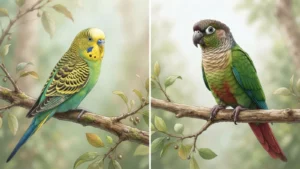
Budgies are small, typically 5 to 7 inches from head to tail, with a compact body and short, thin beak. Their wild coloring is green and yellow with black-scalloped wings, though pet breeding has produced blues, whites, and violets.
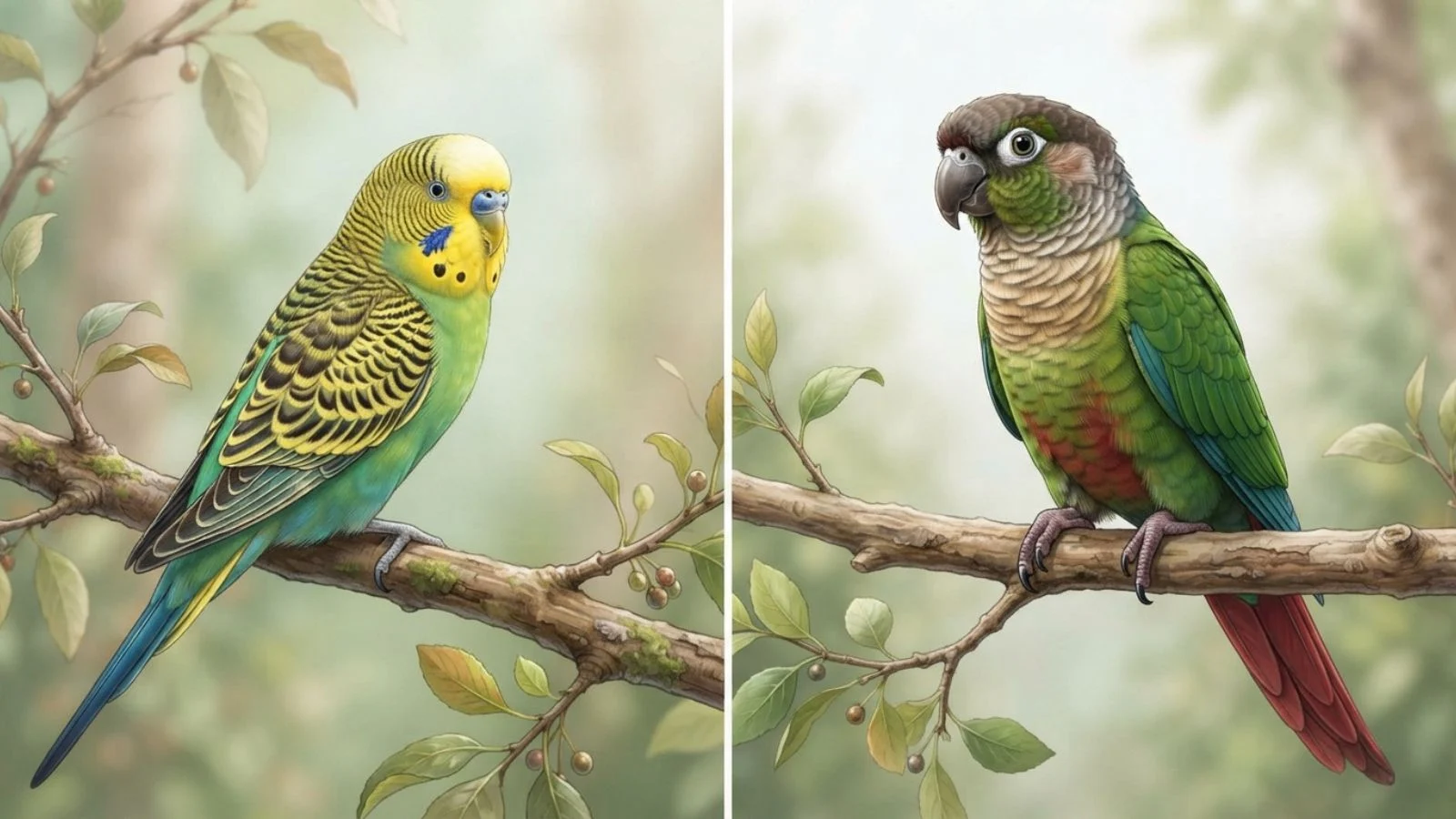
Other parakeets vary a lot more. A rose-ringed parakeet can reach 16 inches including its tail, and species like the Bourke’s parakeet have a softer, more muted color palette and a stockier build. If you’re picturing a small green bird with black stripes on its head, you’re picturing a budgie most other parakeets look noticeably different.
Lifespan Differences
This is one of the biggest practical differences. A budgie typically lives 5 to 10 years with good care, occasionally reaching into the teens. Larger parakeet species often live much longer, some 20 to 30 years. That’s a major commitment difference worth thinking about before you bring one home, since a larger parakeet can outlive a couple of major life changes.
Personality and Talking Ability
Budgies are curious, social, and surprisingly good talkers for their size. Many can learn dozens of words and phrases, especially males that are hand-raised young. They’re generally gentle and easy to tame, though they can get chatty and a little noisy, especially as adolescents.
Other parakeets share that same intelligence and sociability but tend to have bigger personalities to match their bigger bodies. Some species are louder, more prone to nipping when untrained, and need more consistent handling to stay tame. A few species are actually stronger talkers than budgies, but training generally takes more patience.
Care Needs: Budgie vs. Larger Parakeets
Day-to-day care is similar across the group: a pellet-based diet with fresh fruit and vegetables, daily time outside the cage, and enrichment like perches, ropes, and foraging toys. The real difference is scale.
Budgies do fine in a smaller cage and need roughly 20 to 30 minutes of supervised out-of-cage time a day. Larger parakeet species need bigger enclosures, more flight space, and often more mental stimulation to prevent boredom-driven behaviors like feather plucking or excessive screeching.
English Budgie vs. American Parakeet (a Special Case)
There’s a second, smaller layer of confusion worth knowing about: within the budgie world itself, breeders talk about “English budgies” and “American parakeets.” Both are the same species, but English budgies have been selectively bred over generations to be larger, fluffier, and calmer, while American parakeets are closer in size and temperament to the wild Australian budgie, smaller, more active, and a bit more prone to nipping.
If a listing specifically says “English budgie” versus just “parakeet,” that’s usually describing this breeding difference, not a different species.
Which One Should You Get?
- Choose a budgie if you want a smaller footprint, an easier learning curve, and a shorter (though still meaningful) commitment.
- Choose a larger parakeet species if you have more space, want a bird with a bigger personality, and are ready for a pet that may be part of your life for two or three decades.
Either way, you’re getting an intelligent, social bird that needs daily interaction, not a low-maintenance “starter pet” in the way a fish might be.
FAQs
Is a budgie the same as a parakeet?
In the US, yes, “parakeet” is almost always used to mean “budgie.” Technically, a budgie is just one species within the much larger parakeet group.
Why do Americans call budgies parakeets?
It’s a naming habit that stuck because the budgie is by far the most common pet bird in that category in the US, so “parakeet” became shorthand for it.
Which lives longer, a budgie or a parakeet?
Budgies typically live 5 to 10 years. Many other parakeet species live 10 to 30 years, so a non-budgie parakeet is usually the longer-term commitment.
Are budgies easier to train than other parakeets?
Generally, yes. Budgies tend to be gentler and calmer to handle, especially when hand-tamed young, while some larger parakeet species can be nippier and need more patient training.
What’s the difference between an English budgie and an American parakeet?
Both are the same species (the budgerigar). English budgies are selectively bred to be larger and calmer; American parakeets are closer in size and energy to the wild Australian bird.
Conclusion
Budgie vs Parakeet really comes down to one simple fact: every budgie is a parakeet, but not every parakeet is a budgie.
In the US, the two words are used interchangeably, so if you’ve owned a “parakeet,” you’ve almost certainly owned a budgie.
If you’re picking your first pet bird, a budgie’s small size, shorter care commitment, and easygoing nature make it the more beginner-friendly choice while a larger parakeet species suits owners ready for a bigger bird, a longer lifespan, and a bit more space and training.
Either way, you’re bringing home an intelligent, social companion that will reward daily attention with real personality and, quite possibly, a few words of its own.