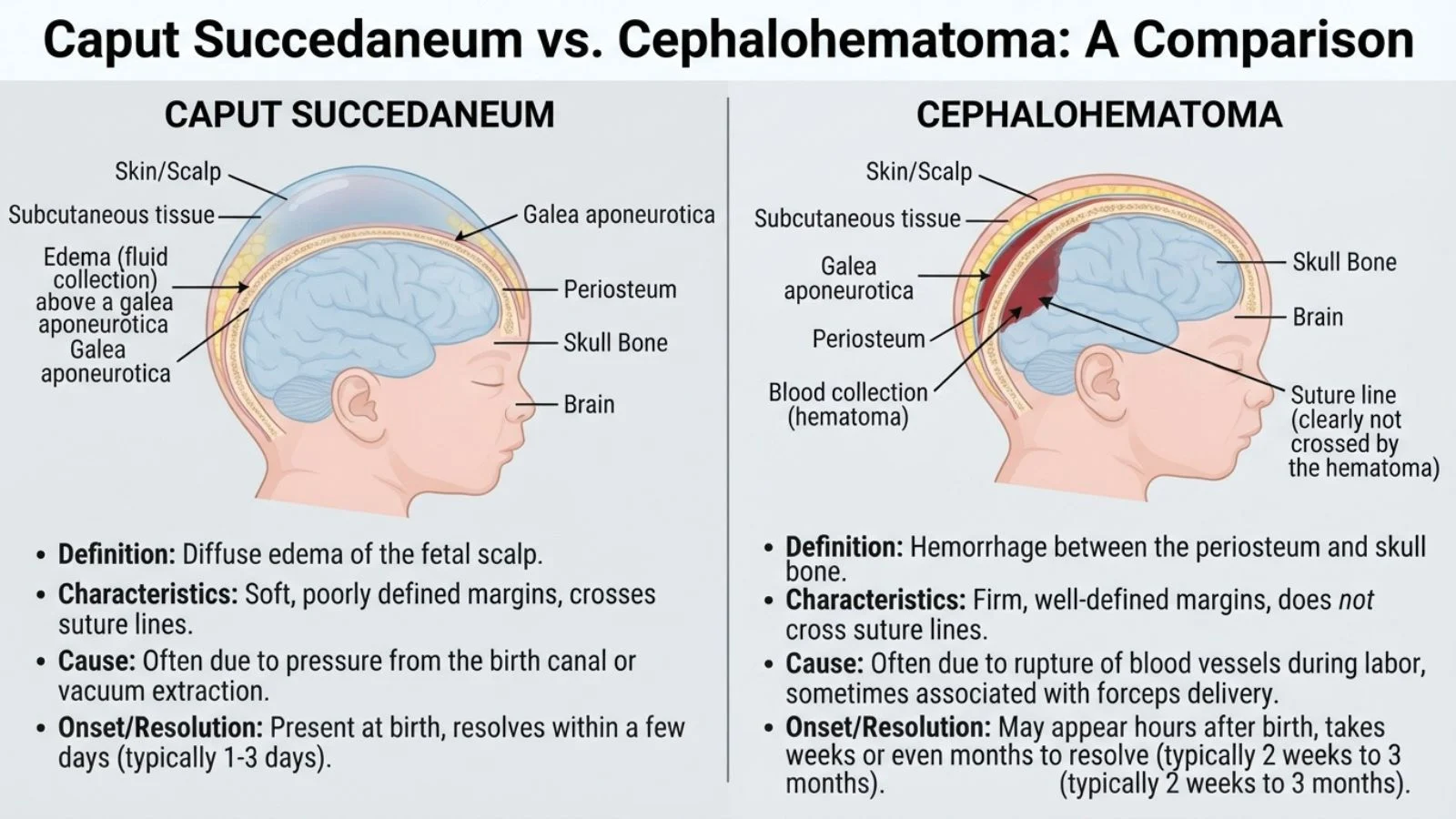
Caput succedaneum and cephalohematoma are both scalp swellings seen in newborns, but they differ in location and behavior.
Caput succedaneum is soft tissue swelling that crosses suture lines and appears right at birth.
A cephalohematoma is a blood collection under the periosteum that does not cross suture lines and shows up hours after birth.
Key Takeaways
- Caput succedaneum is fluid in the scalp’s soft tissue; cephalohematoma is blood trapped under the periosteum (the membrane covering the skull bone).
- Caput crosses suture lines; cephalohematoma stays within the boundary of one skull bone.
- Caput is visible immediately at birth; cephalohematoma usually appears hours to a day later.
- Caput resolves in a few days; cephalohematoma can take weeks to months.
- Both are usually harmless, but a cephalohematoma carries a small risk of newborn jaundice.
What Is Caput Succedaneum?
Caput succedaneum is a soft, puffy swelling that forms on a newborn’s scalp during a vaginal delivery. As the baby’s head pushes against the cervix and birth canal, pressure squeezes fluid out of the blood vessels and into the soft tissue layer just under the skin.
Because this fluid sits above the tough membrane that covers the skull bones, nothing stops it from spreading. That’s why caput succedaneum can cross suture lines the seams between skull bones and sometimes covers a wide, poorly defined area of the scalp.
Key features:
- Soft and doughy, with pitting when pressed
- Present at birth, often most noticeable in the first hour
- Crosses suture lines
- Usually shrinks within 24 to 48 hours and is gone within a few days
- More common after a long labor, prolonged pushing, or vacuum-assisted delivery
No treatment is needed. It’s considered a normal side effect of birth, not an injury.
What Is a Cephalohematoma?
A cephalohematoma is different in both location and mechanism. It’s a collection of blood that pools beneath the periosteum, the thin membrane that wraps tightly around each skull bone. Small blood vessels between the bone and this membrane can tear during delivery, especially with a difficult or instrument-assisted birth.
Because the periosteum is firmly attached at each suture line, the blood has nowhere to spread once it hits the edge of a bone. This is the single biggest distinguishing feature: a cephalohematoma stays confined to one skull bone and never crosses a suture line.
Key features:
- Firm, well-defined lump that does not pit when pressed
- Usually not visible right at birth; it develops over several hours as blood slowly collects
- Does not cross suture lines
- Can take several weeks to a few months to fully resolve
- More common after forceps or vacuum-assisted deliveries, though it can happen with normal births too
Caput vs Cephalohematoma: Side-by-Side Comparison
| Feature | Caput Succedaneum | Cephalohematoma |
| Location | Soft tissue above the skull bone | Beneath the periosteum, on top of the skull bone |
| Contents | Fluid (serum) | Blood |
| Cross suture lines? | Yes | No |
| Onset | Present at birth | Appears hours after birth |
| Texture | Soft, pitting | Firm, non-pitting |
| Resolves in | Days | Weeks to months |
| Main risk | None significant | Mild jaundice, rarely anemia |
Why Do These Conditions Happen?
Both conditions are caused by pressure and friction during labor and delivery, but at different tissue depths.
Caput succedaneum results from the simple mechanical pressure of the baby’s head against the dilating cervix or pelvic bones. Almost any vaginal delivery can cause a mild degree of it, and it’s considered a normal, expected finding rather than a birth injury.
A cephalohematoma requires an actual small blood vessel to rupture under the periosteum. This is more likely when there’s extra friction or shear force on the scalp, such as with:
- Forceps or vacuum-assisted delivery
- A prolonged or difficult second stage of labor
- A first pregnancy, where the birth canal hasn’t stretched before
- A larger-than-average baby
Is Either Condition Dangerous?
For the vast majority of babies, neither condition causes lasting harm. Both are considered common, benign findings that pediatricians and nurses see regularly.
Cephalohematoma and Jaundice
The one condition worth watching for is jaundice. As the trapped blood in a cephalohematoma slowly breaks down over days to weeks, it releases bilirubin, the same pigment responsible for newborn jaundice. Babies with a larger cephalohematoma sometimes need extra bilirubin monitoring in the first week or two of life. In rare cases involving a significant amount of trapped blood, a baby can also become mildly anemic.
Caput succedaneum, because it’s just fluid rather than blood, doesn’t carry this jaundice risk.
When to Call a Doctor
Most swellings need no action beyond routine newborn checkups. Parents should reach out to their pediatrician if they notice:
- The swelling is rapidly getting larger after the first day
- The baby seems unusually sleepy, feeds poorly, or looks yellow (skin or eyes)
- The lump feels soft and fluctuant across a very large, poorly defined area (this can sometimes signal a rarer and more serious condition called subgaleal hemorrhage see below)
- Any fever, irritability, or signs the baby isn’t acting normally
How Are They Treated?
Neither condition typically requires medical treatment. Caput succedaneum resolves on its own within a few days as the fluid is reabsorbed. A cephalohematoma is left alone to reabsorb naturally over weeks to months; doctors specifically avoid draining or aspirating it, since puncturing the skin raises the risk of infection.
In the rare case where a cephalohematoma is large enough to cause significant jaundice, the baby may need phototherapy (light treatment) to help clear the bilirubin, the same standard treatment used for other causes of newborn jaundice.
A Simple Way to Remember the Difference
Nursing students often use this quick memory trick:
- Caput Crosses (sutures) both start with C, and caput crosses.
- Cephalohematoma Confined (to one bone) the blood is trapped and can’t cross.
Another common cue: caput is there the moment the baby is born, while a cephalohematoma “shows up to the party late,” appearing hours afterward as blood slowly accumulates.
What About Subgaleal Hemorrhage?
Parents and students sometimes lump a third condition into this comparison: subgaleal hemorrhage. Unlike caput succedaneum and cephalohematoma, this is a true medical emergency. It’s bleeding into the loose space between the scalp’s connective tissue and the skull’s outer membrane, a space with no boundaries, meaning it can spread across the entire scalp and cause the baby to lose a dangerous amount of blood. It’s rare, but it’s the one scalp swelling that requires immediate medical attention, typically after a difficult vacuum-assisted delivery. If a newborn’s head swelling is soft, boggy, spreading quickly, and shifting when the baby’s head moves, this needs urgent evaluation.
FAQs
What is the main difference between caput succedaneum and cephalohematoma?
Caput succedaneum is fluid swelling in the scalp’s soft tissue that crosses suture lines and is present at birth. Cephalohematoma is blood trapped under the periosteum that stays within one skull bone and appears hours later.
Does caput succedaneum cross suture lines?
Yes. Because the fluid sits above the periosteum, it isn’t blocked by the sutures and can spread across the whole scalp.
How long does a cephalohematoma take to go away?
Most resolve within a few weeks, though larger ones can take two to three months. As it heals, the edges sometimes feel firm or calcified before fully disappearing.
Is cephalohematoma dangerous for a newborn?
Usually not. The main concerns are mild jaundice from the breakdown of trapped blood and, rarely, anemia if the bleeding was significant. Serious complications are uncommon.
Can a cephalohematoma cause brain damage?
No. The bleeding is located between the skull bone and its outer membrane, entirely outside the skull it does not involve the brain.
How do doctors tell caput succedaneum and cephalohematoma apart?
They check three things: whether the swelling was present at birth or appeared later, whether it feels soft and pitting or firm and non-pitting, and whether it crosses a suture line.
Conclusion
Caput succedaneum and cephalohematoma both cause noticeable scalp swelling in newborns, but they come from different tissue layers and behave in distinct ways.
Caput succedaneum is fluid buildup that crosses suture lines and shows up right at birth, disappearing within a few days.
A cephalohematoma is blood trapped beneath the periosteum, confined to one skull bone, that appears hours later and takes weeks to fully resolve.
For most babies, either condition is a normal, temporary part of the birth process rather than a cause for alarm.
The main thing to watch for with a cephalohematoma is mild jaundice as the trapped blood breaks down.
Knowing the difference between soft and crossing sutures versus firm and confined to one bone makes it easy to tell the two apart at a glance, if you’re a new parent checking your baby’s head or a nursing student prepping for an exam.