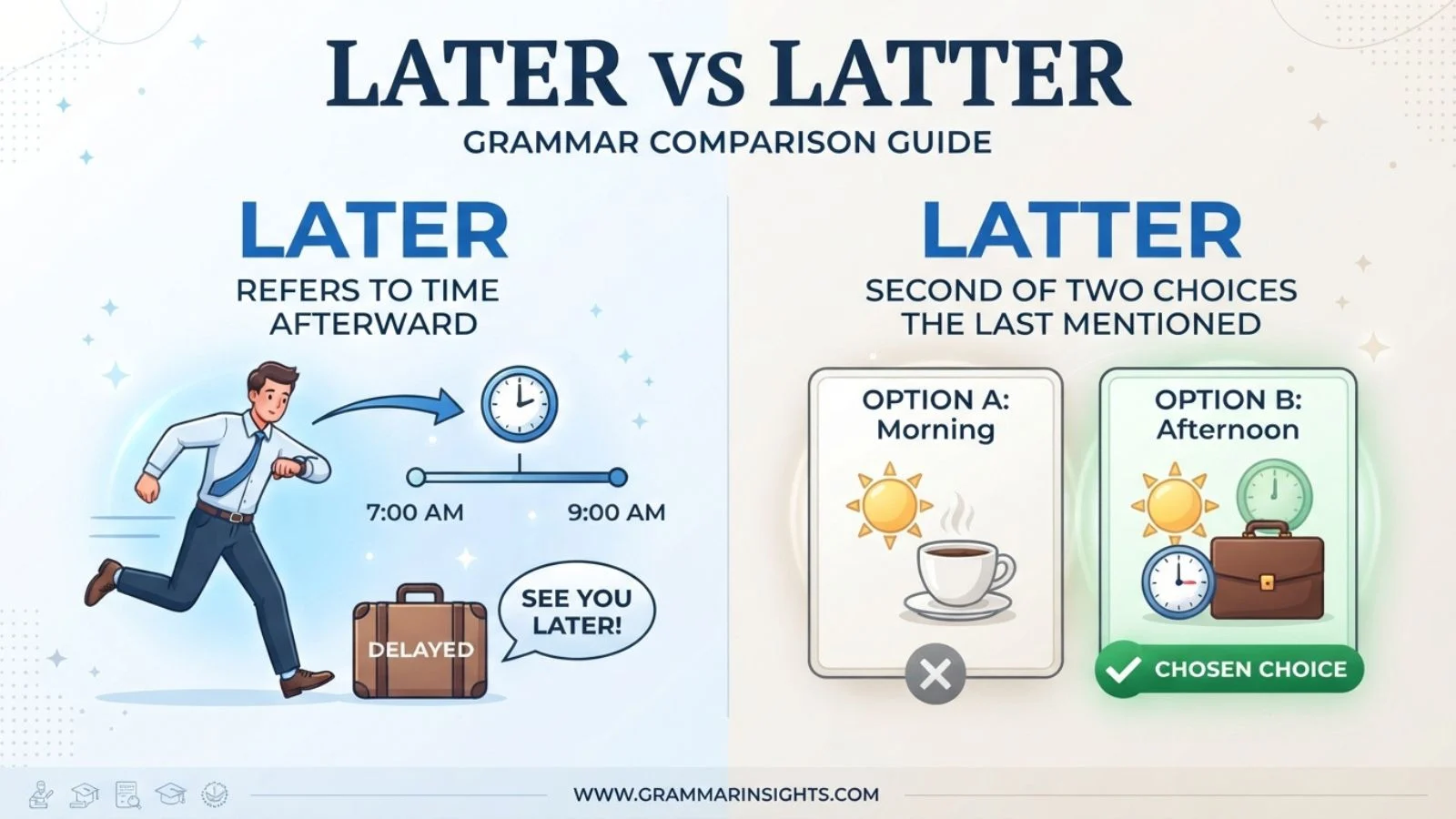
“Later” refers to something happening after the present moment or after something else (I’ll call you later).
“Latter” refers to order; it means the second of two people or things already mentioned (Between coffee and tea, I prefer the latter). They sound similar but serve completely different jobs in a sentence.
Key Takeaways
- Later = about time (afterward, not now)
- Latter = about position (the second of two things mentioned)
- “Latter” is almost always paired with “former” or used with “the”
- “Latter” should only be used for exactly two items, not three or more
- Mixing them up is one of the most common word-confusion errors in English
What Does “Later” Mean?
“Later” is a word about time. It tells you that something happens after now, or after another event.
Later as an Adverb
Most often, “later” works as an adverb describing when something will happen.
- I’ll finish the report later.
- See you later!
- We can talk about this later today.
In every one of these, “later” answers the question “when?”
Later as an Adjective
“Later” can also act as an adjective, meaning “more recent” or “coming after.”
- The later chapters of the book are more exciting.
- He arrived at a later date than expected.
Here, “later” is simply the comparative form of “late” just as “sooner” is the comparative of “soon.”
What Does “Latter” Mean?
“Latter” is a word about order, not time. It means “the second of two things already mentioned.”
Latter as “The Second of Two”
You’ll almost always see “latter” preceded by “the,” and it usually refers back to two items named earlier in the sentence or paragraph.
- I considered both remote work and a hybrid schedule, and chose the latter. (This means the hybrid schedule is the second option listed.)
Latter vs. Former
“Latter” is the natural partner of “former.” When a sentence lists two things, “former” points to the first one and “latter” points to the second.
- Of pizza and sushi, the former is my comfort food; the latter is my celebration food.
This former/latter pairing is one of the clearest signals that “latter” is the word you need.
Later vs Latter: The Key Difference
| Word | Category | Meaning | Example |
| Later | Time | After now; afterward | We’ll discuss the budget later. |
| Latter | Order | The second of two things mentioned | Between email and a call, I prefer the latter. |
The easiest way to separate them: later answers “when,” latter answers “which one.”
A Simple Trick to Remember the Difference
Here’s a memory shortcut that works well:
- Later has the word “late” inside it and lateness is always about time.
- Latter rhymes with “chapter” and a later chapter in a list comes second, matching how “latter” points to the second item in a pair.
Another quick check: if you can replace the word with “afterward” and the sentence still makes sense, you need later. If you can replace it with “the second one,” you need the latter.
Can “Latter” Refer to More Than Two Things?
No, traditionally, “latter” only works when exactly two items are being compared. If you’re referring to the last item in a list of three or more, the correct word is “last,” not “latter.”
- ❌ Of the three finalists, the latter won.
- ✅ Of the three finalists, the last one won.
- ✅ Of the two finalists, the latter won.
Some modern usage has loosened this rule, and you may occasionally see “latter” used for the final item in a longer list. But for clear, correct, professional writing, it’s best to reserve “latter” strictly for pairs.
“Latter” vs “Last”: What’s the Difference?
This is a common point of confusion, so it’s worth spelling out directly:
- Latter = the second of exactly two things.
- Last = the final item in a list of three or more.
Example: “Of the two restaurants, the latter had better reviews.” vs. “Of the five restaurants, the last one had the best reviews.”
Example Sentences: Later vs Latter
Correct usage of “later”:
- Can we reschedule the meeting for later this week?
- She joined the company later than most of her colleagues.
- I’ll explain everything later, I promise.
Correct usage of “latter”:
- The article discussed both anxiety and depression, focusing mostly on the latter.
- Between a loan and an investment, the latter carries more risk.
- He offered two solutions; I chose the latter.
Common mistakes to avoid:
- ❌ I’ll see you latter. (Should be “later” this is about time.)
- ❌ Of the two options, I prefer the later one. (Should be “latter” this is about order, not time.)
- ❌ Among the four candidates, the latter got the job. (Should be “last” there are more than two candidates.)
FAQs
Is “latter” formal?
“Latter” tends to appear more in formal or academic writing, especially when comparing two ideas, options, or people. In casual conversation, people often just repeat the noun instead (“I’ll take the hybrid schedule”) rather than using “the latter.”
Can “later” mean “goodbye”?
Yes, informally. “Later” or “see you later” is commonly used as a casual farewell, even when no specific time is implied.
Is “latter” the opposite of “former”?
Yes. “Former” refers to the first of two items mentioned, and “latter” refers to the second. They’re typically used together in the same sentence.
What part of speech is “latter”?
“Latter” functions as an adjective or pronoun, almost always following “the” (as in “the latter”).
Conclusion
The difference comes down to one simple question: are you talking about when something happens, or which of two things you mean? If it’s about time, use later.
If it’s about order, specifically the second of two things, use the latter. Keep the former/latter pairing in mind, and you’ll rarely mix them up again.