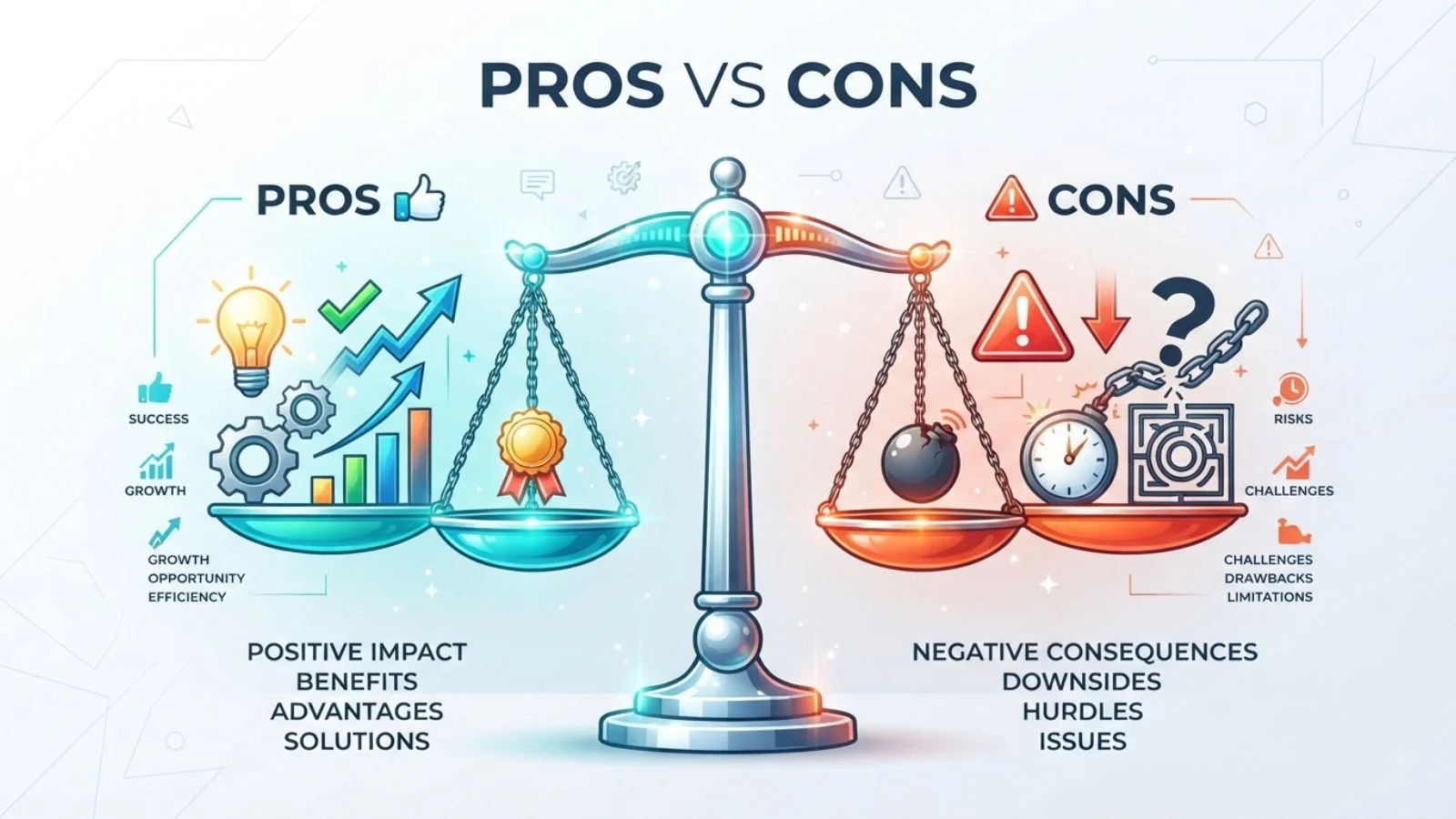
“Pros vs cons” refers to weighing the advantages (pros) against the disadvantages (cons) of a decision.
Pros come from the Latin word for “for,” and cons come from “against.” Comparing them side by side often in a simple two-column list helps you see a choice more clearly before you commit to it.
Key Takeaways
- Pros are the reasons in favor of something; cons are the reasons against it.
- The standard phrase is “pros and cons,” though “pros vs cons” is common when directly comparing the two sides.
- A pros and cons list works by forcing you to slow down and consider both sides before deciding.
- The classic method is a simple T-chart: pros on one side, cons on the other.
- Not every pro or con carries equal weight; a good list accounts for how much each point actually matters.
What Does “Pros vs Cons” Mean?
When people talk about pros vs cons, they mean comparing the good points of a choice against the bad points. It’s a way of organizing your thinking before you make a decision whether that’s a big one, like taking a new job, or a small one, like choosing a restaurant.
- Pros are the benefits, upsides, or reasons to do something.
- Cons are the drawbacks, downsides, or reasons not to do something.
Neither side is automatically “right.” A choice can have five pros and one con, and still be the wrong choice if that one con is serious enough.
Where the Words Come From
Both words trace back to Latin. “Pro” means “for,” and “con” is short for “contra,” meaning “against.” That’s why a pro is something in favor of an idea, and a con is something against it. You’ll also see this root in phrases like “pro bono” (for the public good) or “contradict” (to speak against).
Is It “Pros vs Cons” or “Pros and Cons”?
Both are correct, but they’re used slightly differently.
- “Pros and cons” is the standard, everyday phrase. It treats the two sides as one combined idea “Let’s talk about the pros and cons of this plan.”
- “Pros vs cons” is used when you want to emphasize the comparison itself, often in headings, templates, or when directly contrasting two specific options against each other.
In practice, “pros and cons” is almost always the correct choice in a sentence, while “pros vs cons” works well as a label or title for a comparison tool.
Why Weighing Pros and Cons Actually Helps
It’s easy to dismiss a pros and cons list as too simple to matter. But the value isn’t in the list itself, it’s in the process of making it.
Writing things down forces you to slow down instead of reacting on impulse. It’s easy to focus only on what excites you about a decision and ignore the downsides, or the reverse to focus only on your worries and miss real benefits. Putting both sides on paper interrupts that one-sided thinking.
A written list also gives you something to return to. If you’re still unsure a few days later, you can look at your original list instead of relying on memory, which tends to shift depending on your mood that day.
Finally, a pros and cons list can make you more confident in whatever you decide, because you’ll have already thought through the trade-offs instead of discovering them after the fact.
How to Make a Pros and Cons List (Step by Step)
- Name the decision clearly. Write the specific choice at the top “Should I take this new job?” not just “job stuff.”
- Draw two columns. Label one “Pros” and the other “Cons.” This is sometimes called a T-chart.
- List every pro you can think of. Don’t filter yet get everything down, even small ones.
- List every con you can think of. Be honest here. It’s tempting to skip cons for a choice you already want to make.
- Rank or weight each point. Not all pros and cons matter equally. A quick 1–3 scale for “how much does this matter to me” works well.
- Compare the weighted totals, not just the counts. A list with three heavily weighted pros can outweigh five minor cons.
- Sit with it before deciding. If nothing jumps out immediately, give it a day. Big decisions rarely need to be made at the same time.
A Simple Pros and Cons Example
Here’s what a basic list looks like in practice, using the decision “Should I switch to solar panels?”
| Pros | Cons |
| Lower electricity bills over time | High upfront installation cost |
| Reduces reliance on fossil fuels | Effectiveness depends on sunlight/weather |
| May increase home value | Requires roof space and the right angle |
| Some tax credits or rebates available | Payback period can take several years |
Laid out this way, it’s much easier to see the actual trade-off: long-term savings and environmental benefit versus a real upfront cost and dependence on conditions outside your control.
Common Mistakes That Ruin a Pros and Cons List
A pros and cons list is only as useful as the thinking behind it. A few mistakes show up often:
- Treating every point as equal. “More free time” and “might lose my job” shouldn’t sit on the same level.
- Padding one side. Listing ten small pros to outnumber one major con doesn’t actually change the risk.
- Only listing what you already believe. If you’ve already decided, you’ll unconsciously skip cons that don’t fit your preferred outcome.
- Stopping at the first list. The first draft usually reflects gut feelings more than full thinking. A second pass, a day later, often reveals points you missed.
- Ignoring how reversible the decision is. A con that’s easy to undo later matters less than one that’s permanent.
When a Pros and Cons List Isn’t Enough
A simple list works well for everyday decisions, but it has limits. For very complex decisions, ones with many interdependent factors, long time horizons, or major financial or emotional stakes, a plain list can oversimplify things. In those cases, it can help to combine a pros and cons list with other tools, like talking it through with someone who knows the situation, running the numbers if money is involved, or setting a firm decision deadline so you don’t get stuck comparing indefinitely.
The list is a starting point for clearer thinking, not a replacement for judgment.
FAQs
Is it “pros vs cons” or “pros and cons”?
Both are used, but “pros and cons” is the standard phrase in everyday writing and speech. “Pros vs cons” is more common as a label or heading when directly comparing two sides.
Are pros always good and cons always bad?
Yes, by definition. Pros are the positive or favorable points of a decision, and cons are the negative or unfavorable ones. However, a decision with more pros isn’t automatically the better choice; the weight of each point matters more than the count.
How do you make a pros and cons list?
Write the decision at the top, create two columns labeled “Pros” and “Cons,” list every relevant point on each side, then rank how much each point actually matters before comparing the two sides.
Is a pros and cons list actually effective?
It can be, mainly because it slows down decision-making and forces you to consider both sides. It works best for everyday or moderately complex decisions, and less well for highly complex ones with many interacting factors.
Should every pro and con count equally?
No. Some points matter far more than others. Assigning a simple weight or ranking to each point, rather than just counting pros versus cons, leads to a more accurate comparison.
Conclusion
At the end of the day, “pros vs cons” is really just a simple way to slow down and think clearly before you commit to a choice.
Weighing the advantages against the disadvantages rather than going with your first instinct helps you avoid decisions you’ll regret and gives you more confidence in the ones you make.
If you use a basic two-column list or a weighted version, the goal is the same: see the full picture before you decide, not just the part that feels good in the moment.