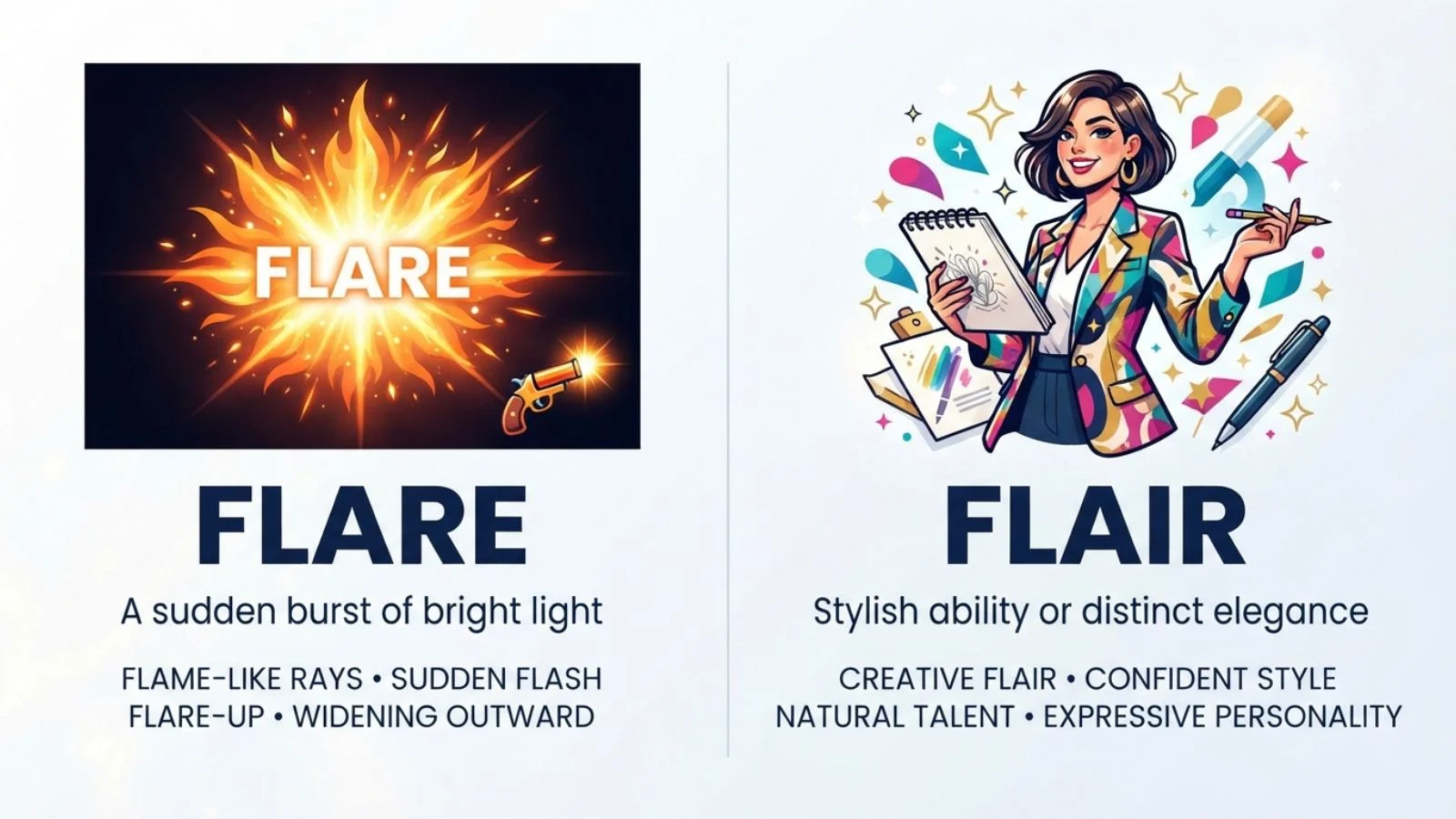
Flare means a sudden burst of light, fire, or emotion, or something that spreads outward (like flared jeans).
Flair means a natural talent or a stylish, distinctive quality. If you mean “sudden burst” or “spreading shape,” use flare. If you mean “talent” or “style,” use flair.
Key Takeaways
- Flare is about light, fire, sudden bursts, or a widening shape.
- Flair is about natural talent, skill, or personal style.
- They’re homophones. They sound the same but mean different things.
- “Flair for” (talent) is often confused with “flare for,” which is incorrect.
- “Flare up” (a sudden worsening or outburst) never uses flair.
What Does “Flare” Mean?
“Flare” is the older, more flexible word. It works as both a noun and a verb, and it always relates to something sudden, bright, or spreading.
Flare as a Noun
As a noun, a flare is:
- A bright flame or light used as a signal or distress call (“The sailors lit a flare.”)
- A sudden burst of something, like anger or pain (“a flare of temper”)
- A gradual widening in shape, especially in clothing (“the flare of her skirt”)
Flare as a Verb
As a verb, “to flare” means to burn suddenly and brightly, to widen outward, or to erupt emotionally.
- “The match flared in the dark room.”
- “His nostrils flared with anger.”
- “Tensions flared between the two countries.”
The phrase “flare up” is especially common. It describes something that suddenly gets worse or more intense: an injury, an illness, an argument, or a fire.
- “Her back pain flared up after the long drive.”
- “The rivalry flared up again during the playoffs.”
What Does “Flair” Mean?
“Flair” is simpler. It’s almost always a noun, and it means a natural ability or a distinctive, stylish quality.
- “She has a flair for design.” (natural talent)
- “He dresses with real flair.” (personal style)
- “The chef added a flair of creativity to the dish.” (a touch of style)
Note the idiom: it’s “a flair for” something, never “a flare for” something. This is one of the most common mix-ups.
Flare vs Flair: Quick Comparison Table
| Word | Part of Speech | Meaning | Example |
| Flare | Noun / Verb | Sudden light, burst, or widening shape | “The road flare lit up the highway.” |
| Flair | Noun (mostly) | Natural talent or stylish quality | “She has a flair for storytelling.” |
Easy Way to Remember the Difference
Here’s a simple trick: flare has an “e,” like explosion both suggest something sudden and fiery. Flair has an “i,” like individuality both relate to a personal, distinctive quality.
Another way to think about it: if you can replace the word with “talent” or “style,” use flair. If you can replace it with “burst,” “flame,” or “widen,” use flare.
Common Phrases: “Flair for” vs “Flare Up”
These two phrases cause the most confusion, so it helps to memorize them as fixed expressions:
- “A flair for [something]” is always about talent. “He has a flair for languages.”
- “Flare up” always flares, always about something intensifying suddenly. “The wound flared up overnight.”
If you keep these two phrases straight, you’ll avoid most flare/flair mistakes in everyday writing.
Example Sentences Side by Side
| Sentence with Flare | Sentence with Flair |
| The emergency crew set off a flare on the shoulder of the road. | The designer showed real flair in her final collection. |
| Old jeans often flare at the ankle. | He handled the negotiation with confidence and flair. |
| Her allergies tend to flare up in the spring. | The restaurant added a modern flair to a classic recipe. |
| Tempers flared during the debate. | She’s always had a flair for public speaking. |
Common Mistakes People Make
- Writing “a flare for cooking” instead of “a flair for cooking.”
- Writing “her skills really flair” instead of “her skills really shine” or “she has real flair.”
- Using “flair up” instead of “flare up” for a sudden worsening of pain or conflict.
- Confusing “flare” (fashion, like flared pants) with “flair” (a fashionable sense of style) related in feel, but grammatically separate.
Frequently Asked Questions
What does “flair” mean in a sentence?
In a sentence, “flair” describes a natural talent or a stylish quality someone has. For example, “She writes with such flair that her essays stand out.”
What does “flare up” mean?
“Flare up” means something suddenly becomes worse, more intense, or more active, often used for injuries, illnesses, fires, or conflicts. Example: “His arthritis flares up in cold weather.”
Is it “fashion flare” or “fashion flair”?
It depends on the meaning. “Flared” jeans or skirts describe their shape (flare). Having a good sense of style is “fashion flair” (talent).
Is it “flare for” or “flair for”?
It’s always “flair for,” meaning a talent for something. “Flare for” is a common misspelling.
What’s the difference between flare and flair?
Flare relates to sudden light, bursts, or widening shapes. Flair relates to natural talent or stylish quality. They sound identical but are unrelated in meaning.
Conclusion
Flare and flair sound exactly alike, but they never mean the same thing. Flare is about sudden bursts, light, or shape think road flares, flared jeans, or tempers that flare up.
Flair is about talent and style, think flair for painting or dressing with flair. Once you lock in the two key phrases, “flair for” and “flare up,” the rest of the distinction becomes easy to remember.