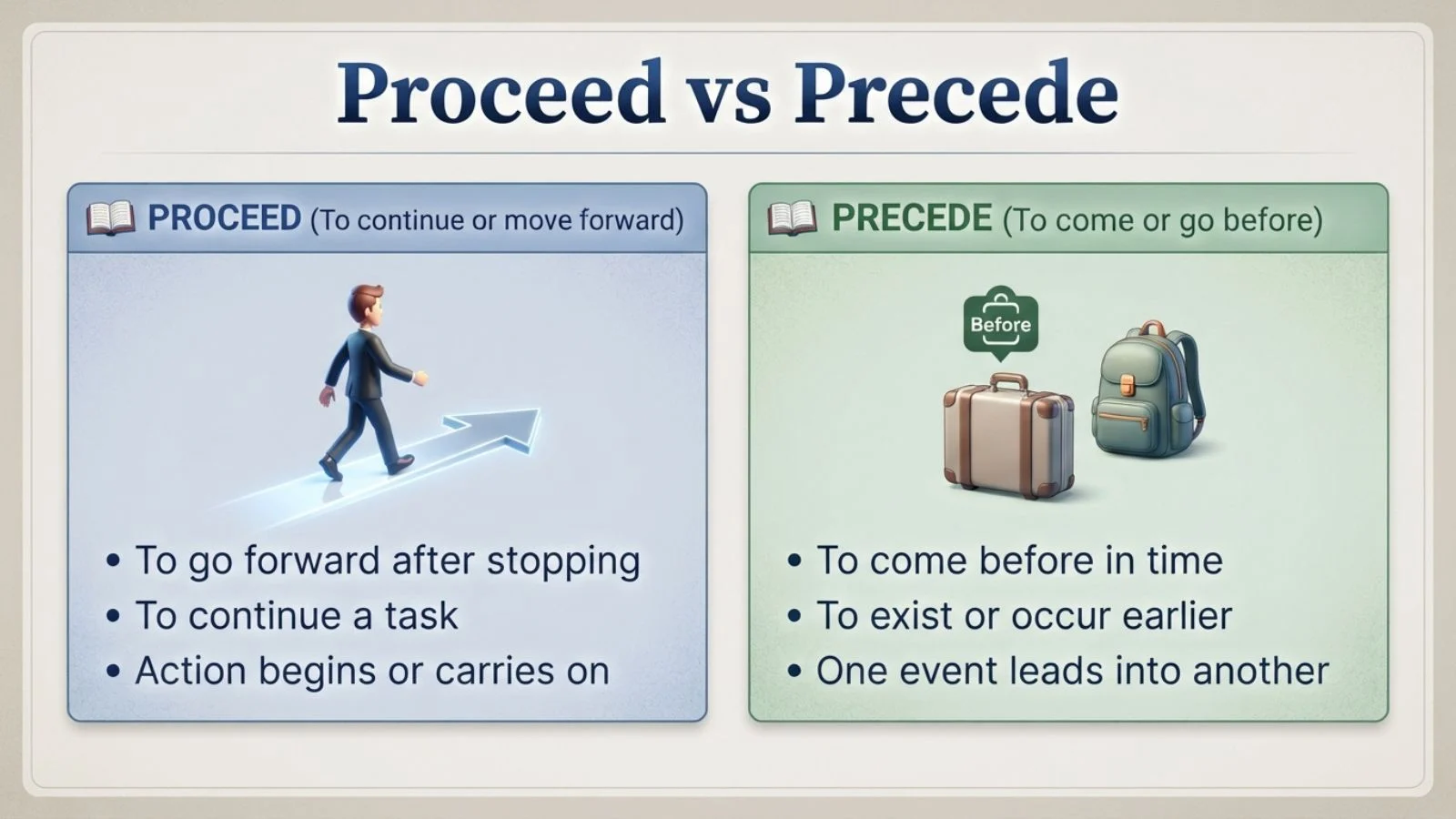
Precede means to come before something in time, order, or position. Proceed means to continue or move forward with an action after a pause or a starting point.
If event A happens first, it precedes event B. If you keep going after a stop, you proceed.
Key Takeaways
- Precede = come before (in time, order, or rank)
- Proceed = go forward or continue
- They are opposites in direction: one looks backward in time, the other moves ahead
- Related words include preceding, precedent, procedure, and proceeds
- A simple memory trick: “Precede” starts with “pre,” like “before”
What Does “Precede” Mean?
Precede is a verb that means to happen, exist, or come before something else. It describes the order of what came first.
Think of it as the “before” word. If you remember that “pre” means “before” (like preview or prepare), you already know half the meaning.
Precede can refer to:
- Time (one event happening before another)
- Order (one item appearing before another in a list or sequence)
- Rank or importance (something taking priority)
Example Sentences with “Precede”
- A loud thunderclap preceded the storm.
- The introduction precedes the main chapters of the book.
- A period of planning precedes any successful product launch.
- Her reputation precedes her; everyone already knew she was talented.
In each case, one thing happens first, and something else follows it.
What Does “Proceed” Mean?
Proceed is a verb that means to move forward, continue, or go ahead with an action, especially after a pause, interruption, or decision point.
Think of it as the “go” word. It answers the question, “What happens next?”
Proceed often appears in instructions, directions, or formal contexts, such as legal, business, or travel settings.
Example Sentences with “Proceed”
- Please proceed to gate 12 for boarding.
- After the break, the meeting will proceed as scheduled.
- She decided to proceed with the surgery despite the risks.
- Once you have your ticket, proceed through the security checkpoint.
In every example, someone is moving forward with an action or a journey.
Proceed vs Precede: Side-by-Side Comparison
The easiest way to see the difference is to compare both words describing the same situation.
| Situation | Using Precede | Using Proceed |
| A speech and a Q&A session | The speech preceded the Q&A. | After the speech, the audience proceeded to the Q&A. |
| Dinner and dessert | Dinner precedes dessert. | After dinner, we proceeded to have dessert. |
| A warning and an action | A warning light preceded the shutdown. | The technician proceeded to shut down the system. |
Notice that precede describes the relationship between two events, while proceed describes the action of moving to the next step.
Where the Confusion Comes From
Proceed and precede look alike because they share a Latin root: cedere, meaning “to go” or “to yield.” The prefixes change the meaning:
- Pre- means “before,” so precede means “to go before.”
- Pro- means “forward,” so proceed means “to go forward.”
Because the words are spelled similarly and both relate to movement in time or sequence, writers often swap them by accident, especially in fast writing or speech.
Related Words: Preceding, Precedent, Procedure, Proceeds
These word families cause similar mix-ups. Here’s a quick guide:
- Preceding (adjective) coming before: “See the preceding paragraph.”
- Precedent (noun) an earlier example used as a guide: “The court case set a legal precedent.”
- Procedure (noun) a series of steps to complete a task: “Follow the safety procedure.”
- Proceeds (noun, pronounced differently) money earned from an event or sale: “The proceeds went to charity.”
Knowing these related terms makes it easier to spot which root word pre- or pro- belongs in a sentence.
A Simple Trick to Remember the Difference
If you only remember one thing, remember this: “Pre” means “before.”
- Precede → happens before something else.
- Proceed → moves forward (both start with a forward-sounding “pro”).
You can also picture a wedding procession: it proceeds down the aisle, moving forward and it’s preceded by the music that starts playing first.
Common Mistakes to Avoid
- Wrong: “Let’s proceed with the plan.”
Right: “Let’s proceed with the plan.” (You’re moving forward, not coming before something.) - Wrong: “The storm preceded the power outage.”
Right: “The storm preceded the power outage.” (The storm happened first.) - Wrong: “She has a proceeding reputation.”
Right: “Her reputation precedes her.” (This is a common idiom.)
A good rule of thumb: if you can replace the word with “come before,” use precede. If you can replace it with “continue” or “go ahead,” use proceed.
FAQs
What is the difference between proceed and precede?
Precede means to come before something in time or order. Proceed means to move forward or continue an action, especially after a pause.
How do you use “precede” in a sentence?
Use it to show that one thing happens before another, such as: “A safety briefing precedes every flight.”
Is it correct to say “proceed the meeting” or “precede the meeting”?
Neither is typically correct on its own. You would say “proceed with the meeting” (continue it) or “the announcement preceded the meeting” (came before it).
What is a synonym for precede?
Common synonyms include come before, predate, lead up to, and antedate.
What is a synonym for proceed?
Common synonyms include continue, advance, move forward, and carry on.
Can precede and proceed ever mean the same thing?
No. They describe opposite directions in time: one looks backward (before), and one looks forward (continue).
Conclusion
Proceed and precede sound alike, but they point in opposite directions. Precede looks backward; it tells you what came first.
Proceed looks forward and it tells you to keep going. Once you connect “pre” with “before” and “pro” with “forward,” the difference becomes easy to remember, and you’ll use both words correctly every time.