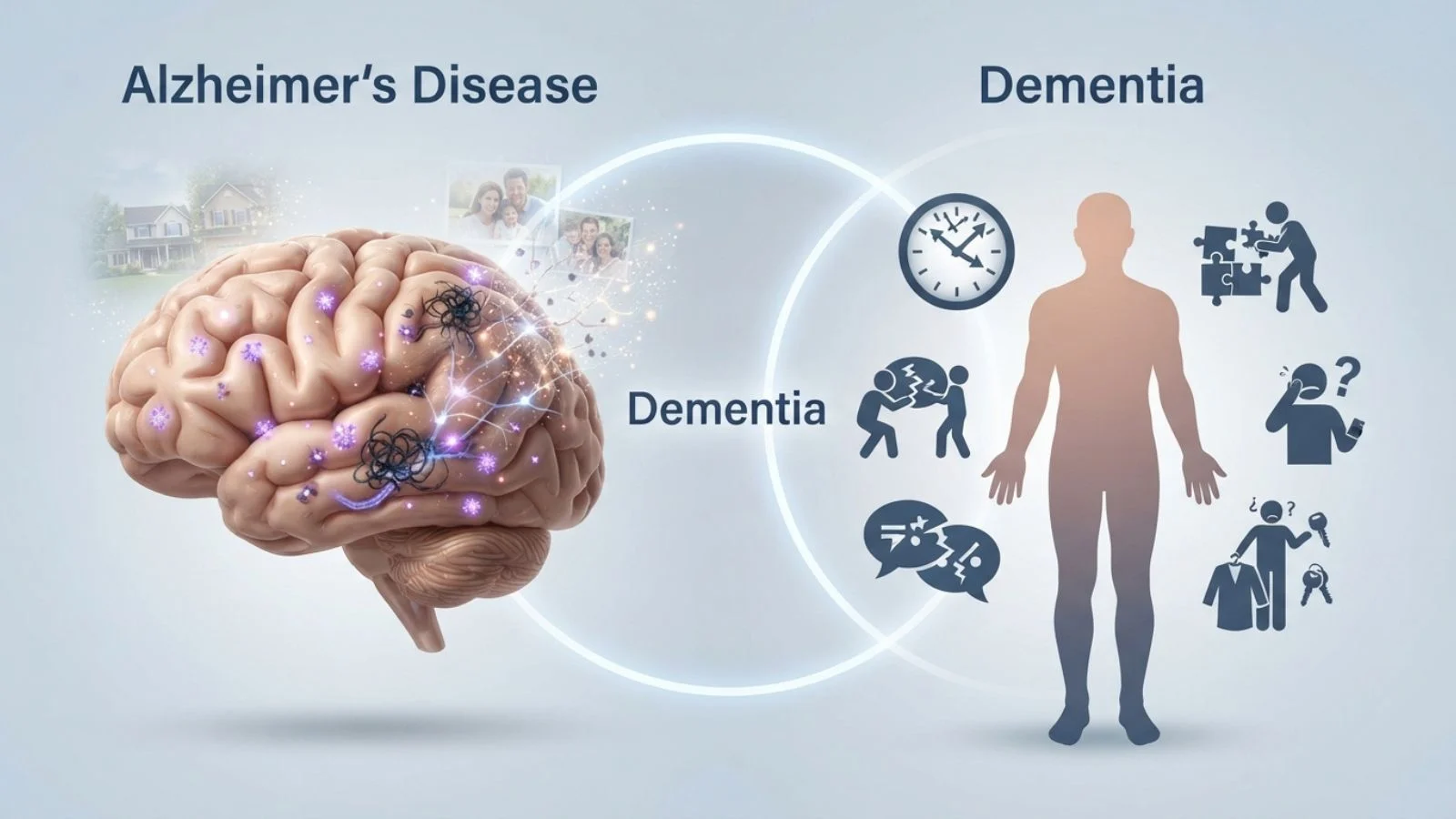
Dementia is a broad term for a decline in memory and thinking severe enough to interfere with daily life.
It’s not one disease but a set of symptoms with many possible causes. Alzheimer’s disease is the most common cause of dementia making up 60–80% of cases.
In short: every person with Alzheimer’s has dementia but not everyone with dementia has Alzheimer’s.
Key Takeaways
- Dementia is an umbrella term describing symptoms; Alzheimer’s is a specific disease that causes those symptoms.
- Alzheimer’s accounts for 60–80% of all dementia cases making it the most common cause.
- Other causes of dementia include vascular dementia, Lewy body dementia and frontotemporal dementia.
- Alzheimer’s typically starts with memory loss while other dementias may start with mood movement or personality changes.
- A proper diagnosis matters because treatment and care plans differ depending on the underlying cause.
Dementia Is a Syndrome Not a Disease
It helps to start with a basic distinction: dementia is a syndrome and Alzheimer’s is a disease.
A syndrome is a group of symptoms that tend to occur together without pointing to one single cause. Dementia describes symptoms like memory loss confusion, poor judgment and difficulty communicating, all severe enough to disrupt everyday activities like paying bills, cooking or driving.
Think of dementia the way you’d think of “fever.” A fever tells you something is wrong but it doesn’t tell you why. It could be the flu, an infection or something else entirely. Dementia works the same way. It’s a signal that brain function has declined but the specific disease behind that decline can vary from person to person.
What Is Alzheimer’s Disease?
Alzheimer’s disease is a specific progressive brain disease one of many possible causes of dementia and by far the most common one.
Inside the brain Alzheimer’s is linked to a buildup of two abnormal proteins: amyloid plaques and tau tangles. Over time these interfere with communication between brain cells and cause the cells to die. This leads to shrinking in areas of the brain responsible for memory language and reasoning.
Alzheimer’s usually develops slowly. Early on it mainly affects short-term memory; someone might repeat questions or misplace items more often. As it progresses it starts to affect language decision-making and eventually the ability to carry out basic daily tasks independently.
Because Alzheimer’s is so common, people often use “Alzheimer’s” and “dementia” as if they mean the same thing. But that habit can cause confusion especially for families trying to understand a loved one’s diagnosis.
Alzheimer’s vs. Dementia: The Core Difference in One Table
| Dementia | Alzheimer’s Disease | |
| What it is | An umbrella term for symptoms | A specific brain disease |
| Category | Syndrome | Disease |
| Cause | Many possible causes | One specific cause (amyloid plaques and tau tangles) |
| Relationship | Includes Alzheimer’s and other conditions | One type of dementia |
| Progression | Depends on the underlying cause | Progressive; worsens over time |
| Reversibility | Sometimes reversible (if caused by a treatable condition) | Not reversible |
Other Types of Dementia Besides Alzheimer’s
Alzheimer’s is the leading cause of dementia but it isn’t the only one. Understanding the other main types shows why “dementia” and “Alzheimer’s” aren’t interchangeable.
Vascular Dementia
This is the second most common type of dementia. It happens when reduced blood flow to the brain often after a stroke or from damaged blood vessels deprives brain cells of oxygen and nutrients. Symptoms often include slowed thinking and trouble with planning rather than memory loss being the first sign.
Lewy Body Dementia
Caused by abnormal protein deposits called Lewy bodies in the brain. It often brings visual hallucinations, sleep disturbances and movement symptoms similar to Parkinson’s disease alongside cognitive decline.
Frontotemporal Dementia
This type affects the frontal and temporal lobes of the brain which control personality behavior and language. Unlike Alzheimer’s it often starts with noticeable changes in personality or behavior rather than memory loss and it tends to appear at a younger age.
Mixed Dementia
Some people have more than one type of dementia at once for example Alzheimer’s changes combined with vascular damage. This is more common than many people realize, especially in older adults.
How Symptoms Compare
Dementia symptoms overlap quite a bit across types which is part of why diagnosis can take time. Still some patterns are useful to know.
Alzheimer’s disease typically starts with:
- Forgetting recent conversations or events
- Repeating questions
- Misplacing items in unusual places
- Growing difficulty finding the right words
Other dementias may start differently. Vascular dementia often shows up first as slowed thinking or trouble organizing tasks. Frontotemporal dementia often begins with personality changes or poor social judgment. Lewy body dementia frequently starts with sleep problems or hallucinations before memory issues become obvious.
What Causes Each One
Dementia has many possible causes and identifying the right one guides how it’s managed:
- Alzheimer’s disease amyloid and tau protein buildup in the brain
- Vascular dementia reduced blood flow often from stroke or vessel damage
- Lewy body dementia abnormal protein deposits affecting brain function
- Frontotemporal dementia degeneration of the frontal and temporal lobes
- Other causes traumatic brain injury Parkinson’s disease Huntington’s disease and in rare cases treatable issues like vitamin deficiencies or thyroid problems
That last point matters: a small number of dementia cases stem from reversible causes. This is one reason a proper diagnosis is worth pursuing rather than assuming the worst.
How Doctors Diagnose the Difference
There’s no single test that instantly separates Alzheimer’s from other dementias. Doctors typically combine several tools:
- A detailed medical history and symptom timeline
- Cognitive and memory tests
- Blood tests to rule out treatable causes (like thyroid issues or vitamin deficiencies)
- Brain imaging (MRI or CT scans) to check for stroke damage or brain shrinkage patterns
- In some cases specialized tests for amyloid or tau proteins
Because early symptoms can overlap, a diagnosis sometimes gets refined over time as doctors observe how symptoms progress.
Why the Distinction Matters for Treatment and Care
Getting the right diagnosis isn’t just a technicality, it shapes real decisions.
Some medications approved for Alzheimer’s target the amyloid and tau processes specific to that disease and aren’t designed for other dementia types. Vascular dementia on the other hand often involves managing blood pressure cholesterol and stroke risk to slow further damage. Lewy body dementia requires extra caution with certain medications that can worsen symptoms.
Care planning also differs. Families dealing with frontotemporal dementia for instance often need support around behavioral changes earlier than families managing typical Alzheimer’s. Knowing the specific cause helps caregivers anticipate what’s coming and connect with the right resources.
Frequently Asked Questions
Is Alzheimer’s the same as dementia?
No. Alzheimer’s is a specific disease while dementia is a broader term for symptoms caused by several possible conditions. Alzheimer’s is the most common cause of dementia, not the only one.
What percentage of dementia cases are caused by Alzheimer’s?
Alzheimer’s disease accounts for roughly 60–80% of dementia cases making it by far the leading cause.
Can someone have dementia without having Alzheimer’s?
Yes. Dementia can result from vascular damage Lewy body disease frontotemporal degeneration and other conditions that have nothing to do with Alzheimer’s.
Which type of dementia is the most serious?
All progressive dementias worsen over time and are serious. Severity depends more on the stage of the disease and the individual than on which type it is.
Is dementia always permanent?
Most progressive dementias including Alzheimer’s are not reversible. However a small percentage of dementia-like symptoms come from treatable causes such as vitamin deficiencies or thyroid problems which can improve with treatment.
Bottom Line
Dementia and Alzheimer’s aren’t competing terms, they’re related but different. Dementia is the broad category of symptoms; Alzheimer’s is the specific disease most often behind it.
Understanding that difference helps families ask better questions, get an accurate diagnosis and plan care around the actual condition rather than a general label.