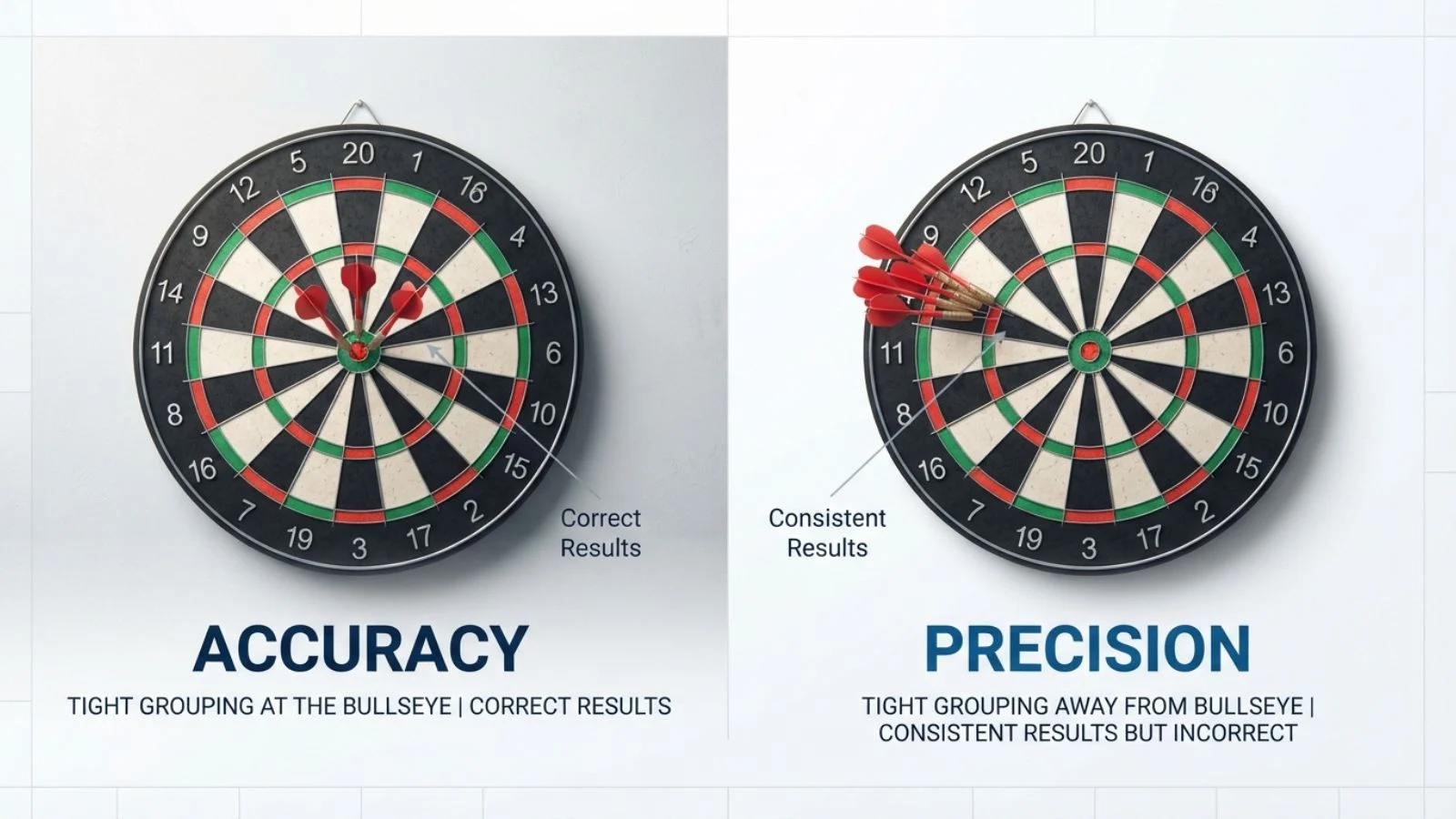
Accuracy is how close a measurement or result is to the true or accepted value. Precision is how close repeated measurements are to each other.
A result can be precise without being accurate, and it can be accurate without being precise. The best results are both.
Key Takeaways
- Accuracy measures closeness to the true value.
- Precision measures consistency between repeated measurements.
- Precise results can still be wrong if the tool is biased.
- Accurate results can still vary if the tool is noisy.
- Checking both requires comparing results to a known standard and repeating the measurement.
What Is Accuracy?
Accuracy describes how close a measured or calculated value is to the true value. If you weigh a bag of flour that is exactly 1,000 grams and your scale reads 999 grams, the reading is very accurate. If it reads 1,150 grams, it is not.
In everyday language, people use “accurate” to mean correct or free from mistakes. A weather forecast is accurate when the predicted temperature matches what actually happens. A map is accurate when the streets are where they should be.
Accuracy in Everyday Language
In daily conversation, “accurate” often describes a statement or a record. A news report is accurate if its facts match the events. A recipe is accurate if its measurements produce the dish it describes.
What Is Precision?
Precision describes how consistent a set of measurements is. If you weigh the same bag of flour five times and get 1,000.1, 1,000.2, 999.9, 1,000.0, and 1,000.1 grams, your readings are precise. They cluster tightly together, even if you do not know the true weight.
Precision says nothing about whether the readings are correct. Five identical wrong readings are still precise.
Precision in Everyday Language
People often use “precise” to mean detailed or exact. A precise address includes the apartment number. A precise instruction tells you exactly what to do. In measurement, though, precision is about repeatability, not detail.
Accuracy vs Precision: The Key Difference
The simplest way to remember the difference is to picture an archery target.
Accuracy is how close the arrows land to the bullseye. Precision is how close the arrows land to each other. Accuracy looks at the center. Precision looks at the grouping.
Because accuracy compares a result to a true value, you need to know that true value to judge it. Precision only compares results to each other, so you can judge it using the data alone.
Four Possible Outcomes
Combining these two ideas gives four possible outcomes.
Accurate and precise. The arrows are tightly grouped near the bullseye. This is the goal in most measurement work.
Precise but not accurate. The arrows are tightly grouped but far from the bullseye. This often happens when a tool is miscalibrated. A scale that always reads 5 grams heavy gives consistent readings that are consistently wrong.
Accurate but not precise. The arrows are scattered around the bullseye. On average they are near the center, but any single shot could be far off. A noisy instrument can produce this pattern.
Neither. The arrows are scattered and far from the center. This suggests both a bias and a lack of control in the process.
Why Accuracy and Precision Are Different Problems
Each quality is affected by a different type of error, which is why they can vary independently.
Systematic Error
Systematic error pushes every result in the same direction. A ruler with a worn end, a thermometer that reads 2 degrees high, or a balance that was never zeroed all cause systematic error. Systematic error reduces accuracy but does not necessarily reduce precision.
Random Error
Random error causes results to scatter unpredictably. Small changes in temperature, hand movement, or electrical noise can cause it. Random error reduces precision. Taking many measurements and averaging them can reduce its effect on the average.
Because the errors are different, fixing one does not automatically fix the other. Recalibrating a scale improves accuracy. Using a steadier method or a better instrument improves precision.
How to Check Accuracy and Precision
You can test both qualities with a simple process.
- Measure a reference sample with a known true value, such as a certified weight or standard solution.
- Repeat the measurement several times, usually at least five.
- Calculate the average of the results and compare it to the true value. The gap between them shows accuracy. Percent error is often used for this.
- Calculate the standard deviation of the results. A smaller value means higher precision.
If the average is close to the true value but the standard deviation is large, the measurement is accurate but not precise. If the standard deviation is small but the average is far off, the measurement is precise but not accurate.
Accuracy vs Precision in Everyday Speech
Outside of science, the two words are often used interchangeably, and that is usually fine. Someone who says “your estimate was precise” may simply mean it was specific. Problems start when the words are used in technical settings, such as lab reports, engineering specifications, or medical devices, where the distinction changes the meaning.
In writing, a useful test is to ask: am I describing how close something is to the truth, or how consistent or detailed it is? Choose the word that matches your answer.
Frequently Asked Questions
Can a measurement be both accurate and precise?
Yes. This is the goal of most measurement work. It means the results are consistent with each other and close to the true value. Reaching it usually requires a calibrated tool, a controlled method, and repeated measurements.
Which matters more, accuracy or precision?
It depends on the task. For a single measurement that must be correct, such as a medication dose, accuracy matters most. For detecting small changes over time, precision often matters more, as long as the bias is known and stable. In most serious work, both are needed.
What is an example of accuracy and precision?
A digital thermometer that reads 37.0 degrees each time you measure a patient who is actually 37.0 degrees is both accurate and precise. A thermometer that reads 38.5 every time is precise but not accurate. One that reads anywhere from 36 to 39 around a true 37.0 is accurate on average but not precise.
Conclusion
Accuracy and precision are both measures of quality, but they answer different questions. Accuracy asks if a result is close to the truth. Precision asks whether repeated results agree with each other.
A tool can be consistent and still wrong, or roughly correct and still inconsistent. Knowing which problem you have tells you what to fix: calibrate the instrument for bias, and tighten the method to reduce scatter.
The best approach is to check both. Measure a known reference, repeat the process, and compare the average to the true value and the spread of the results to each other.
Once you can tell the two apart, you can read data more carefully, explain results more clearly, and avoid trusting a number just because it looks exact.