A boysenberry is a hybrid fruit created from blackberry, raspberry, and loganberry parents, while a blackberry is a naturally occurring bramble fruit.
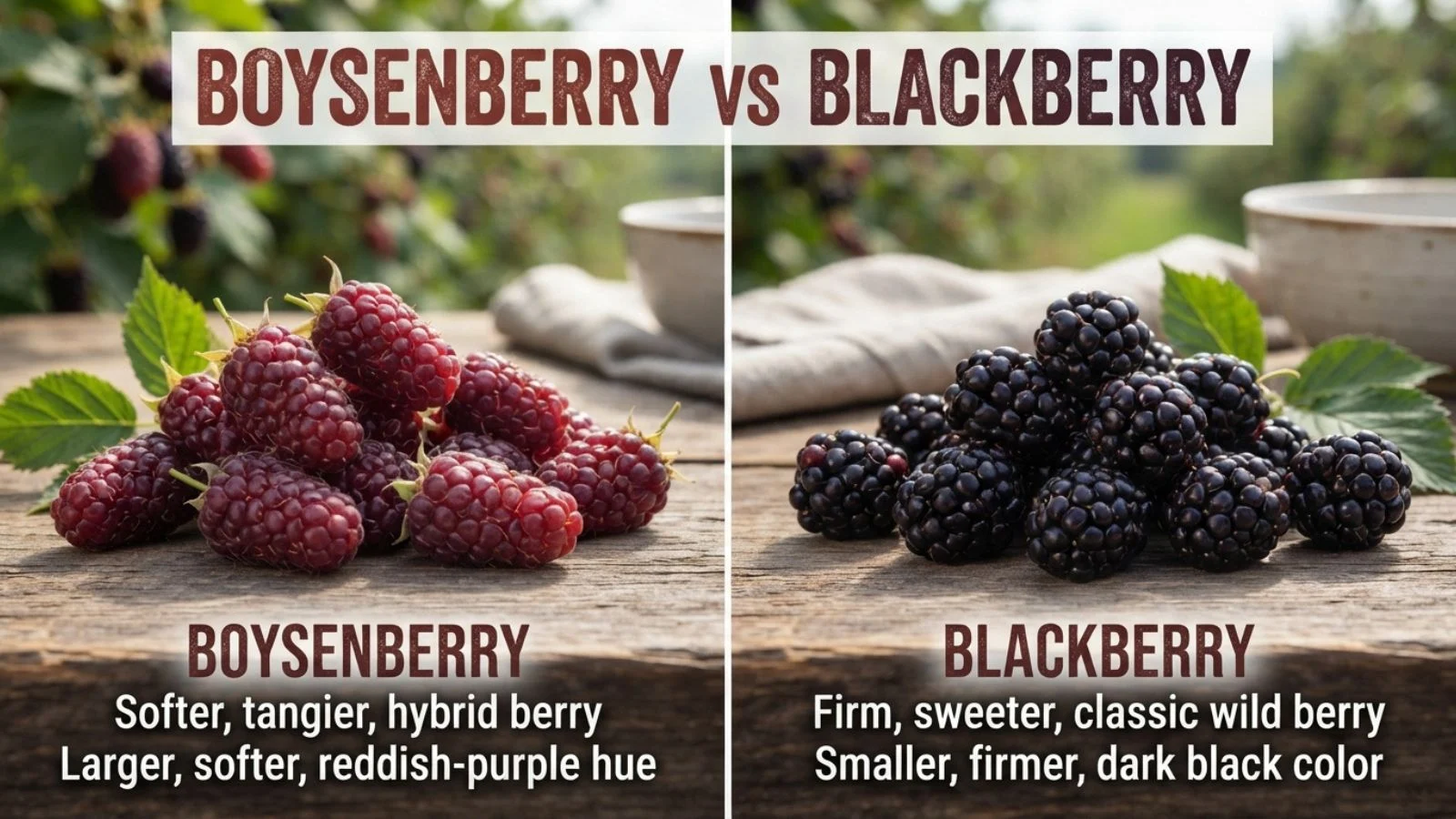
Boysenberries are larger, softer, and more purple with a sweeter, more floral flavor. Blackberries are smaller, firmer, glossier black, and slightly tarter.
Key Takeaways
- Boysenberries are a man-artificial cross of blackberry, raspberry, and loganberry, developed in California in the 1920s.
- Blackberries are a naturally occurring wild fruit found across the world.
- Boysenberries are larger, deep purple, and softer; blackberries are smaller, black, and firmer.
- Boysenberries taste sweeter with a floral, tangy edge; blackberries are more straightforwardly tart-sweet.
- You can usually swap blackberries for boysenberries in recipes, though the flavor and texture will shift slightly.
What Is a Boysenberry?
The boysenberry is a hybrid berry. It doesn’t grow wild; it was deliberately bred by crossing a blackberry, a raspberry, and a loganberry. The berry gets its name from Rudolph Boysen, a California horticulturist who first experimented with the cross in the 1920s. Walter Knott, founder of Knott’s Berry Farm, later rescued Boysen’s struggling vines, perfected the fruit, and artificial it famous. Knott’s Berry Farm still celebrates the boysenberry with its own festival every spring.
Boysenberries ripen to a deep reddish-purple color and grow bigger than most blackberries. They’re also more fragile, with a short growing season, which is one reason you rarely see them fresh in grocery stores.
What Is a Blackberry?
Blackberries are a true, naturally occurring bramble fruit that has grown wild for centuries across North America, Europe, and Asia. Unlike the boysenberry, no one had to engineer it; it’s simply part of the Rubus genus that includes raspberries, dewberries, and other cane fruits.
Blackberries grow on upright or semi-upright canes, ripen to a glossy black color, and hold their shape well after picking. That firmness is a big reason blackberries show up in grocery stores far more often than boysenberries do.
Boysenberry vs Blackberry: Side-by-Side Comparison
Comparison Table
| Feature | Boysenberry | Blackberry |
| Origin | Hybrid (blackberry x raspberry x loganberry), 1920s California | Naturally occurring, ancient origin |
| Color | Deep reddish-purple | Glossy black |
| Size | Larger | Smaller |
| Texture | Soft, delicate | Firmer, holds shape |
| Flavor | Sweet, floral, tangy | Tart-sweet, slightly earthy |
| Plant growth | Trailing canes | Upright or semi-upright canes |
| Availability | Rare fresh, mostly frozen or jam | Widely available fresh |
| Common uses | Jam, pie filling, wine, syrup | Fresh eating, baking, smoothies, jam |
Taste Differences
This is usually what people actually want to know. Boysenberries taste like a cross between a blackberry and a raspberry. They carry the deep, juicy intensity of a blackberry along with the sweet, floral notes of a raspberry, plus a bit more tang than either parent fruit. Blackberries, by comparison, taste more straightforwardly tart with a mild sweetness and a slightly woody or earthy undertone, especially when they’re not fully ripe.
If you’ve ever had a jar of boysenberry jam next to blackberry jam, the boysenberry version usually tastes rounder and sweeter, while the blackberry version tastes brighter and a little more tart.
Appearance and Size
Boysenberries are noticeably larger than blackberries and rounder, more like a marble shape. Their color leans purple rather than true black, and their seeds tend to be smaller. Blackberries are more oblong, almost cone-shaped, with a deep black color and larger, more noticeable seeds.
Because boysenberries are softer and juicier, they bruise and spoil faster after picking. Blackberries hold up better during shipping and storage, which is part of why they’re the more common option at the grocery store.
Where Each Berry Comes From
Blackberries have no single point of origin; they’ve grown wild across multiple continents for thousands of years and were used in food and folk medicine long before modern agriculture. Boysenberries, on the other hand, have a very specific and recent history. Rudolph Boysen began crossing blackberries, raspberries, and loganberries on his California farm in the 1920s. His vines struggled, but Walter Knott took over the project, successfully cultivated the fruit, and started selling boysenberries commercially by the 1930s. Today, boysenberries are still closely associated with California and the Pacific Northwest.
Nutrition Comparison
Both berries are low-calorie, high-fiber fruits packed with antioxidants, but they’re not identical nutritionally. Per 100 grams, boysenberries tend to run slightly higher in calories and carbohydrates than blackberries, while blackberries are a bit lower in fat and sugar. Neither berry is a “better” choice nutritionally in any dramatic way; both are good sources of fiber, vitamin C, and anthocyanins (the antioxidant compounds that give berries their deep color). If you’re comparing labels or nutrition databases, expect the numbers to be close, with boysenberries usually landing a little higher in natural sugar content because of their sweeter flavor.
Can You Substitute One for the Other?
In most recipes, yes. Blackberries and boysenberries are close enough in flavor and texture that you can swap them in pies, jams, muffins, and sauces without ruining the dish. A few things to keep in mind:
- Sweetness: Boysenberries are sweeter, so if you swap in blackberries, you may want to add a little extra sugar.
- Texture: Boysenberries are softer and break down faster when cooked, so blackberry-based fillings may hold their shape a bit better.
- Color: Boysenberry desserts tend to look more purple-red than the deep black of blackberry desserts.
If a recipe specifically calls for boysenberry syrup or jam and you can’t find it, blackberry jam is the closest and most practical substitute, followed by a mix of blackberry and raspberry.
Why Boysenberries Are Harder to Find
Boysenberries have a short growing season typically late spring to early summer and they’re extremely delicate once picked. Unlike blackberries, which can be picked slightly underripe and still ship well, boysenberries are best at peak ripeness, which also happens to be when they’re most fragile. That combination of a short season and low shelf life means most boysenberries are sold frozen, canned, or turned into jam and syrup rather than sold fresh in supermarkets. If you want to try them fresh, a local farmers market or a farm that grows them, like Knott’s Berry Farm in California, is usually your best bet.
FAQs
Is a boysenberry a type of blackberry?
Not exactly. A boysenberry is a hybrid created by crossing a blackberry, a raspberry, and a loganberry. It’s related to the blackberry but is considered its own distinct fruit.
What does a boysenberry taste like?
Boysenberries taste like a blend of blackberry and raspberry juicy and deep like a blackberry, with the sweet floral quality of a raspberry and a bit more tang.
Can I substitute blackberries for boysenberries in a recipe?
Yes. Blackberries work well as a substitute, though the result will be slightly less sweet and less floral than the original boysenberry version.
Are boysenberries healthier than blackberries?
Not significantly. Both are low-calorie, fiber-rich, antioxidant-packed fruits. Boysenberries run a bit higher in calories and natural sugar, while blackberries are slightly lower in carbs.
Is boysenberry the same as loganberry?
No. A loganberry is one of the three parent fruits used to create the boysenberry, alongside blackberry and raspberry. Loganberries taste more tart and raspberry-like, without the sweetness of a boysenberry.
Conclusion
Boysenberries and blackberries share a family tree, but they’re not the same fruit. Blackberries are a natural, widely available bramble fruit with a firmer texture and tart-sweet flavor.
Boysenberries are a deliberately bred hybrid, larger and softer, with a sweeter, more floral taste and a much shorter window to enjoy them fresh.
For everyday baking and snacking, blackberries are the practical choice. For a specialty jam, pie, or a taste of California berry history, boysenberries are worth seeking out when they’re in season.