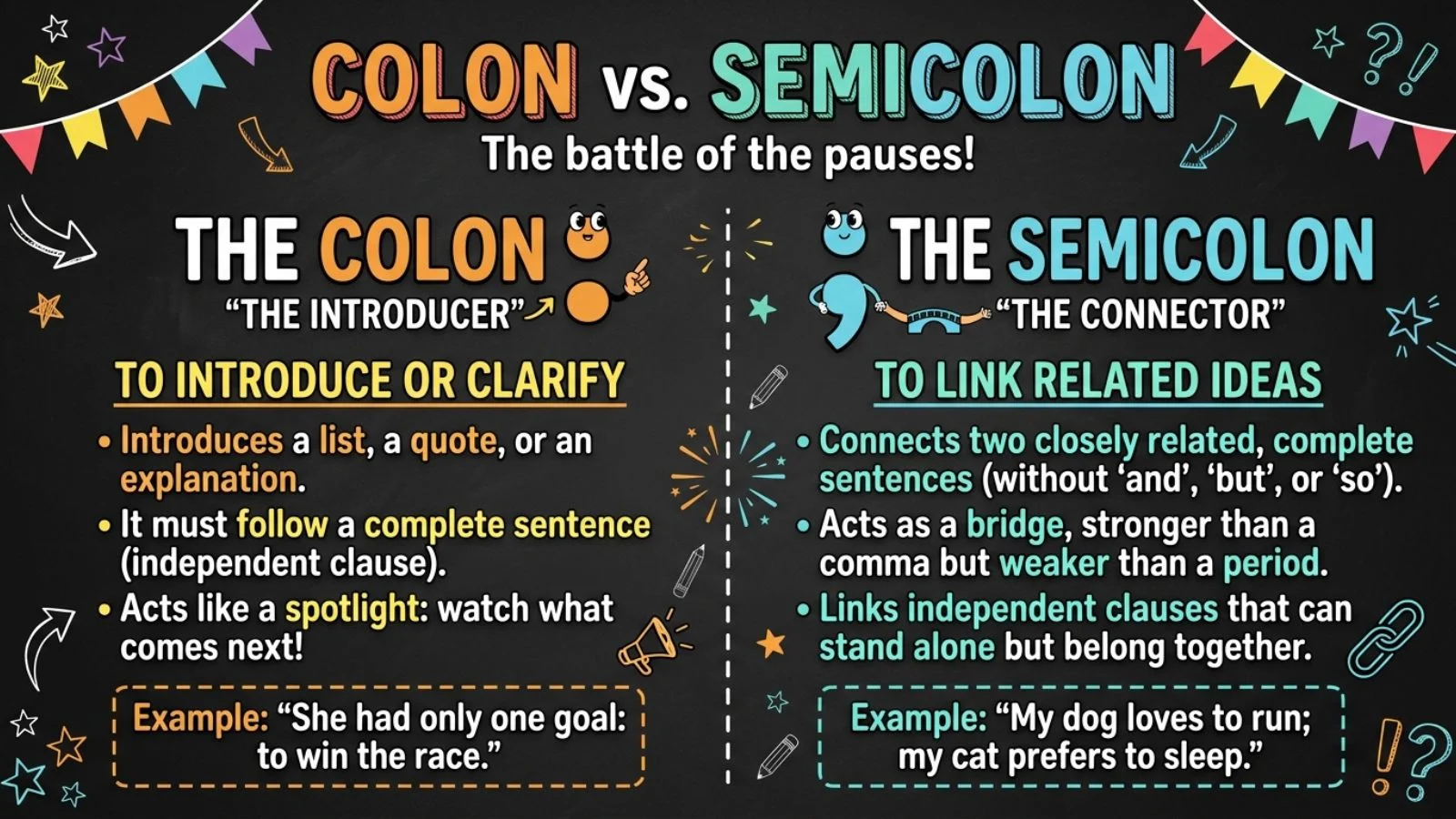
A colon (:) introduces something that follows from a complete sentence, such as a list, an explanation, or a quotation.
A semicolon (;) connects two closely related independent clauses, or separates items in a list when those items already contain commas.
The colon points forward. The semicolon links two complete thoughts that belong together.
Key Takeaways
- A colon introduces information. It must follow a complete sentence.
- A semicolon joins two independent clauses that are closely related.
- Use a semicolon before words like “however” or “therefore” when they connect two full sentences.
- Use semicolons to separate list items that contain commas.
- Capitalize the word after a colon only if it starts a complete sentence or is a proper noun.
Colons and semicolons look similar, and people mix them up all the time. The good news is that each mark has a clear job. Once you know the job, the choice becomes much easier.
What a Colon Does
A colon is a signal. It tells the reader, “Here comes the thing I promised.” The most important rule is that the words before a colon should form a complete sentence. The colon then introduces what comes next.
Here are three common uses.
To introduce a list: “The recipe needs three ingredients: flour, eggs, and milk.”
To introduce an explanation: “She had one goal: to finish the marathon before dark.”
To introduce a quotation: “The coach summed up the season in one word: patience.”
Notice that each sentence before the colon could stand alone. “The recipe needs three ingredients” is a full sentence. If you remove the colon, you still have a complete thought. That is the test.
Capitalization is a common point of confusion. In American usage, the word after a colon is usually lowercase. The exception is when what follows is a complete sentence or a proper noun. For example: “He gave me this advice: Always save your work before you close the file.” Some style guides differ on this, so check the one your publication uses.
What a Semicolon Does
A semicolon is a connector. It joins two independent clauses, which are groups of words that could each stand as a sentence. It is used when the two ideas are closely linked and the writer wants to show that link without a word like “and” or “but.”
“The meeting ran long; nobody seemed to mind.” Both halves are complete sentences, and the semicolon shows that they are connected.
A semicolon also works with conjunctive adverbs such as “however,” “therefore,” “moreover,” and “in fact.” Place the semicolon before the adverb and put a comma after it: “The store was closed; however, the office was open.” Writers often forget the comma after “however,” so it is worth checking.
Semicolons have one more job that many guides overlook. They separate items in a list when those items already contain commas. Imagine a sentence listing three people with their job titles: “The panel included Maria Lopez, the director; Jon Park, the designer; and Ana Ruiz, the editor.” Using commas alone would make the list hard to follow. The semicolons keep each item clear.
Colon vs Semicolon at a Glance
| Feature | Colon (:) | Semicolon (;) |
| Main job | Introduces what follows | Connects related ideas or separates complex list items |
| What comes before it | A complete sentence | A complete sentence |
| What comes after it | A list, explanation, quote, or example | Another complete sentence or a conjunctive adverb |
| Example | “She packed one thing: her camera.” | “She packed her camera; he packed the tent.” |
| Capitalization after it | Usually lowercase unless a complete sentence or proper noun follows | Not applicable (the next word is usually lowercase) |
Common Mistakes to Avoid
The most frequent error is using a colon after an incomplete sentence. For example, “My favorite fruits are: apples, pears, and plums” is incorrect because “My favorite fruits are” cannot stand on its own. Remove the colon, or rewrite the sentence as “My favorite fruits are apples, pears, and plums.”
Another common mistake is using a semicolon before a coordinating conjunction such as “and” or “but.” When you join two clauses with these words, a comma is correct. Write “I finished the report, and I sent it to my manager.” A semicolon would be acceptable here, but it is not the standard choice for most everyday writing.
Writers also overuse semicolons. One or two in a long piece is usually enough. If your sentences keep getting longer, consider splitting them into shorter sentences. Clear writing is more important than showing off punctuation.
Other Uses of the Colon
The colon has a few additional roles that come up in everyday writing. In time expressions, it separates hours and minutes, as in 3:30 p.m. In American business letters, it follows a salutation, as in “Dear Ms. Chen:”. It also separates a title from a subtitle, such as “Punctuation Basics: A Guide for Writers.” These uses follow their own conventions, so they do not depend on the complete-sentence test.
Frequently Asked Questions
Can I use a colon and a semicolon in the same sentence?
Yes, though it is uncommon. A colon might introduce a list, and semicolons might separate complicated items within that list. The result should still be easy to read. If it becomes confusing, split the sentence.
Is a semicolon the same as a comma?
No. A comma can join two independent clauses only when paired with a conjunction like “and” or “but.” A semicolon can join them alone. A semicolon is also stronger than a comma, meaning it creates a bigger pause.
Which one is easier to use correctly?
The colon is usually easier because its rule is simple: put a complete sentence before it and the item you want to introduce after it. The semicolon takes more practice, but the two-clause pattern becomes familiar quickly.
Conclusion
The colon and semicolon are small marks, but they do important work. The colon introduces what comes next, such as a list, an explanation, or a quotation, and it must follow a complete sentence.
The semicolon connects two closely related independent clauses, and it also separates list items that already contain commas. Once you remember these two jobs, the choice becomes much easier.
When you are unsure, read the sentence before the mark. If it stands on its own and you are pointing to something that follows, use a colon.
If you are linking two complete thoughts that belong together, use a semicolon. Reading your work aloud is also a useful check, because your ear often catches a misplaced mark before your eyes do.
Punctuation is a tool for clarity, not decoration. Use these marks when they help your reader follow your ideas, and do not force them into every sentence. Clear, simple sentences almost always beat complicated ones with a semicolon in the middle.