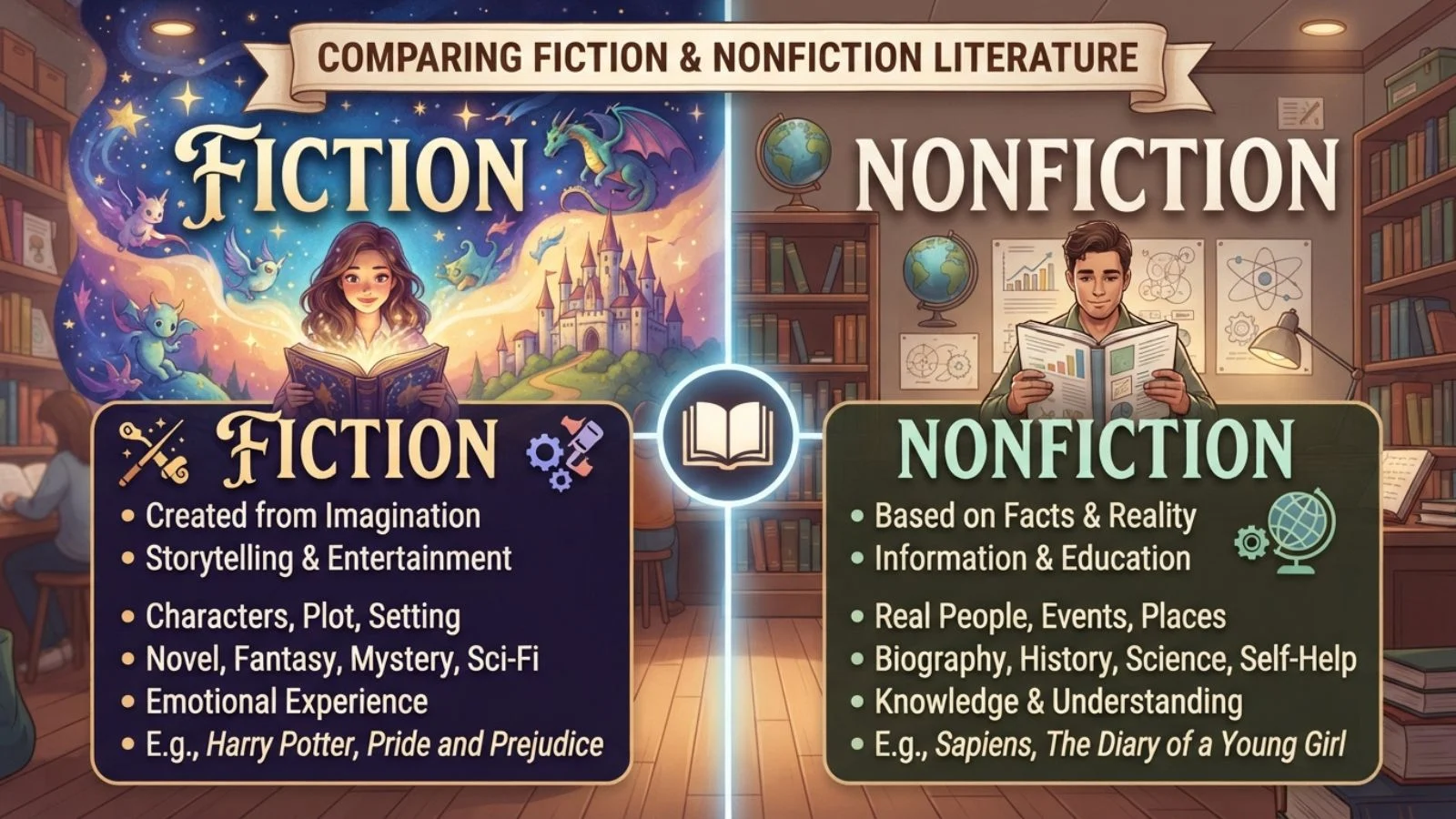
Fiction is writing about invented people, places, and events created from the author’s imagination.
Nonfiction is writing about real people, places, and events that can be checked against facts. The key difference is the source of the content: fiction is made up, while nonfiction is meant to be true.
Key Takeaways
- Fiction comes from imagination, even when it feels realistic.
- Nonfiction is based on real events, people, and verifiable facts.
- Nonfiction writers have a duty to be accurate, so mistakes can damage credibility.
- Some works, like memoirs and creative nonfiction, use fiction techniques while staying true to facts.
- Bookstores and libraries shelve books by these categories, but labels like “a novel” or “based on a true story” help readers decide.
What Is Fiction?
Fiction is storytelling built from imagination. Its characters, settings, and plots may be invented, although many fiction writers draw on real places, feelings, and experiences. A novel about a family in a small Texas town is fiction even if the town exists and the author once lived there.
Examples of Fiction
Common examples include novels like Pride and Prejudice by Jane Austen, short stories, fantasy books, and most science fiction. Even stories set in the real world are fiction if the people and events were made up.
What Is Nonfiction?
Nonfiction is writing about things that actually happened. It includes history, biography, journalism, science writing, self-help guides, and essays. Its main promise to the reader is that the information is accurate.
Because nonfiction claims to be true, readers expect careful research. A few invented details in a novel may go unnoticed, but a few made-up facts in a history book can destroy trust in the whole work.
Examples of Nonfiction
Examples include a biography of a president, a science book about how vaccines work, a newspaper investigation, and a travel guide. Each one is built on sources that a reader could check.
Fiction vs Nonfiction: Key Differences
| Feature | Fiction | Nonfiction |
| Source | Imagination | Real events and people |
| Main goal | Entertain, move, or explore ideas | Inform, explain, or document |
| Truth standard | Not required to be factual | Expected to be accurate |
| Characters | Often invented | Real people |
| Research | Helpful but optional | Essential |
| Typical examples | Novels, short stories | Biographies, history, journalism |
The main difference is the promise the writer makes. A fiction writer tells the reader, through the label and the genre, that the story is invented. A nonfiction writer promises that the story is true to the best of their knowledge.
Why the Line Sometimes Blurs
Some books mix the two. Readers may find it hard to tell where one ends and the other begins.
Creative Nonfiction
Creative nonfiction, also called literary nonfiction, tells true stories with the tools of fiction, such as scenes, dialogue, and vivid description. Truman Capote’s In Cold Blood is a well-known example. It is nonfiction because it reports real events, but Capote’s detailed scenes make it read like a novel.
Many writers of creative nonfiction rebuild dialogue from memory or interviews. Good ones say so in their notes or introduction.
Based on a True Story
A novel labeled “based on a true story” is usually fiction. The author took real events as a starting point but changed names, timelines, or details. The label signals that the book is inspired by real life, not that it is a factual record.
Memoir
A memoir is a nonfiction account of the author’s own life. Memory is imperfect, so memoirs can contain small errors, but they should still reflect what the author honestly remembers.
How Libraries and Bookstores Classify Books
In most U.S. libraries and bookstores, books are shelved by genre first, then by whether they are fiction or nonfiction. Fiction is often arranged alphabetically by the author’s last name. Nonfiction usually follows a classification system, such as the Dewey Decimal System, which groups books by subject.
Publishers also use labels. A book marked “a novel” is almost always fiction, even when it draws on real events.
How to Tell Which Is Which
Ask yourself these questions:
- Does the book describe real people, places, or events?
- Does the author cite sources, notes, or an index?
- Does the cover or subtitle say “a novel,” “a memoir,” or “a history”?
- Does the author explain what parts were reconstructed or changed?
If most answers point to real events and sources, the book is probably nonfiction. If the author admits to inventing characters or scenes, the book is fiction, even if it feels true.
Frequently Asked Questions
Is nonfiction fake?
No. Nonfiction is meant to be true, so calling it fake misses its purpose. A nonfiction book can still contain errors or biased interpretations, but it is not invented. Its value depends on how carefully the author checked the facts.
Can nonfiction include made-up parts?
Some nonfiction includes reconstructed dialogue or composite characters, especially in creative nonfiction. Responsible writers say so in an author’s note. Invented events that are presented as fact would make the work misleading.
Is memoir fiction or nonfiction?
A memoir is nonfiction. It tells the author’s own life story. Memories can be incomplete, so some details may be shaped by time, but the book should still aim to be honest.
Is poetry fiction or nonfiction?
Poetry can be either. A poem about a real event or feeling can be nonfiction, while an imagined poem is fiction. Many poets blend both.
Is a novel based on true story fiction?
Yes. Even when a novel uses real events, the characters, dialogue, or timeline are usually changed or invented, so it is categorized as fiction.
Conclusion
Fiction and nonfiction differ at their core. Fiction invents its people and events, while nonfiction reports what really happened and holds itself to the truth.
Knowing this difference helps readers choose the right book, and it helps writers understand the promise they make to their audience.
The line is not always sharp. Creative nonfiction, memoirs, and “based on a true story” novels mix the two, so it’s worth checking the label, the author’s notes, and the sources when you’re unsure. When in doubt, ask one simple question: is this story meant to be true?