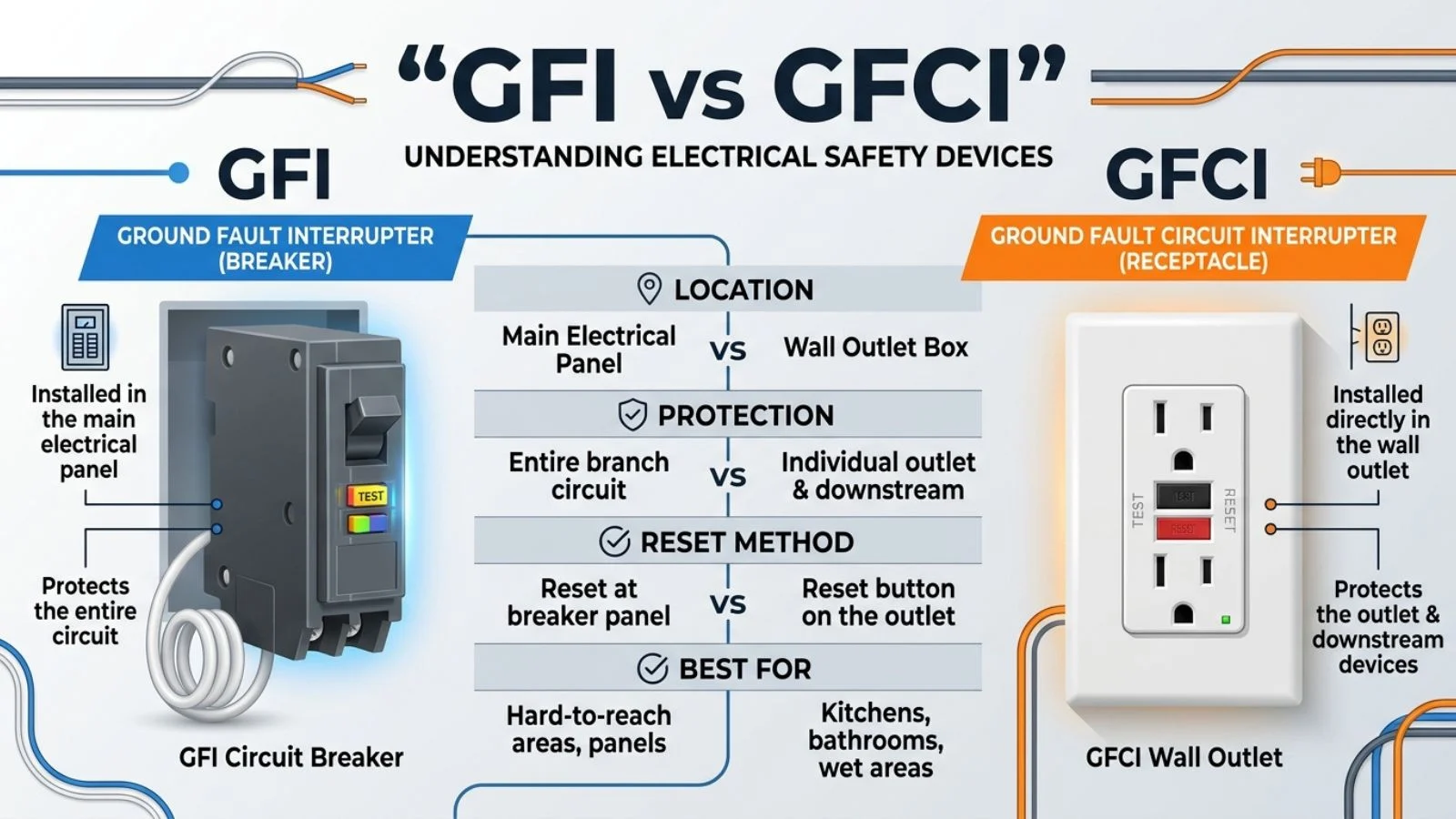
A GFI and a GFCI are the same device both names refer to a ground-fault circuit interrupter, a safety device that shuts off power when it detects electricity leaking to ground.
“GFCI” is the term used most often in the United States, while “GFI” is a shorter version of the same name.
Key Takeaways
- GFI and GFCI mean the same thing. “Gfic” is a common misspelling.
- A GFCI cuts power in a fraction of a second when current leaks to ground.
- US electrical code requires GFCI protection in many wet and outdoor locations.
- GFCI protection can come from an outlet or a circuit breaker.
- Test your GFCI devices monthly by pressing the TEST button.
What Does GFCI Stand For?
GFCI stands for ground-fault circuit interrupter. The name describes what the device does. It watches the current flowing through a circuit. Normally, the current going out on the hot wire returns on the neutral wire. If some of that current escapes and flows to ground, the device detects the imbalance and interrupts the circuit.
You may also see the device called a ground-fault interrupter. Dropping the word “circuit” does not change what the device is. Electricians, store packaging, and product listings use both terms, often in the same sentence.
Is a GFI the Same as a GFCI?
Yes. In everyday use, GFI and GFCI refer to the same protective device. Some homeowners search for “GFI vs GFCI” because they see both on a box or in a code book and assume two different products exist. They do not.
The confusion usually comes from a few sources:
- Shorthand: People drop the “C” when speaking casually.
- Spelling mistakes: Searches for “Gfic” are usually typos for GFCI.
- Different countries: Canada and the United States both use GFCI in many contexts, but other countries use the term RCD (residual current device) for a similar function. The principle is related, but RCD standards and wiring rules differ.
If you are shopping, look for a device labeled GFCI or ground-fault interrupter. Either label means you are getting the same protection.
How a GFCI Protects You
A GFCI does not stop an overload or a short circuit. A standard circuit breaker handles those. The GFCI handles a different hazard: current leaking through a path it should not take, such as through a person.
When you touch a live wire and a grounded surface at the same time, some current passes through your body. A GFCI is designed to trip when it detects a small leakage, typically around 5 milliamps, and to do so very quickly. Standard UL-listed GFCIs must trip before harmful current can cause serious injury in most cases, though no device prevents shock entirely.
Because of this, a GFCI protects people more than it protects wiring or appliances.
Where US Code Requires GFCI Protection
The National Electrical Code (NEC), published by the NFPA, lists the locations that need GFCI protection. The list grows with each edition. Common locations include:
- Bathrooms
- Kitchens, especially countertop outlets
- Garages
- Outdoors
- Basements and crawl spaces
- Laundry areas
- Unfinished areas
- Near sinks, including wet bars and utility sinks
Local codes can add requirements or change the timing for adoption. Your city or county building department can tell you which edition applies to your home.
GFCI Outlets vs GFCI Breakers
GFCI protection comes in two main forms.
GFCI outlets (receptacles) replace a standard outlet. They protect the outlet itself and sometimes other outlets wired downstream. Their test and reset buttons sit on the front of the outlet.
GFCI circuit breakers are installed in the electrical panel. They protect every outlet, light, or appliance on that circuit. They are useful when outlets are hard to reach or when a whole circuit needs protection.
Either type works. The right choice depends on your wiring, your budget, and whether you want protection at one spot or across a whole circuit.
How to Test and Reset a GFCI
Testing takes less than a minute:
- Press the TEST button. The device should click, and the RESET button should pop out.
- Plug a lamp or small appliance into the outlet. The light should go off.
- Press RESET to restore power.
Test your GFCIs once a month. If the device does not trip when you press TEST, or if it trips repeatedly without a clear cause, stop relying on it and have a licensed electrician inspect it. Do not bypass a GFCI by wiring over it, because that removes the protection you are paying for.
GFCI vs AFCI: Quick Comparison
People sometimes mix up GFCIs with AFCIs (arc-fault circuit interrupters). They protect against different problems.
| Feature | GFCI | AFCI |
| Full name | Ground-fault circuit interrupter | Arc-fault circuit interrupter |
| Detects | Current leaking to ground | Dangerous electrical arcing |
| Main purpose | Prevent shock | Reduce fire risk |
| Common locations | Bathrooms, kitchens, garages, outdoors | Bedrooms, living areas, and other general spaces |
Many modern homes need both types in different parts of the house.
Common Mistakes to Avoid
- Ignoring nuisance trips. If a GFCI trips often, find the cause, such as a damp appliance or a faulty cord.
- Plugging a GFCI into a non-GFCI outlet and expecting protection. Only the GFCI device itself and any downstream outlets it protects are covered.
- Assuming an old outlet is protected. Many older homes lack GFCI protection in required areas.
- Replacing a GFCI with a standard outlet to fix a trip. This removes the safety feature.
FAQs
Is GFI the same as GFCI?
Yes. Both terms describe the same ground-fault circuit interrupter. GFCI is the more common term in the United States.
What does GFCI stand for?
GFCI stands for ground-fault circuit interrupter.
Is “GFIC” a real term?
No. It is a misspelling of GFCI. Search results for that spelling should lead to the same information.
Do I need GFCI outlets in my house?
Most likely, yes, in areas such as bathrooms, kitchens, garages, and outdoor spaces. Requirements depend on your local code and the year your home was built or last updated. A licensed electrician or your local building department can confirm what applies to you.
Can I install a GFCI myself?
Some homeowners do this, but electrical work carries real risk. If you are not comfortable turning off power and identifying wires, hire a licensed electrician.
How often should I test a GFCI?
Test it once a month and after any storm or power surge.
Conclusion
GFI aur GFCI alag cheezein nahi hain. Dono naam ek hi safety device ke liye use hote hain, jo zameen mein leak hone wali bijli ko pehchan kar circuit ko jaldi band kar deta hai. Practical taur par, aapko sirf yeh yaad rakhna hai ke jahan code GFCI protection maangta hai, wahan yeh device aapki aur aapke ghar walon ki hifazat karta hai. Har mahine TEST button dabakar isay check karte rahen, aur agar yeh baar baar trip ho ya kaam na kare to kisi licensed electrician se masla theek karwayen.