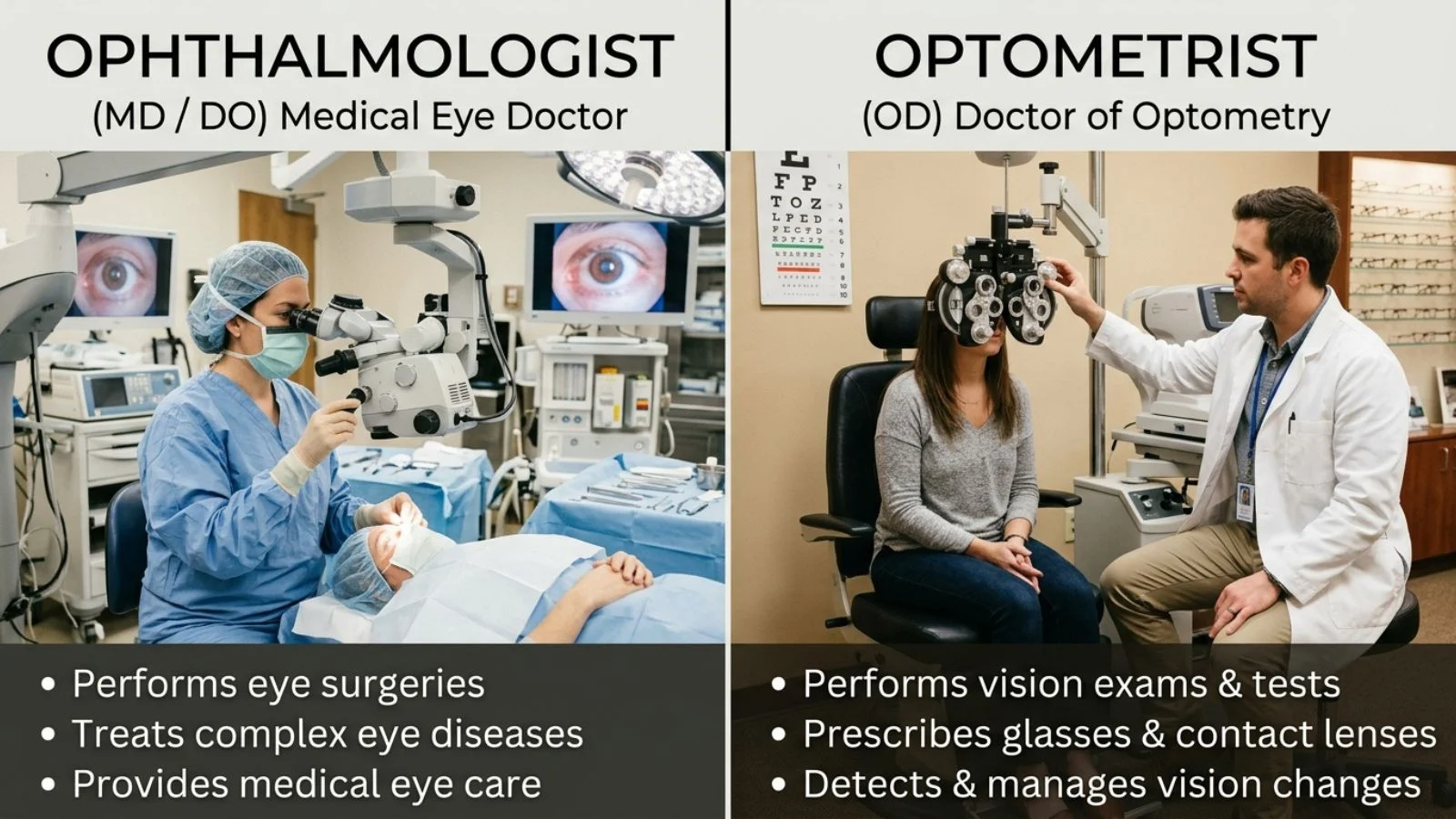
An optometrist (OD) provides routine eye exams, prescribes glasses and contact lenses, and manages many common eye conditions.
An ophthalmologist is a medical doctor (MD or DO) who completes medical school and a specialty residency, and can diagnose and treat all eye diseases and perform eye surgery.
For routine vision care, an optometrist is usually the right first stop. For surgery or complex eye disease, you need an ophthalmologist.
Key Takeaways
- Optometrists earn a Doctor of Optometry (OD) degree after college and about four years of optometry school.
- Ophthalmologists go to medical school and then complete a multi-year residency in eye care.
- Both can perform eye exams, prescribe glasses and contacts, and in most states prescribe eye medications.
- Ophthalmologists perform eye surgery. Optometrists generally do not, though a few states allow limited laser procedures.
- Start with an optometrist for routine care. Your optometrist can refer you to an ophthalmologist when needed.
What Is an Optometrist?
An optometrist is a primary eye care provider. Most people who visit an eye doctor for a checkup see an optometrist. Optometrists test how well you see, check your eye health, and correct vision problems with glasses, contact lenses, or other tools.
Training and Licensing
Optometrists first complete a bachelor’s degree, usually with science coursework such as biology, chemistry, and physics. They then spend about four years in a college of optometry and earn the Doctor of Optometry (OD) degree. After that, they must pass national and state exams to get a license. They also take continuing education courses to keep their license current.
Services Optometrists Provide
Optometrists handle a wide range of everyday care. They perform comprehensive eye exams, prescribe eyeglasses and contact lenses, and screen for common conditions such as glaucoma and diabetic eye changes. They also manage many conditions like dry eye, pink eye, and mild infections. In most states, they can prescribe oral and topical medications for eye conditions. Some also offer low-vision rehabilitation and vision therapy.
What Is an Ophthalmologist?
An ophthalmologist is a medical doctor who specializes in eye and vision care. The name comes from the Greek word for eye, and the training is what sets this specialty apart.
Medical Training
To become an ophthalmologist, a person completes a bachelor’s degree, then four years of medical school. After medical school, they finish a one-year internship in general medicine, pediatrics, or surgery. They then complete a three-year residency focused on eye care. Many go on to a fellowship for further training in a subspecialty, such as retina, cornea, glaucoma, or pediatric eye care.
Surgery and Specialty Care
Ophthalmologists treat the full range of eye problems, including complex diseases that affect the eye and the rest of the body. They diagnose and manage cataracts, glaucoma, macular degeneration, diabetic retinopathy, and eye infections. They also perform surgery, including cataract removal, retinal repair, corneal procedures, and some eyelid surgery. Because they have medical training, they also understand how conditions like diabetes or autoimmune disease can affect the eyes.
Ophthalmologist vs Optometrist: Side-by-Side Comparison
| Feature | Optometrist | Ophthalmologist |
| Degree | Doctor of Optometry (OD) | Medical Doctor (MD or DO) |
| Post-college training | About 4 years of optometry school | About 4 years of medical school, plus residency |
| Routine eye exams | Yes | Yes |
| Prescribes glasses and contacts | Yes | Yes |
| Prescribes eye medications | Yes, in most states | Yes |
| Treats most eye diseases | Many common conditions | All eye conditions |
| Performs eye surgery | Generally no | Yes |
| Typical role | Primary eye care | Medical and surgical eye care |
Can an Optometrist Perform Eye Surgery?
In most cases, no. Optometrists are not trained in surgical procedures such as cataract removal or retinal surgery. A small number of states allow optometrists to perform certain laser procedures, and the rules differ from state to state. Even in those states, the scope is narrow. Optometrists can still provide the before-and-after care for a surgery, such as pre-operative exams and post-operative checkups, even when an ophthalmologist does the operation.
Which Eye Doctor Should You See?
The right choice depends on what you need.
For routine care and glasses
If you need a regular eye exam, a new prescription, contact lenses, or help with dry eye or mild irritation, an optometrist is a good place to start. Most people can get this care with an optometrist alone.
For eye disease or surgery
If you have a serious eye condition, sudden vision loss, a retinal problem, or a need for surgery, see an ophthalmologist. If your optometrist finds a problem outside their scope, they will refer you. You can also ask for a referral if you have a condition that needs specialist care, such as glaucoma or a retinal disorder.
Some symptoms need urgent care no matter which doctor you choose. Sudden vision loss, flashes of light with a sudden rise in floaters, or severe eye pain should be checked right away.
How They Work Together
Optometrists and ophthalmologists often work as a team. An optometrist may spot early signs of disease and refer you to an ophthalmologist for treatment. After surgery, many patients return to their optometrist for follow-up care and new glasses. Some patients keep an optometrist for routine care and see an ophthalmologist for specialty needs. This is a common and reasonable setup.
Frequently Asked Questions
Is an optometrist a real doctor?
Yes. An optometrist holds a Doctor of Optometry (OD) degree and is licensed by the state to provide primary eye care. An optometrist is not a medical doctor, though, and does not hold an MD or DO degree.
Is an ophthalmologist better than an optometrist?
Neither is better overall. An ophthalmologist has more medical and surgical training, so they are better suited for complex eye disease and surgery. An optometrist is well suited to routine eye care and vision correction. The right choice depends on your needs.
Do I need an ophthalmologist to get glasses?
No. An optometrist can examine your eyes and write a prescription for glasses or contact lenses. Ophthalmologists can also do this, but most people do not need to see one for that alone.
Can an optometrist prescribe medicine?
In most states, yes. Optometrists can prescribe eye drops and some oral medications for eye conditions. The specific medications they can prescribe depend on state law.
Who should I see first for an eye problem?
For most problems, start with an optometrist. They can diagnose many conditions and refer you to an ophthalmologist when needed. If you have a severe or sudden problem, go to an emergency room or see an ophthalmologist directly.
Conclusion
Ophthalmologists and optometrists both care for your eyes, but they train differently and do different work.
An optometrist is usually the best first stop for eye exams, glasses, contact lenses, and common eye problems.
An ophthalmologist is the right choice for serious eye disease, complex conditions, and eye surgery.
For most people, the simplest approach is to start with an optometrist. If a problem needs more care, your optometrist can refer you to an ophthalmologist.
If you have sudden vision loss, severe eye pain, or a sudden change in your vision, don’t wait for an appointment. Seek care right away.