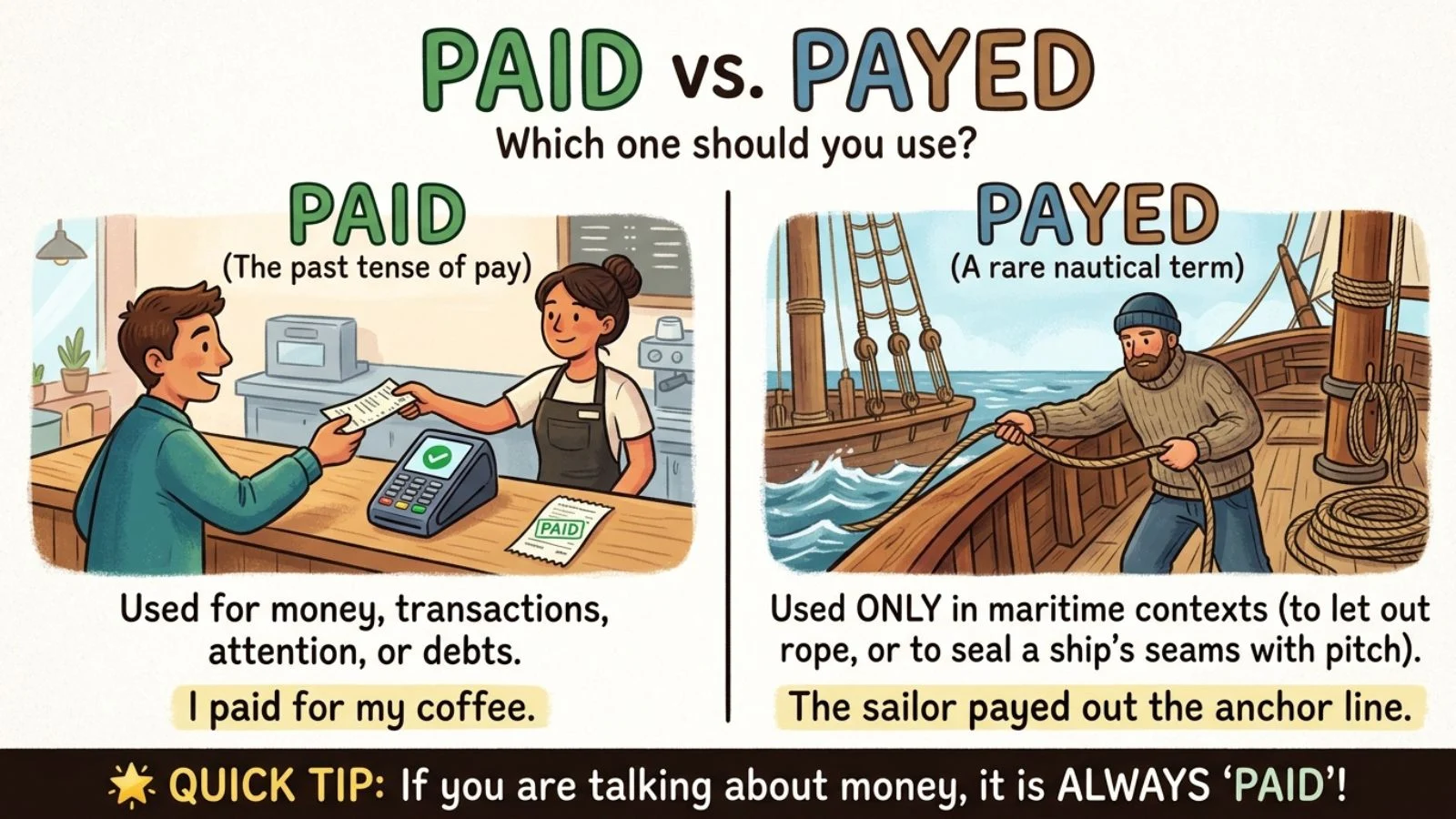
Paid is the correct past tense and past participle of “pay” in almost every situation, including money, bills, and favors.
Payed is a rare, specialized spelling used only in nautical contexts for coating a boat with tar or grease, or for releasing (paying out) a rope or chain.
Key Takeaways
- Use paid for anything related to money, time, attention, or general use of the verb “pay.”
- Use payed only in nautical settings: coating a ship’s surface or letting out rope.
- “Paid attention” and “paid off” are always correct “payed” never appears in these phrases.
- If you’re not writing about ships or sailing, you almost certainly want “paid.”
- When in doubt, “paid” is the safe choice 99% of the time.
What’s the Difference Between Payed and Paid?
“Pay” is an irregular verb, so its past tense doesn’t follow the normal “add -ed” rule in a straightforward way. Most people only ever need one spelling: paid.
“Payed” exists, but it’s a leftover from older nautical English. Sailors still use it today in two narrow situations. Outside of boats, ropes, and the sea, “payed” is considered a misspelling.
When to Use “Paid”
Paid for Money and Transactions
Use “paid” whenever you’re talking about money changing hands, debts, bills, wages, or any transaction.
- I paid the electric bill yesterday.
- She paid $40 for the concert tickets.
- They paid off their car loan last year.
“Paid” also covers figurative uses of “pay,” like paying a compliment or paying the price for a mistake.
- He paid the price for being late.
- She paid him a compliment.
Paid as an Adjective
“Paid” also works as an adjective describing something that has been compensated for or settled.
- It’s a paid internship.
- The invoice is marked paid.
- She took paid leave for two weeks.
When to Use “Payed” (The Nautical Exception)
“Payed” shows up in exactly two maritime senses. Both come from old sailing vocabulary, and both are rare outside of ships, rigging, and rope work.
Payed to Mean “Coated with Tar or Grease”
In shipbuilding, “pay” can mean sealing a wooden surface with tar, pitch, or another waterproof substance. In this sense, the past tense is “payed.”
- The crew payed the deck seams with tar before the voyage.
- Sailors payed the hull to protect it from rot.
Payed Out to Mean “Released a Rope”
“Pay out” means to let a rope, chain, or cable slide out gradually, usually when anchoring or lowering something. Many style guides accept “payed out” here, though “paid out” is also common and widely used.
- The crew payed out the anchor chain slowly.
- He payed out more rope as the boat drifted.
Because “paid out” is so common even in nautical writing, you won’t be wrong to use it. But if you see “payed out” in a sailing context, it’s not a typo it’s the traditional spelling.
Is It “Paid Attention” or “Payed Attention”?
It’s always paid attention. This phrase has nothing to do with boats or ropes, so “payed” never applies here, no matter how it sounds.
- Correct: She paid attention to every detail.
- Incorrect: She payed attention to every detail.
Is It “Paid Off” or “Payed Off”?
It’s always paid off. Whether you mean settling a debt or something working out well, “paid off” is the only correct form.
- Correct: Their hard work paid off.
- Correct: He finally paid off his student loans.
- Incorrect: He finally payed off his student loans.
Quick Comparison Table
| Context | Correct Spelling | Example |
| Money, bills, wages | Paid | I paid my rent on time. |
| Compliments, consequences | Paid | She paid the price for rushing. |
| Adjective (paid leave, paid ad) | Paid | This is a paid partnership. |
| Coating a boat with tar | Payed | They payed the hull before sailing. |
| Releasing rope or chain | Payed (or paid) | The sailor payed out the line. |
| “Paid attention” | Paid | He paid attention in class. |
| “Paid off” | Paid | Her patience paid off. |
A Simple Trick to Remember the Difference
Think of “payed” as a word that only belongs on a ship. If your sentence has nothing to do with sailors, rope, tar, or a boat deck, swap in “paid” instead. For everyday writing emails, invoices, conversations, articles “paid” is virtually always the answer.
Common Mistakes to Avoid
- Don’t write “payed” for money, bills, or wages. That’s always “paid.”
- Don’t write “payed attention” or “payed off.” Neither phrase ever takes “payed.”
- Don’t assume “payed” is simply an alternate spelling of “paid.” They mean different things in different contexts.
- If you’re unsure, default to “paid” it’s correct in every non-nautical situation.
FAQs
Is “payed” a real word?
Yes. It’s a real but rare word limited to nautical English, used for coating a boat’s surface or releasing rope. It is not an acceptable substitute for “paid” in everyday writing.
Why do people mistakenly write “payed”?
Because “pay” looks like a regular verb, and adding “-ed” seems like the logical past tense. The irregular form “paid” doesn’t follow that pattern, which causes confusion.
Can I use “paid out” instead of “payed out” for rope?
Yes. “Paid out” is widely accepted even in nautical contexts, so it’s a safe choice if you’re unsure which spelling to use.
Is “payed” British or American English?
Neither variant uses “payed” in everyday writing. The nautical spelling appears in both British and American maritime English, but it’s equally rare in both.
Conclusion
The payed vs paid question has a simple answer once you know the context: paid covers almost everything money, bills, attention, favors, and consequences while payed is reserved for a narrow nautical use involving boat maintenance or releasing rope.
Unless you’re writing about ships, sailors, or sailing gear, stick with “paid.” When you do need the nautical sense, remember that “paid out” is also accepted, so you’re never really at risk of making a mistake either way.