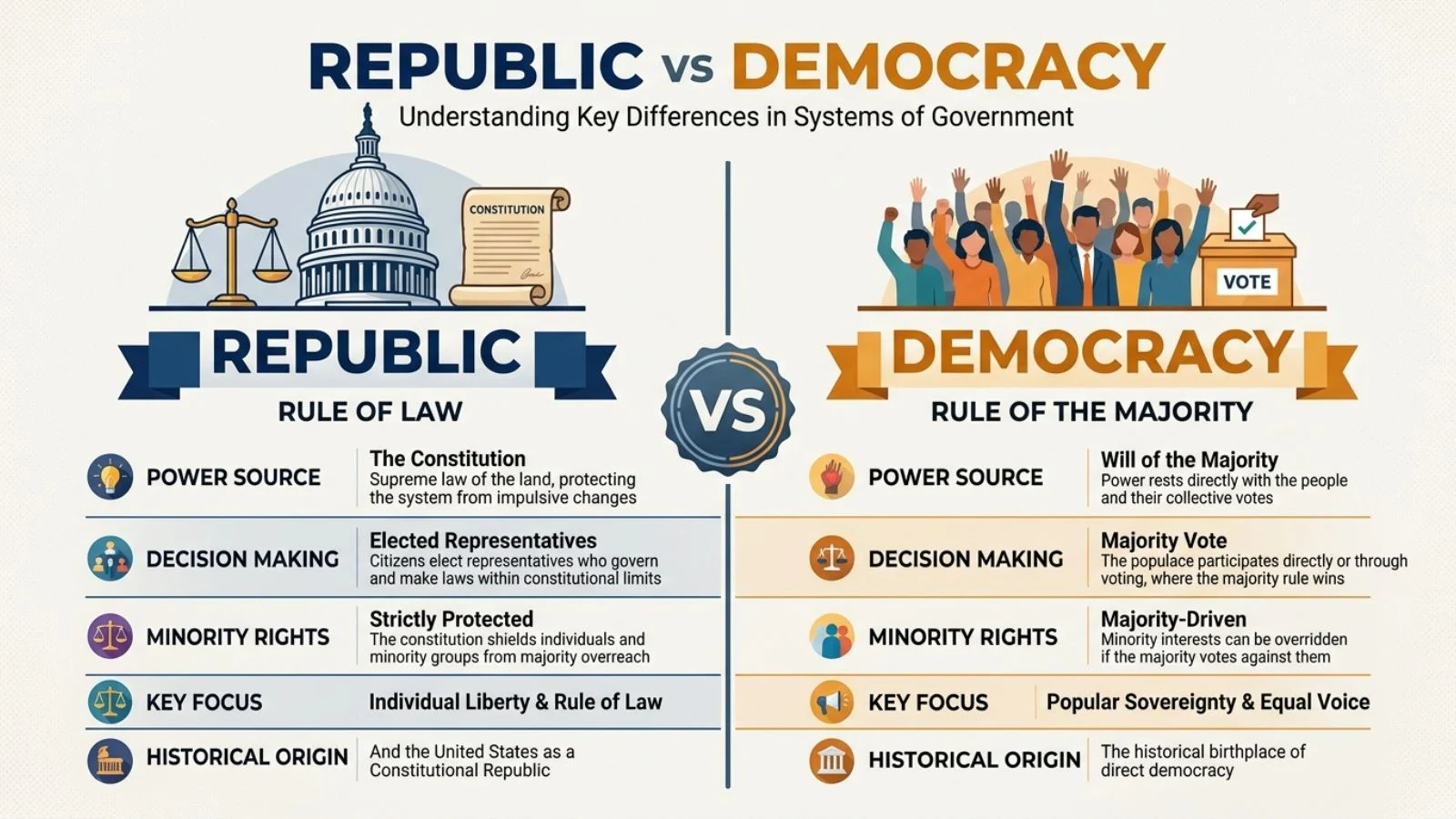
A democracy is a system where power comes from the people, either directly or through elected representatives.
A republic is a system where the country is led by elected representatives rather than a monarch, and power is limited by a constitution.
Most modern republics, including the United States, are also representative democracies; the terms describe different features of government, not opposite systems.
Key Takeaways
- Democracy describes who holds power: the people, directly or through representatives.
- Republic describes how a state is structured: no monarch, elected leaders, and a constitution that limits government power.
- The U.S. is both a republic and a representative democracy; the two labels aren’t mutually exclusive.
- “Direct democracy” (citizens vote on laws themselves) is different from “representative democracy” (citizens elect lawmakers).
- A republic without free elections or rule of law is not democratic, even if it uses the word “republic” in its name.
What Is Democracy?
Democracy comes from the Greek words demos (people) and kratos (rule). At its core, it means a government where ordinary citizens hold the power, either by voting directly on laws or by choosing representatives to do it for them.
There are two main types.
Direct Democracy
In a direct democracy, citizens vote on laws and policies themselves, with no middleman. Ancient Athens is the classic example of eligible citizens gathered to debate and vote on issues directly. Today, pure direct democracy at a national level is rare because it’s hard to manage with millions of people, but elements of it survive in things like ballot referendums and town hall meetings in small U.S. communities.
Representative Democracy
In a representative democracy, citizens elect people to make decisions on their behalf. This is how most modern democracies actually work, including the United States, the United Kingdom, and Germany. Voters choose lawmakers, and those lawmakers debate and pass legislation in their place.
What Is a Republic?
A republic is a form of government in which the state is considered a “public matter” (from the Latin res publica), not the private property or inheritance of a ruler. In practice, this means:
- There is no king, queen, or hereditary monarch.
- The head of state is elected or appointed, not born into the role.
- A constitution or set of laws limits what those in power can do.
A republic doesn’t automatically guarantee free elections or individual rights. Some countries call themselves republics even in their official name while being run as one-party states with no real voting choice. Being a republic is about structure, not necessarily about how democratic that structure is in practice.
Republic vs Democracy: The Core Difference
The simplest way to understand the difference is that democracy and republic answer two different questions:
- Democracy asks: Who holds the power? (The people.)
- Republic asks: How is the state organized? (No monarch, elected leadership, limited by law.)
Because they answer different questions, a country can be a republic, a democracy, both, or neither.
Comparison Table
| Feature | Democracy | Republic |
| Core idea | Power belongs to the people | No monarch; power is limited by law |
| Head of state | Can be elected or hereditary (e.g., a constitutional monarchy can be democratic) | Always elected or appointed, never hereditary |
| Decision-making | Direct vote or elected representatives | Governed through elected representatives and a constitution |
| Guarantees rights? | Not automatically | Not automatically |
| Example | Direct democracy (Swiss cantons’ referendums) | Roman Republic, modern constitutional republics |
| Can overlap with the other? | Yes a representative democracy is often also a republic | Yes most republics today are also democracies |
Is the United States a Republic or a Democracy?
Both. The United States is a federal, constitutional republic that operates through representative democracy. The Constitution limits government power and guarantees no monarchy, which makes it a republic. At the same time, citizens elect the people who represent them in Congress, state legislatures, and the presidency, which makes it democratic.
The confusion often comes from the Electoral College, which selects the president indirectly rather than through a national popular vote. This is a democratic process with a republican structure layered on top of it, not evidence that the U.S. isn’t democratic at all.
Why People Say “It’s a Republic, Not a Democracy”
This phrase became popular as a political talking point, often used to argue against pure majority rule or to push back on calls for things like abolishing the Electoral College. It draws on a real historical concern: the Founding Fathers were wary of “pure democracy,” fearing it could lead to mob rule or the majority trampling the rights of the minority.
Their solution was a republic with democratic elections built in a system designed to reflect the will of the people while still protecting individual rights through a constitution and separation of powers. So the phrase isn’t technically wrong about the Founders’ intent, but it’s misleading if it’s used to suggest the U.S. isn’t democratic. It is both.
Can a Country Be Both?
Yes, and most countries that are commonly called “democracies” today are also republics. France, Germany, India, and Brazil are all republics that function as representative democracies. The United Kingdom is a notable exception: it’s a democracy but not a republic, because it retains a hereditary monarch as head of state (a constitutional monarchy).
Examples of Republics and Democracies Around the World
- Republic and democracy: United States, France, Germany, India, Brazil
- Democracy but not a republic (constitutional monarchy): United Kingdom, Japan, Sweden, Canada
- Republic but not meaningfully democratic: North Korea, which calls itself the “Democratic People’s Republic of Korea” but holds no free, contested elections
This last category is why the words alone don’t guarantee anything about freedom or fairness; it’s the actual practice of elections, rule of law, and rights protection that matters most.
FAQs
Is the United States a republic or a democracy?
Both. It’s a constitutional republic (no monarch, power limited by law) that functions through representative democracy (citizens elect lawmakers).
What is the main difference between a republic and a democracy?
Democracy describes who holds power over the people. Republic describes how the state is structured with no monarch, with power limited by a constitution. The two can and often do overlap.
Can a country be both a republic and a democracy?
Yes. Most modern democracies, including the U.S., France, and Germany, are also republics.
What did the Founding Fathers mean by “republic”?
They wanted a system where citizens elect representatives to govern, with a constitution limiting power, rather than either a monarchy or pure direct democracy where a simple majority could overrule minority rights.
Is a republic better than a democracy?
Neither is inherently “better” ; they describe different aspects of government. A country’s actual freedoms depend more on whether it holds free elections and protects rights than on which label it uses.
What is a constitutional republic?
A republic where a written constitution limits the powers of government and protects citizens’ rights, while leaders are chosen through elections rather than inheritance.
Conclusion
Republic and democracy aren’t rival systems; they answer two different questions about government.
Democracy is about who holds power: the people, whether directly or through elected representatives.
Republic is about structure: no monarch, elected leadership, and power limited by a constitution.
The United States, like most modern nations, is both at once a constitutional republic that runs on representative democracy. Understanding that overlap clears up most of the confusion behind the “republic, not a democracy” debate.