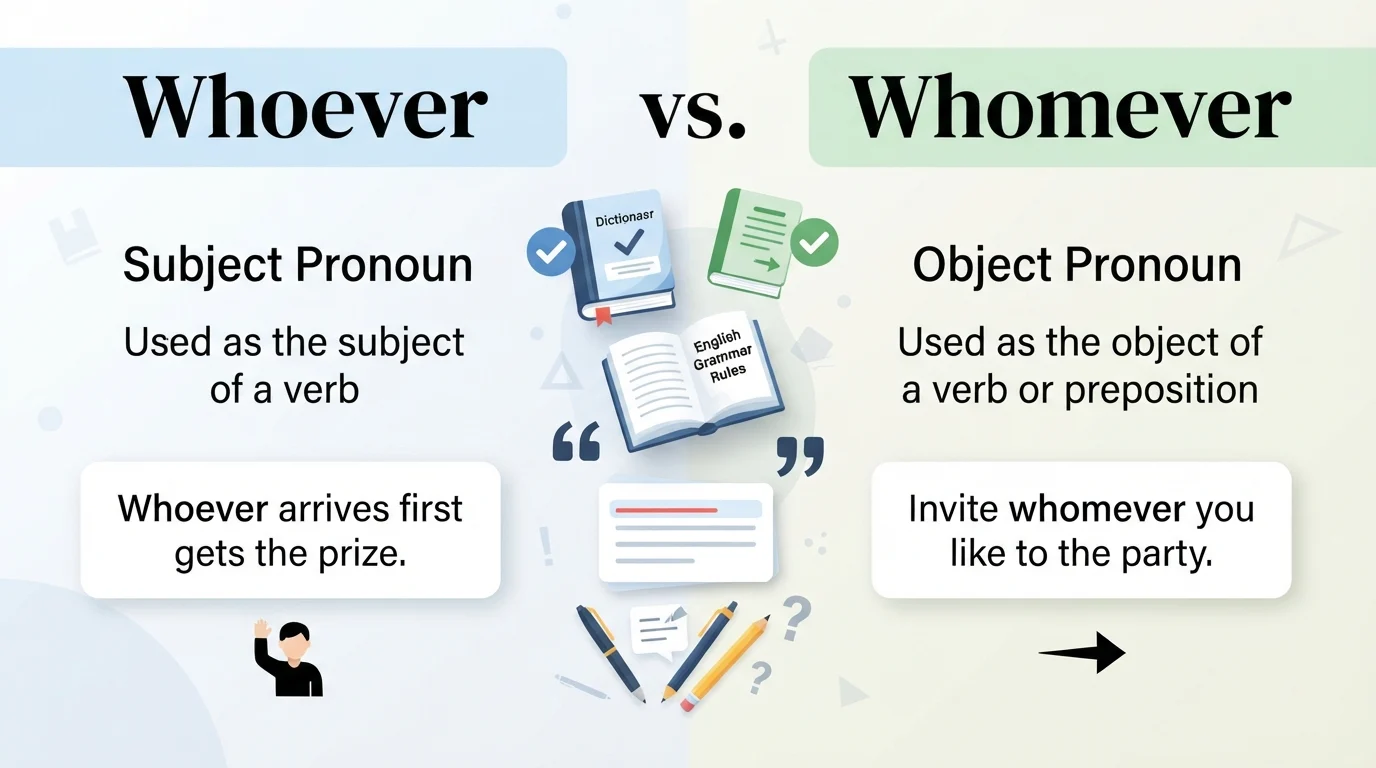
Use whoever when the word acts as the subject of a verb (it could be replaced with “he” or “they”).
Use whomever when the word acts as the object of a verb or preposition (it could be replaced with “him” or “them”).
Example:
Whoever calls first wins (he calls) vs. Give it to whomever you trust (trust him).
Key Takeaways
- Whoever = subject pronoun, like “he” or “they.”
- Whomever = object pronoun, like “him” or “them.”
- Focus on the clause that contains whoever/whomever, not the whole sentence.
- When in doubt, “whoever” is the safer, more common choice in everyday writing.
- “Whomever” is grammatically correct but increasingly rare, even in formal writing.
What’s the Difference Between Whoever and Whomever?
Whoever and whomever are both relative pronouns. They connect a clause to the rest of a sentence and refer to an unspecified person.
The difference comes down to grammatical role:
- Whoever is a subject pronoun. It performs the action of a verb.
- Whomever is an object pronoun. It receives the action of a verb, or it follows a preposition like “to,” “with,” or “for.”
This is the same pattern as who and whom, just extended to cover “any person” instead of a specific one.
The Easy He/Him Trick
You don’t need to diagram sentences to get this right. Use a simple substitution test.
- If you can replace the word with he, she, or they, use whoever.
- If you can replace the word with him, her, or them, use whomever.
This works because whoever and whomever follow the exact same logic as these familiar pronouns. Nobody second-guesses “he called” versus “call him” ; the same instinct applies here.
Step-by-Step: How to Apply the Trick
- Find the clause that contains whoever or whomever (ignore the rest of the sentence for a moment).
- Rearrange that clause into a simple statement.
- Swap in “he” or “him” and see which one sounds right.
- Match your choice: he → whoever, him → whomever.
Try it with: Give the prize to whoever/whomever finishes first.
Isolate the clause: ” finishes first.” Would you say “he finishes first” or “him finishes first”? “He” wins, so the answer is whoever.
Whoever vs. Whomever Examples
Examples Where Whoever Is Correct
- Whoever left their umbrella can pick it up at the front desk. (He left it.)
- I’ll vote for whoever has the best plan. (They have the best plan.)
- Whoever wins the race gets a trophy. (He wins.)
- Tell whoever is in charge that the delivery arrived. (She is in charge.)
Examples Where Whomever Is Correct
- Invite whomever you like to the party. (You like them.)
- She’ll hire whomever the manager recommends. (The manager recommends him.)
- Send the package to whomever ordered it. (Wait this one is actually “whoever.” See below.)
- Choose whomever you trust most for the job. (You trust him most.)
The Tricky Part: Look at the Whole Clause, Not Just the Verb
This is where most writers slip up. Many assume that any word right after a preposition like “to” or “for” must be whomever, since prepositions usually take objects. But that’s not always true.
Compare these two sentences:
- Give it to whoever asks for it. → Correct: whoever, because “whoever asks for it” is its own clause, and inside that clause, whoever is the subject of “asks.” The whole clause, not just “whoever” , is the object of “to.”
- Give it to whomever you choose. → Correct: whomever, because inside the clause “whomever you choose,” whomever is the object of “choose” (you choose him).
The rule: always check the pronoun’s job inside its own clause first. Ignore what comes before the clause.
Is It “To Whoever” or “To Whomever It May Concern”?
The classic letter opener should technically be “To Whomever It May Concern” but in practice, “To Whom It May Concern” is the standard phrase, and it’s far more common than either whoever or whomever version. If you’re starting a formal letter and unsure, “To Whom It May Concern” is the safest, most widely accepted choice.
Why People Overuse “Whomever”
Writers often swap in “whomever” because it sounds more formal or sophisticated, similar to how some people overuse “whom” in casual speech. This is called hypercorrection reaching for the “fancier” word even when it’s grammatically wrong.
The safest fix is the he/him test above. It removes guesswork and formality bias from the decision entirely.
Is “Whomever” Still Used Today?
Yes, but it’s fading. In spoken English and casual writing, many native speakers default to “whoever” in almost every context, even where “whomever” is technically correct. Formal writing legal documents, academic papers, official correspondence still expects the distinction to be followed. If your writing is casual, “whoever” is rarely flagged as wrong. If your writing is formal, it’s worth applying the rule carefully.
Quick Reference Table
| Whoever | Whomever | |
| Grammatical role | Subject | Object |
| Replace with | he / she / they | him / her / them |
| Common use | Everyday speech and writing | Formal writing, after prepositions |
| Example | Whoever answers first gets a point. | Thank whomever helped you. |
Frequently Asked Questions
Is “whomever” grammatically correct?
Yes. Whomever is correct when it functions as the object of a verb or preposition within its own clause, such as “Choose whomever you prefer.”
Can a sentence start with “whomever”?
Yes, if whomever is the object inside the clause that follows, like “Whomever you select will represent the team” (you select him).
Is it okay to just always use “whoever”?
In casual writing and speech, yes most readers won’t notice or mind. In formal or professional writing, using the correct form shows attention to detail.
What’s the fastest way to check my answer?
Isolate the clause containing whoever/whomever, turn it into a simple sentence, and test it with “he” or “him.” Whichever one sounds natural tells you the answer.
Conclusion
Whoever and whomever follow the same logic as he and him one is a subject, the other is an object.
The trick is to isolate the clause the word belongs to before testing it, since the surrounding sentence can be misleading. With the he/him substitution in hand, you’ll rarely need to guess again.