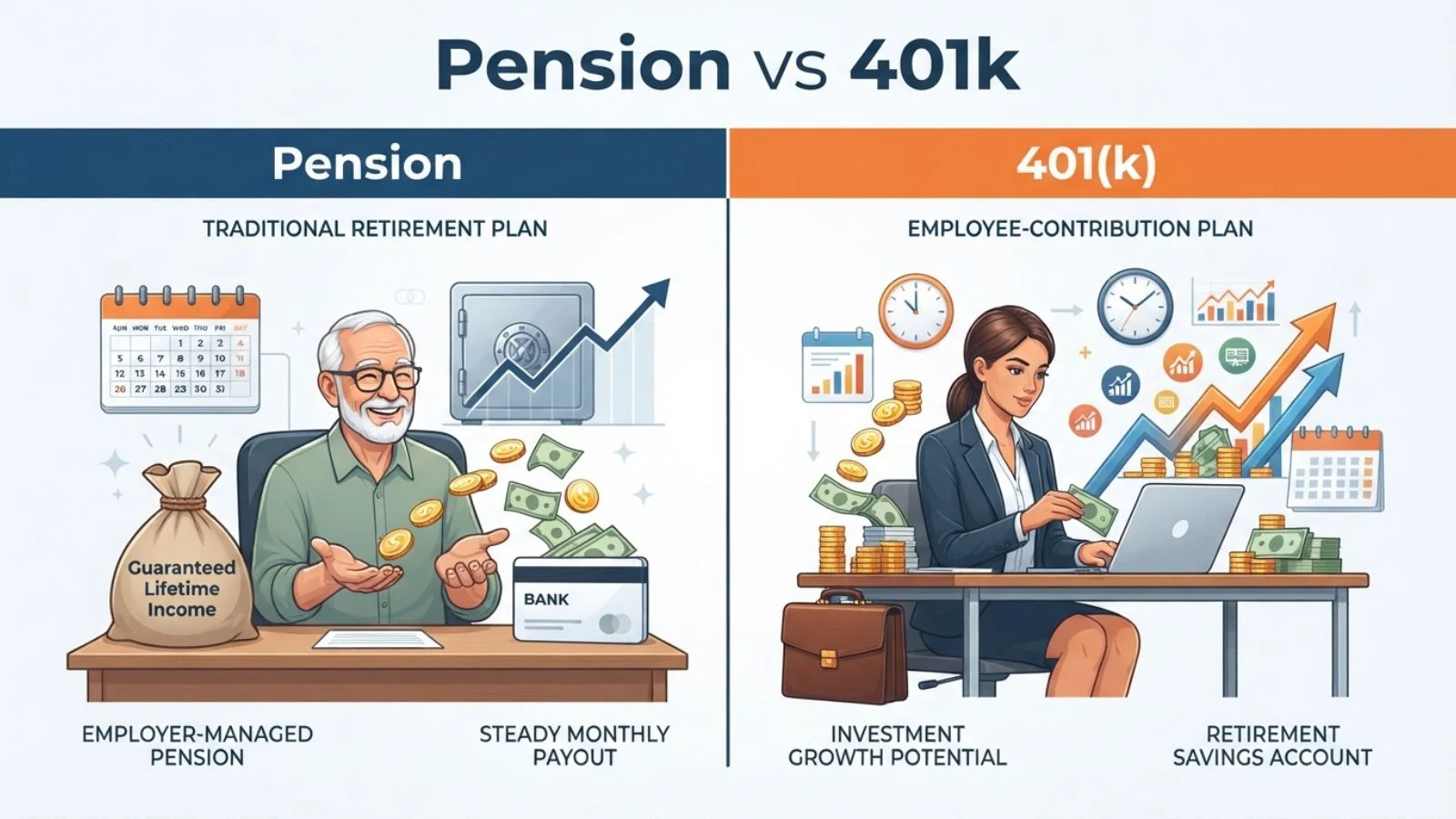
A pension is a retirement plan funded and managed by your employer that pays you a set monthly income for life.
A 401(k) is a retirement account funded mainly by you, the employee, where you choose your own investments and your retirement income depends on how those investments perform.
Key Takeaways
- A pension guarantees fixed income; a 401(k)’s income depends on investment performance.
- Employers fund most pensions; employees fund most of their own 401(k).
- Pensions are becoming rare outside government jobs; 401(k)s are now the standard workplace plan.
- A 401(k) moves with you when you change jobs; a pension usually does not.
- The 2026 401(k) employee contribution limit is $24,500, with an $8,000 catch-up limit for workers 50 and older.
What Is a Pension?
A pension, also called a defined-benefit plan, is a retirement plan your employer sets up and pays into on your behalf. In return, you get a guaranteed monthly payment once you retire, usually based on your salary and how many years you worked for the company.
An actuary calculates pension benefits using a formula that each employer sets for its workforce. About 1 in 3 older adults received pension benefits as of 2018, with a median benefit ranging from roughly $9,800 to $30,000 a year, depending on the type of pension. Pensions used to be common across private industry. Today they’re mostly found in government jobs, unions, and a shrinking number of large private companies. The number of traditional pension plans being offered has been declining for years.
How Pension Benefits Are Calculated
Your employer’s formula typically weighs:
- Years of service more years usually means a bigger payout.
- Final or average salary is often based on your highest-earning years.
- A benefit multiplier is a percentage set by the plan, multiplied by years worked and salary.
At retirement, you usually get to choose how your pension is paid out; most plans offer a lump sum or monthly payments for life.
What Is a 401(k)?
A 401(k) is a workplace retirement account that you, the employee, fund mostly out of your own paycheck. Like pension plans, traditional 401(k) contributions come out of your salary before taxes, which lowers your taxable income today. Your money grows tax-deferred until you withdraw it in retirement.
Unlike a pension, your 401(k) balance isn’t a promise from your employer; it’s an account that holds whatever you and your employer put in, plus or minus investment gains and losses. You pick where the money is invested, usually from a menu of mutual funds offered by the plan.
Traditional vs. Roth 401(k)
Many employers now offer both options:
- Traditional 401(k): Contributions are pre-tax. You pay income tax when you withdraw the money in retirement.
- Roth 401(k): Contributions are after-tax. Withdrawals in retirement, including investment growth, are tax-free if you meet the requirements.
Some employers also match a portion of what you contribute, which is essentially free money added to your retirement savings.
Pension vs 401(k): Key Differences
Who Funds the Plan
The main difference between a pension and a 401(k) is that the employer usually funds the pension, while the employee usually funds the 401(k). Some employers do contribute to employees’ 401(k) accounts through a match, but the bulk of the funding typically comes from the worker’s own paycheck.
Who Controls the Investments
Employees can choose their own 401(k) investments, but with a pension, the employer controls how the fund is invested. That’s a major trade-off: a 401(k) gives you more control and more responsibility, while a pension takes both out of your hands.
Risk and Guarantees
A pension is a defined-benefit plan, meaning the benefit amount is fixed regardless of how the underlying investments perform. A 401(k) is a defined-contribution plan your retirement income depends entirely on your contributions and how your investments do over time.
A pension guarantees a certain dollar amount of benefits every month, while a 401(k) offers no such guarantee. Some pension plans are at risk if the company that offers them fails or closes, though others are protected by the Pension Benefit Guaranty Corporation, a federal agency. Pension plans are usually federally insured in this way, while 401(k)s are not though a 401(k) isn’t tied to your employer’s financial health the way a pension is, since the money sits in your own account.
Payout Options
Pensions typically pay out as a monthly check for life, with a lump-sum option in some plans. A 401(k) gives you more flexibility: you can withdraw as needed, convert the balance into an annuity for guaranteed income, or let it keep growing and take required distributions later in retirement.
Portability
This is one of the biggest practical differences. A 401(k) belongs to you. If you switch jobs, you can roll it into a new employer’s plan or into an IRA without losing anything you’ve vested in. A pension is tied to your employer, and in most cases the money stays in the pension plan until you retire rather than following you to a new job. Some government jobs allow you to transfer part of a pension to a plan at a different government employer, but that’s the exception, not the rule.
Pros and Cons of a Pension
Pros and Cons of a 401(k)
| Pros | Cons |
| You control your investment choices | Your balance can shrink in a market downturn |
| Fully portable between jobs | Requires you to actively manage contributions and investments |
| Employer match can boost savings | No guaranteed income in retirement |
| Higher potential growth over time | Early withdrawals usually trigger taxes and penalties |
2026 401(k) Contribution Limits
For 2026, the annual contribution limit for 401(k), 403(b), governmental 457 plans, and the federal Thrift Savings Plan rises to $24,500, up from $23,500 in 2025. Workers aged 50 and older can make catch-up contributions, which increase to $8,000 in 2026. Pensions don’t have an equivalent contribution limit for employees, since the employer, not the worker, typically funds the plan.
Can You Have Both a Pension and a 401(k)?
Yes. Pensions and 401(k)s are both employer benefits, and some employers offer one, the other, both, or neither. If your employer offers both, contributing to the 401(k) on top of your pension can add flexibility and extra retirement income, especially since pension benefits alone often don’t fully replace your working income.
Which Is Better: a Pension or a 401(k)?
Neither is universally “better” ; it depends on what you value more.
- Choose a pension-friendly mindset if you want predictable, guaranteed income and don’t want to manage investments yourself.
- Choose a 401(k)-friendly mindset if you want control over your money, expect to change jobs, or want the potential for higher long-term growth.
In practice, most workers today don’t get to choose 401(k)s which have become the default retirement plan in the private sector, while pensions are now mostly limited to public-sector and union jobs. If you’re deciding between two job offers, it helps to run the numbers: estimate your pension’s expected lifetime payout against what a 401(k) with an employer match could realistically grow to by retirement.
FAQs
Is a pension better than a 401(k)?
Neither is better in every case. A pension offers guaranteed income with no investment risk to you, while a 401(k) offers more control and growth potential but no guarantees.
What happens to my pension if I change jobs?
In most private pension plans, the money stays with your former employer and you collect the benefit at retirement age, based on the years you worked there. It generally doesn’t transfer to a new employer.
Can I withdraw money early from a pension or 401(k)?
Early withdrawals from a 401(k) before age 59½ usually trigger income tax plus a 10% penalty, with some exceptions. Pensions offer very little flexibility to access funds before retirement age.
Are pensions still offered by employers?
Fewer private employers offer pensions than in past decades. They’re still common in government, education, and some unionized industries.
Is a 401(k) safer than a pension?
It depends on the risk. A 401(k)’s value can drop with the market, but it’s not tied to your employer’s financial health. A pension’s payout is fixed, but it can be at risk if the sponsoring company fails and isn’t covered by the PBGC.
Conclusion
A pension and a 401(k) solve the same problem funding your retirement in very different ways.
A pension hands the investment risk and decision-making to your employer in exchange for a guaranteed check each month.
A 401(k) gives control to you, along with the responsibility for making it grow. Knowing which type of plan you have, or which one a job offer includes, makes it much easier to plan realistically for retirement.