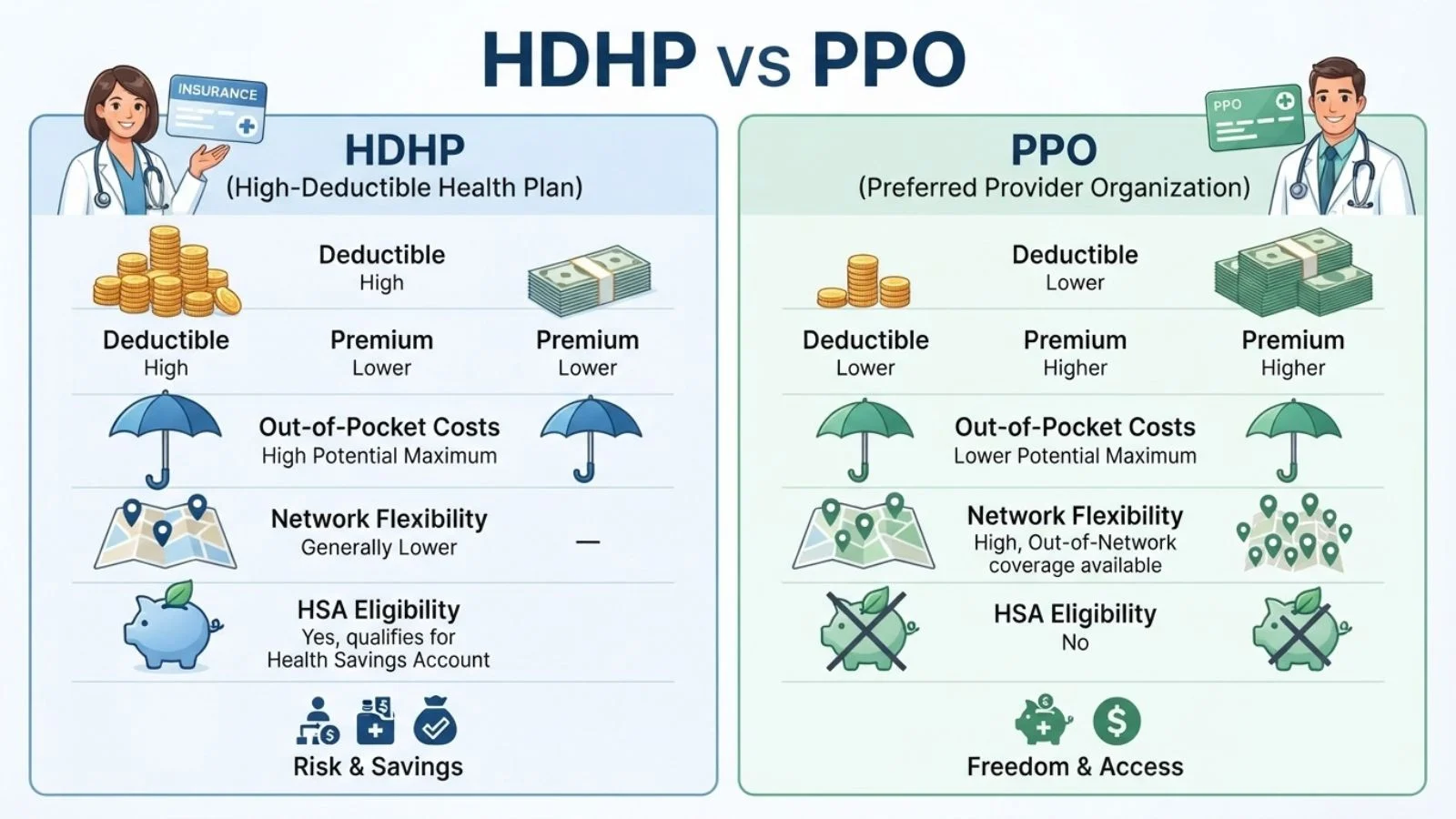
An HDHP (high-deductible health plan) usually has lower monthly premiums but requires you to pay more out of pocket before insurance covers most costs.
A PPO (preferred provider organization) usually costs more each month but gives you more freedom to see specialists without referrals and more predictable copays.
An HDHP can be paired with a tax-advantaged HSA, while a PPO cannot.
Key Takeaways
- HDHPs have lower premiums but higher deductibles, so you pay more before coverage kicks in.
- PPOs have higher premiums but offer lower copays and more flexibility to see out-of-network providers, usually at a higher cost.
- Only HDHPs qualify for an HSA, which lets you save pre-tax money for medical costs.
- Your health use matters most. Frequent care favors a PPO. Rare care often favors an HDHP.
- For 2027, HDHP minimum deductibles are $1,750 (self-only) and $3,500 (family), with out-of-pocket maximums of $8,700 and $17,400.
Quick Comparison
| Feature | HDHP | PPO |
| Monthly premium | Lower | Higher |
| Deductible | Higher (minimum set by IRS) | Usually lower |
| Copays | Usually none until deductible is met | Fixed copays for most visits |
| Out-of-network care | Usually costs more | Covered, at a higher cost |
| Referrals for specialists | Generally not required | Generally not required |
| Tax-advantaged savings account | Yes (HSA) | No |
What Is an HDHP?
An HDHP is a health plan with a deductible at or above IRS minimums. For 2027, the minimum deductible is $1,750 for self-only coverage and $3,500 for family coverage. The plan’s out-of-pocket maximum cannot exceed $8,700 for self-only or $17,400 for family. Premiums do not count toward these limits.
Because of the higher deductible, you pay most routine care costs yourself until you meet it. Preventive care is usually covered in full before the deductible under federal rules.
What Is a PPO?
A PPO gives you a network of preferred doctors and hospitals. You can also see providers outside the network, but you will pay more. Most PPOs charge a set copay for doctor visits and lower deductibles than HDHPs, so you pay less when you get care.
How the Costs Compare
Premiums are only part of the picture. Consider this example:
- HDHP: Lower monthly premium, but you pay the full negotiated price of care until you reach your deductible.
- PPO: Higher monthly premium, but you pay a copay for visits and a smaller share of major costs.
If you rarely see a doctor, the HDHP often costs less over a year. If you take regular prescriptions, see specialists, or expect surgery, the PPO can save you money even with higher premiums.
The HSA Advantage
Only HDHP enrollees can open a Health Savings Account (HSA). Contributions are tax-deductible, growth is tax-free, and withdrawals for qualified medical expenses are tax-free. For 2027, the IRS sets the contribution limit at $4,500 for self-only coverage and $9,000 for family coverage. People age 55 and older can add a $1,000 catch-up contribution.
The HSA stays with you if you change jobs, which makes it a useful long-term savings tool.
Which Plan Fits You?
Choose an HDHP if you are generally healthy, want lower premiums, and can afford to cover a higher deductible if something unexpected happens. It works well with an HSA if you can save part of your income for future medical costs.
Choose a PPO if you have ongoing health conditions, take regular medications, expect planned procedures, or want predictable copays and freedom to choose specialists.
Compare the total yearly cost, not just the premium. Add up your premiums, expected care, and the most you could pay out of pocket.
Frequently Asked Questions
Is an HDHP cheaper than a PPO?
Often, yes, if you are healthy and use little care. The lower premium can save money in a year with few medical visits. But if you need frequent care, the higher deductible can cost you more than the premium savings. Compare your expected yearly costs under each plan.
Can I have an HSA with a PPO?
No. To contribute to an HSA, you must be enrolled in an HDHP and generally have no other non-HDHP health coverage. Some exceptions exist for certain dental, vision, and limited-purpose coverage.
What is a good deductible for an HDHP?
There is no single right answer. Pick a deductible you could pay on short notice without hardship, and check whether the premium savings justify the risk.
Do PPOs cover out-of-network care?
Yes, most PPOs cover some out-of-network care, but you pay more than you would for in-network providers, and the out-of-pocket maximum is usually higher.
Conclusion
The choice between an HDHP and a PPO largely depends on how much health care you use and how much you can afford to pay out of pocket.
If most people in your household are healthy and rarely visit the doctor, an HDHP may be a better option because of its lower premiums, especially if you want to save through an HSA.
If you need regular medications, specialist visits, or a planned surgery, a PPO may offer better value through more predictable copays and greater flexibility.
Before choosing, calculate each plan’s total yearly cost, including annual premiums, expected medical expenses, and the maximum amount you could have to pay out of pocket.
This approach helps you understand your potential savings instead of looking at the premium alone.