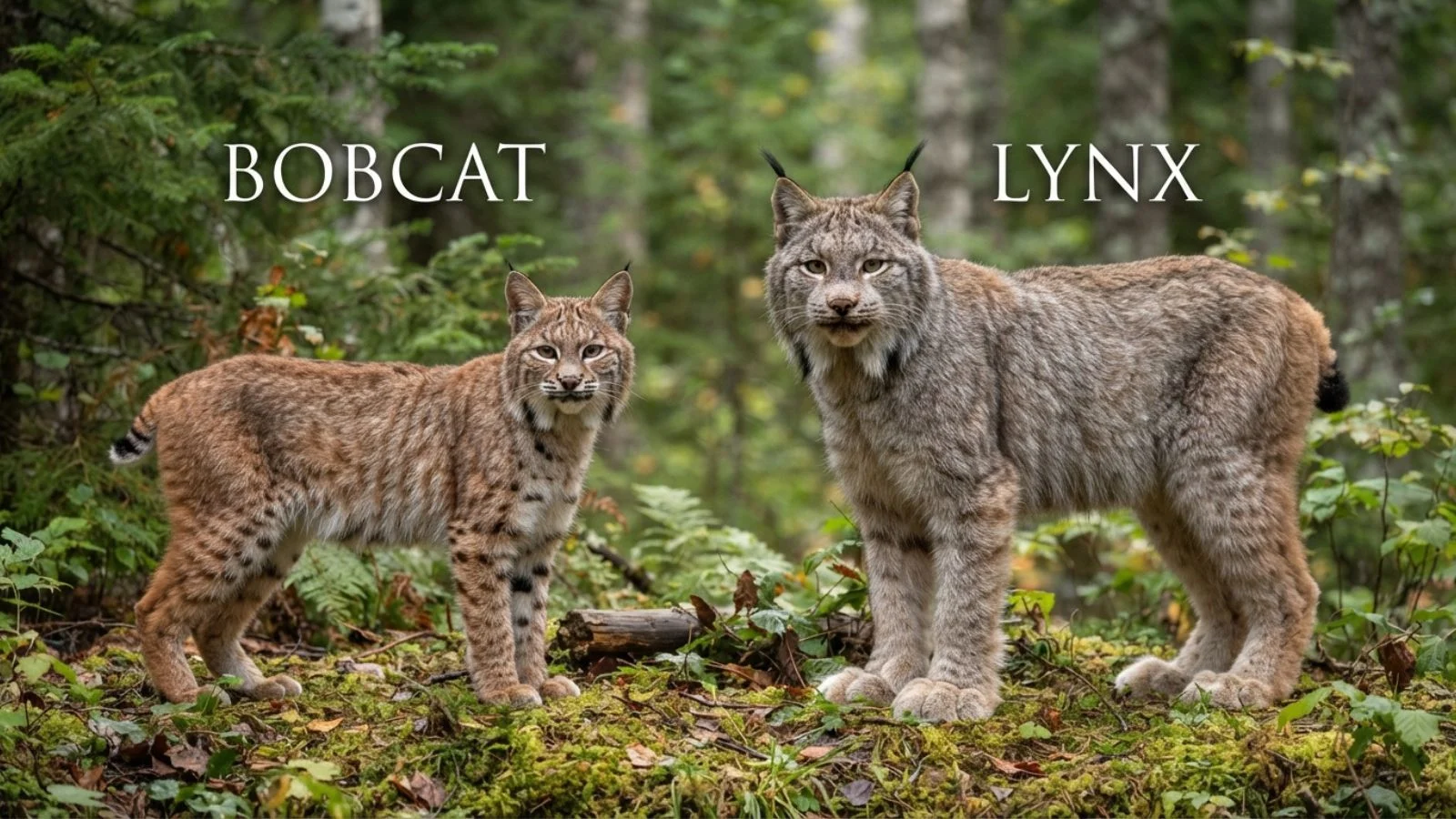
A bobcat is a lynx. Its scientific name is Lynx rufus. In the United States, the word “lynx” usually refers to the Canada lynx (Lynx canadensis), a close relative that lives farther north.
The two animals are different species, but they share the same genus. The main differences are in their size, tail, feet, fur, range, and diet.
Key Takeaways
- The bobcat is a North American lynx, so “bobcat vs lynx” really means “bobcat vs Canada lynx.”
- Bobcats have a short tail with a black tip on top and underneath. Canada lynx have a black tip all the way around.
- Canada lynx have longer legs and much larger, furry paws that help them move on deep snow.
- Bobcats live across most of the lower 48 states, while Canada lynx live mainly in the northern forests.
- Canada lynx depend heavily on snowshoe hares, while bobcats eat a wider range of prey.
Is a Bobcat a Lynx?
Yes. Biologists group the bobcat with the lynxes because it shares the traits that define the group, including tufted ears, a short tail, and a stocky, cat-like build. Scientists count four lynx species in the world: the Eurasian lynx, the Iberian lynx, the Canada lynx, and the bobcat. Confusion comes from the name. The bobcat got its name from its short, “bobbed” tail, while the Canada lynx is the animal most Americans think of when they hear “lynx.”
What Is a Bobcat?
The bobcat is a medium-sized wild cat found across most of the contiguous United States, southern Canada, and Mexico. It is adaptable. It lives in forests, deserts, swamps, farmland, and even suburban edges.
Size and Appearance
Adult bobcats usually weigh about 15 to 35 pounds, with males larger than females. They have a tawny or reddish-gray coat marked with dark spots and streaks. Their faces often show a light ruff of fur, and their ear tufts are short. The tail is about 4 to 7 inches long, with black on the top and underside but usually not all the way around.
What Is a Lynx?
When people say “lynx” in North America, they usually mean the Canada lynx. It lives in cold, snowy forests across Canada, Alaska, and a few northern US states. Its body is built for winter. It has long legs, a thick gray coat, and large, heavily furred feet.
The Canada Lynx
The Canada lynx is typically similar in weight to the bobcat, with many adults falling in the 18 to 30 pound range. It looks taller and leggier, especially at the shoulder and hip. Its coat is thicker and grayer, and its spots are faint or hard to see.
Bobcat vs Lynx: Key Differences
| Feature | Bobcat (Lynx rufus) | Canada Lynx (Lynx canadensis) |
| Typical range | Most of the lower 48 states, southern Canada, Mexico | Northern forests of Canada, Alaska, and a few northern US states |
| Coat color | Tawny to reddish-gray | Silvery gray to pale brown |
| Spots | Clear spots and streaks | Faint or barely visible |
| Tail | Short, black on top and underside | Short, black all the way around |
| Ear tufts | Shorter | Longer and more prominent |
| Feet | Smaller | Large, furry, snowshoe-like |
| Legs | Shorter | Longer |
| Main food | Varied: rabbits, rodents, birds, deer | Mostly snowshoe hares |
Tail and Ears
The tail is one of the quickest ways to tell the two apart. A bobcat’s tail has a black tip on the top and bottom, which can look like a stripe pattern. A Canada lynx’s tail is black all the way around at the tip. The lynx’s ear tufts are also longer and easier to spot.
Feet and Legs
The Canada lynx has very large, wide feet covered in dense fur. These act like natural snowshoes, letting it walk on soft snow without sinking. Bobcats have smaller feet and are better suited to rocky, brushy, or warmer terrain.
Coat and Markings
Bobcats are warmer in color and easier to recognize by their spots. Canada lynx have a cooler, grayer coat with fewer visible markings. In winter, a lynx’s coat is especially thick, which makes it look bulkier.
Where Each Animal Lives
The bobcat has one of the widest ranges of any wild cat in North America. You can find it in deserts in the Southwest, forests in the East, and farmland across the Midwest. The Canada lynx has a much narrower range. It stays in dense boreal forests where winters are long and snowy. In the lower 48, it is found mainly in parts of Maine, Minnesota, Montana, and Washington, along with other northern areas.
Because their ranges touch in some northern forests, the two animals can occur in the same general area. When they do, the lynx usually stays deeper in the snowy forest, while the bobcat tends to use more open or mixed terrain.
What They Eat
Diet is where the two species differ most. The Canada lynx depends heavily on the snowshoe hare. When hare populations rise and fall, lynx numbers often follow. Bobcats are more flexible. They hunt rabbits, mice, squirrels, birds, and sometimes larger animals such as young deer. This flexible diet helps explain why bobcats can survive in such a wide range of habitats.
Conservation Status
The two animals have very different conservation situations. The bobcat is common and widespread, and it is not listed as endangered or threatened in the United States. Many states allow regulated hunting and trapping, and wildlife agencies monitor populations.
The Canada lynx is a different story. It was listed as endangered under the US Endangered Species Act in 1973, and it was reclassified as threatened in 2000 in the contiguous United States. Its main concerns are loss of boreal forest, changes in snowshoe hare populations, and the effects of climate change on snowy habitat.
How to Tell Them Apart in the Wild
If you see a cat-like animal and want to identify it, start with these questions:
- Look at the tail. Is the tip black only on top and underneath, or all the way around?
- Check the ears. Are the tufts short or long?
- Look at the feet and legs. Do the paws look large and furry, and are the legs long?
- Notice the coat. Is the animal warm-toned and spotted, or gray and faintly marked?
- Consider the location. Is it in a snowy northern forest, or in a warmer, more varied habitat farther south?
Keep in mind that a sighting at a distance can be hard to judge, and young animals can look different from adults. If you are unsure, a local wildlife agency can help.
Frequently Asked Questions
Is a bobcat a lynx?
Yes. The bobcat is a lynx species, scientifically named Lynx rufus. It is one of the four lynx species recognized in the world, and it is the most common lynx in North America.
Are bobcats bigger than lynx?
Not by much. Both animals often weigh between about 15 and 30 pounds, though individuals vary. The Canada lynx looks bigger because it has longer legs and a thicker coat.
Do bobcats and lynx live in the same place?
Sometimes. Their ranges overlap in parts of northern North America, but the Canada lynx is found mainly in cold, snowy boreal forests, while the bobcat lives in a much wider range of habitats.
Are lynx endangered?
The Canada lynx is listed as threatened in the contiguous United States under the Endangered Species Act. The bobcat is not listed and is common across much of its range.
What is the easiest way to tell them apart?
Look at the tail. A bobcat’s tail has a black tip only on the top and bottom. A Canada lynx’s tail is black all the way around the tip.
Conclusion
Bobcats and lynx are not two completely different types of animals. A bobcat is actually a species of lynx, and in the U.S., the word “lynx” often refers to the Canada lynx. Both belong to the same genus, but they differ in size, tail shape, paws, coat, range, and diet.
The easiest way to tell them apart is by looking at the tail. A bobcat’s tail has black only on the upper and lower surfaces of the tip, while a Canada lynx has a tail tip that is black all the way around.
If you spot one in a jungle, forest, or snowy area, pay attention to its tail, ears, paws, and location. And if you are still unsure about the identification, it is best to contact a local wildlife agency for help.