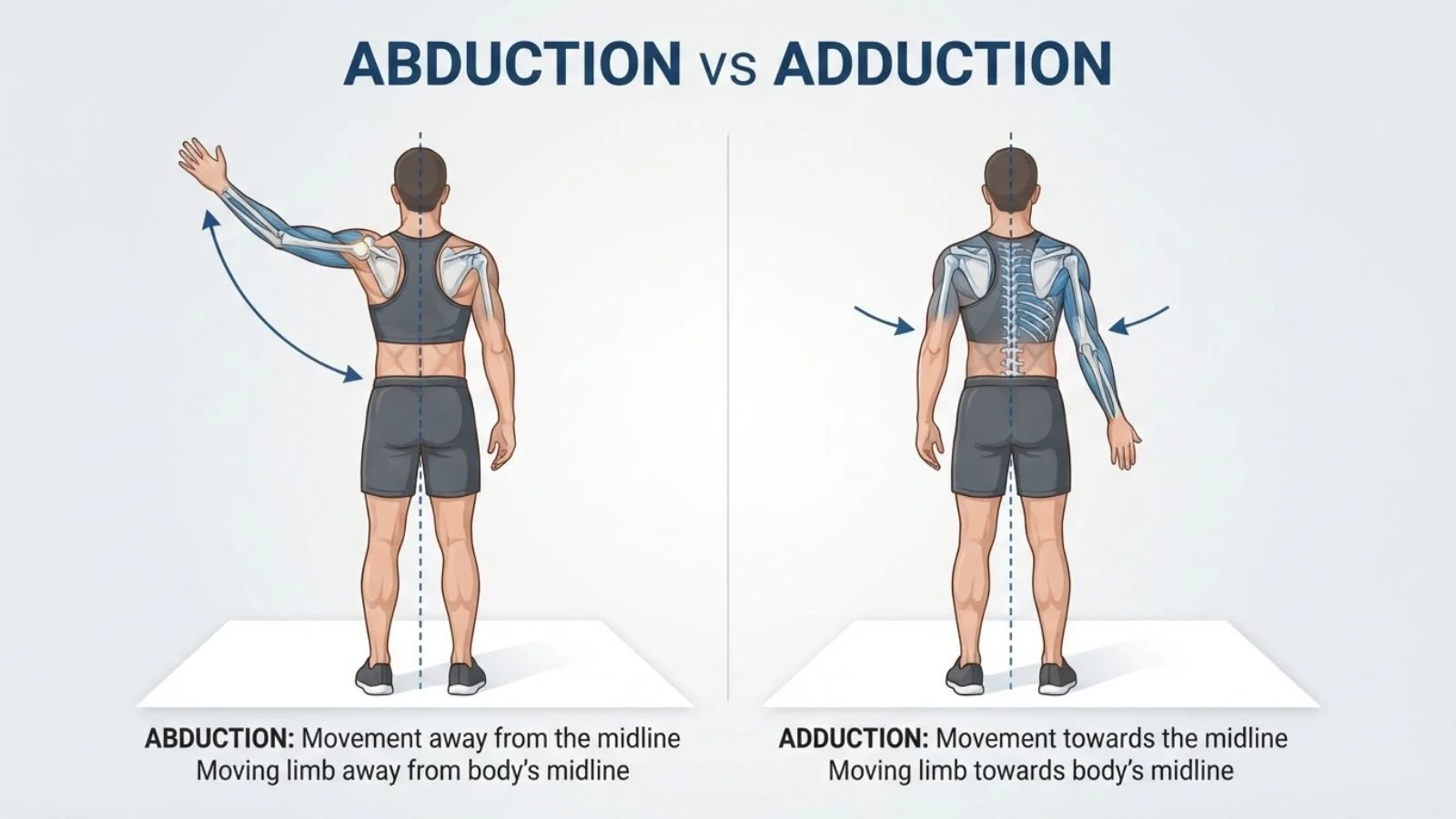
Abduction and adduction are opposite movements of a body part. Abduction moves a limb or other body part away from the midline of the body. Adduction moves it back toward the midline.
For example, raising your arm out to the side is abduction, and lowering it back to your side is adduction.
Key Takeaways
- Abduction means moving a body part away from the body’s midline.
- Adduction means moving a body part toward the midline.
- The Latin roots tell the story: ab- means “away,” ad- means “toward,” and ducere means “to lead.”
- The same joint can perform both movements, such as the shoulder and hip.
- In legal or crime reporting, “abduction” means kidnapping, which has a separate meaning.
What Is Abduction?
Abduction is a movement in which a body part moves away from the midline, the imaginary line that runs down the center of the body. Anatomists describe these movements in the frontal plane, which is the view you see when someone faces you.
Abduction Examples in the Body
Think about spreading your arms out like a bird’s wings. Your shoulder is performing abduction. The same thing happens when you lift your leg out to the side, as in a side leg raise during a workout. Spreading your fingers apart is also abduction, because each finger moves away from the middle finger.
What Is Adduction?
Adduction is the reverse. It moves a body part back toward the midline. If you press your arms back down to your sides, your shoulders are adducting. If you bring your legs together, your hips are adducting.
Adduction Examples in the Body
Squeezing your knees together while sitting is a simple example. Bringing your fingers back together after spreading them is another. In both cases, the body part is traveling toward the center of the body.
Abduction vs Adduction at a Glance
| Feature | Abduction | Adduction |
| Direction | Away from the midline | Toward the midline |
| Latin root | ab- (“away”) | ad- (“toward”) |
| Shoulder example | Raising the arm to the side | Lowering the arm to the side |
| Hip example | Moving the leg outward | Bringing the leg inward |
| Finger example | Spreading the fingers apart | Bringing the fingers together |
How to Remember the Difference
A simple trick is to link the words to their prefixes. Abduction starts with ab-, as in “absent” or “abnormal,” which both suggest moving away. Adduction starts with ad-, as in “add” or “approach,” which both suggest bringing things toward something. Another quick check is to picture a person standing straight with arms at their sides. Moving the arm away from the body is abduction. Moving it back in is adduction.
Body Parts Where These Movements Matter
Abduction and adduction are most often discussed for the shoulder, hip, and fingers. Knowing these terms helps you understand exercise instructions, physical therapy notes, and anatomy lessons.
Shoulder
The shoulder can move in many directions, and abduction is a key part of lifting the arm. The middle part of the deltoid muscle is one of the main muscles that lifts the arm to the side. Adduction brings the arm back toward the body, and muscles such as the latissimus dorsi and pectoralis major help with this motion.
Hip
Hip abduction is used when stepping sideways or stabilizing the body while standing on one leg. The gluteus medius and gluteus minimus are major hip abductors. Hip adduction brings the thighs together. The adductor group, including the adductor longus and adductor magnus, performs this action. Hip adductor strength matters for running, cycling, and changing direction quickly.
Fingers and Thumb
Fingers have abduction and adduction too. The thumb is a special case because its movement is more complex, but the basic idea is the same: abduction moves the thumb away from the hand, and adduction moves it back toward the palm or index finger.
Abduction Meaning in Other Contexts
The word “abduction” has a second, very different meaning. In everyday news and law, abduction means the illegal taking of a person against their will, often called kidnapping. When a news story mentions a child abduction, it is not talking about body movement at all. The anatomy meaning is a technical term used in medicine, fitness, and biology. Context usually makes the meaning clear. If you are reading a medical note, a physical therapy report, or a textbook, the anatomy meaning applies. If you are reading a crime report, it refers to kidnapping.
“Adduction” has little to no common meaning outside anatomy, so it is mostly used in medical and science settings.
Common Mistakes
The most common mistake is reversing the two terms. Many people remember “abduction” as “bringing in” because of how it sounds, but it means moving away. Another mistake is assuming that a movement is always one or the other. The direction depends on the body part and the starting position. For example, a leg moving outward is abduction, but moving that same leg across the body is abduction.
People also confuse these terms with flexion and extension, which describe forward and backward movement. Abduction and adduction describe side-to-side movement relative to the midline.
Frequently Asked Questions
What is the main difference between abduction and adduction?
Abduction moves a body part away from the midline of the body. Adduction moves it toward the midline. The two movements are opposites and usually happen around the same joint.
What is an example of abduction?
Raising your arm out to the side, like a T-pose, is an example of shoulder abduction. Lifting your leg out to the side is an example of hip abduction.
What is an example of adduction?
Lowering your arm back down to your side is shoulder adduction. Bringing your legs together while sitting or standing is hip adduction.
Is abduction the same as kidnapping?
No, not in anatomy. In law and news reporting, abduction means kidnapping. In medical and fitness contexts, it means moving a body part away from the midline.
Which muscles cause hip abduction?
The gluteus medius and gluteus minimus are the main hip abductors. The tensor fasciae latae also helps.
Which muscles cause hip adduction?
The adductor group, including the adductor longus, adductor brevis, adductor magnus, gracilis, and pectineus, brings the thighs toward the midline.
Final Thoughts
Abduction and adduction describe opposite movements. Abduction takes a body part away from the midline, and adduction brings it back.
Once you connect ab- with “away” and ad- with “toward,” the terms become much easier to remember.
Use the shoulder and hip examples to check your understanding, and keep the legal meaning of abduction separate from the anatomy meaning.