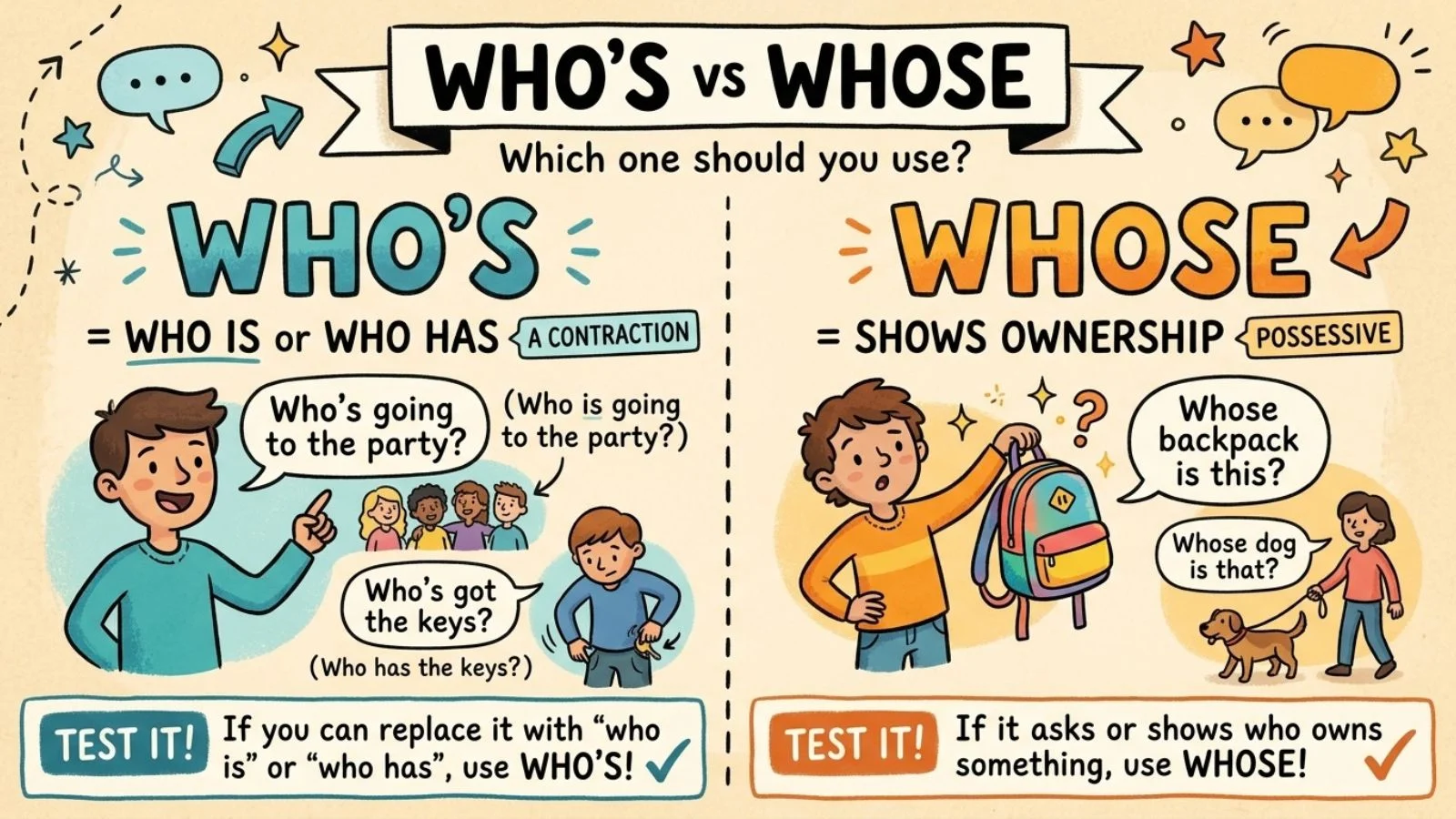
“Who’s” is a contraction of “who is” or “who has.” “Whose” is a possessive word that shows ownership or belonging, as in “whose book is this?”
A simple test helps: if you can replace the word with “who is” or “who has” and the sentence still makes sense, use who’s. If not, use whose.
Key Takeaways
- Who’s always means “who is” or “who has.”
- Whose shows ownership or belonging and never takes an apostrophe.
- Replace the word with “who is” or “who has” to test it.
- Whose can refer to people, animals, and things.
- When in doubt, read the sentence out loud with the full words.
What Does “Who’s” Mean?
Who’s is a contraction, which means it is a shortened form of two words joined by an apostrophe. The apostrophe takes the place of the missing letters. Who’s can stand for either “who is” or “who has.”
Here are a few examples:
- Who’s coming to dinner tonight? (Who is coming?)
- Who’s finished the report? (Who has finished the report?)
The “Who Is” and “Who Has” Test
The fastest way to check your choice is to swap in the full words. Read the sentence with “who is” or “who has” in place of the word. If it still makes sense, you need who’s.
Try this sentence: ” going to the party?” Replace the blank with “who is.” “Who is going to the party?” works, so the answer is who’s.
What Does “Whose” Mean?
Whose is a possessive word. It answers the question “belonging to whom?” or “belonging to what?” Unlike most possessives in English, whose never takes an apostrophe. Writers sometimes add one by mistake because they expect it from words like John’s or the dog’s.
Here are some examples:
- Whose jacket is this on the chair?
- Whose turn is it to wash the dishes?
- She is the author whose novel won the award.
Whose for People, Animals, and Things
Many writers think whose only refers to people. That is not true. Whose can also refer to animals and objects, especially in formal or descriptive writing:
- The city whose river flooded last spring is rebuilding its levees.
- The cat whose tail was injured is recovering well.
For things, some style guides prefer “of which” in certain constructions, such as “a house the roof of which collapsed.” However, whose is widely accepted and is often the more natural choice. Both are correct in standard American English.
Who’s vs Whose: Side-by-Side Examples
| Sentence | Correct Word | Why |
| ___ leaving early today? | Who’s | Who is leaving |
| ___ keys are on the table? | Whose | Shows ownership of keys |
| ___ already eaten the cake? | Who’s | Who has eaten |
| ___ idea was this? | Whose | Shows ownership of an idea |
| ___ going to call the client? | Who’s | Who is going to call |
| ___ car is blocking the driveway? | Whose | Shows ownership of a car |
A Quick Test to Choose the Right Word
Use this three-step check when you are unsure:
- Read the sentence and find the blank.
- Try “who is” or “who has” in the blank.
- If the sentence works, use who’s. If it does not, use whose.
For example, ” going to win?” becomes “Who is going to win?” so the answer is who’s. But ” prize is it?” does not become “Who is prize is it?” so the answer is whose.
Common Mistakes to Avoid
Adding an apostrophe to whose. The sentence “Whose’s car is this?” is wrong. Whose never takes an apostrophe.
Using who’s for ownership. “Who’s car is this?” is incorrect. The sentence should read “Whose car is this?”
Forgetting who’s can mean “who has.” Writers often think who’s only means “who is.” Remember the second meaning, especially in sentences like “Who’s seen my glasses?”
Confusing it with its and it’s. The same logic applies to its and it’s. It’s is a contraction of “it is” or “it has,” and its is the possessive form. Whose follows the same pattern as its, with no apostrophe.
Who’s vs Whose FAQ
Is whose a contraction?
No. Whose is a possessive word, not a contraction. Only who’s is a contraction, and it stands for “who is” or “who has.”
Can whose refer to things?
Yes. Whose can refer to people, animals, and objects. In formal writing, you may see “of which” used with things, but whose is still widely accepted and clear.
Is “who’s car is this” ever correct?
No. In that sentence, you are showing ownership, so the correct word is whose. The sentence should read “Whose car is this?”
Why does whose have no apostrophe?
Whose is a possessive form that developed differently from most possessives. Like his, hers, its, and theirs, it does not use an apostrophe. Remembering that pattern makes the spelling easier.
Conclusion
Who’s and whose are easy to mix up because they sound the same, but their jobs in a sentence are different.
Who’s is a contraction of “who is” or “who has.” Whose shows ownership or belonging and never takes an apostrophe.
When you are unsure, replace the word with “who is” or “who has.” If the sentence still makes sense, use who’s.
If it does not, use whose. With this quick check and a little practice, you will get it right every time.