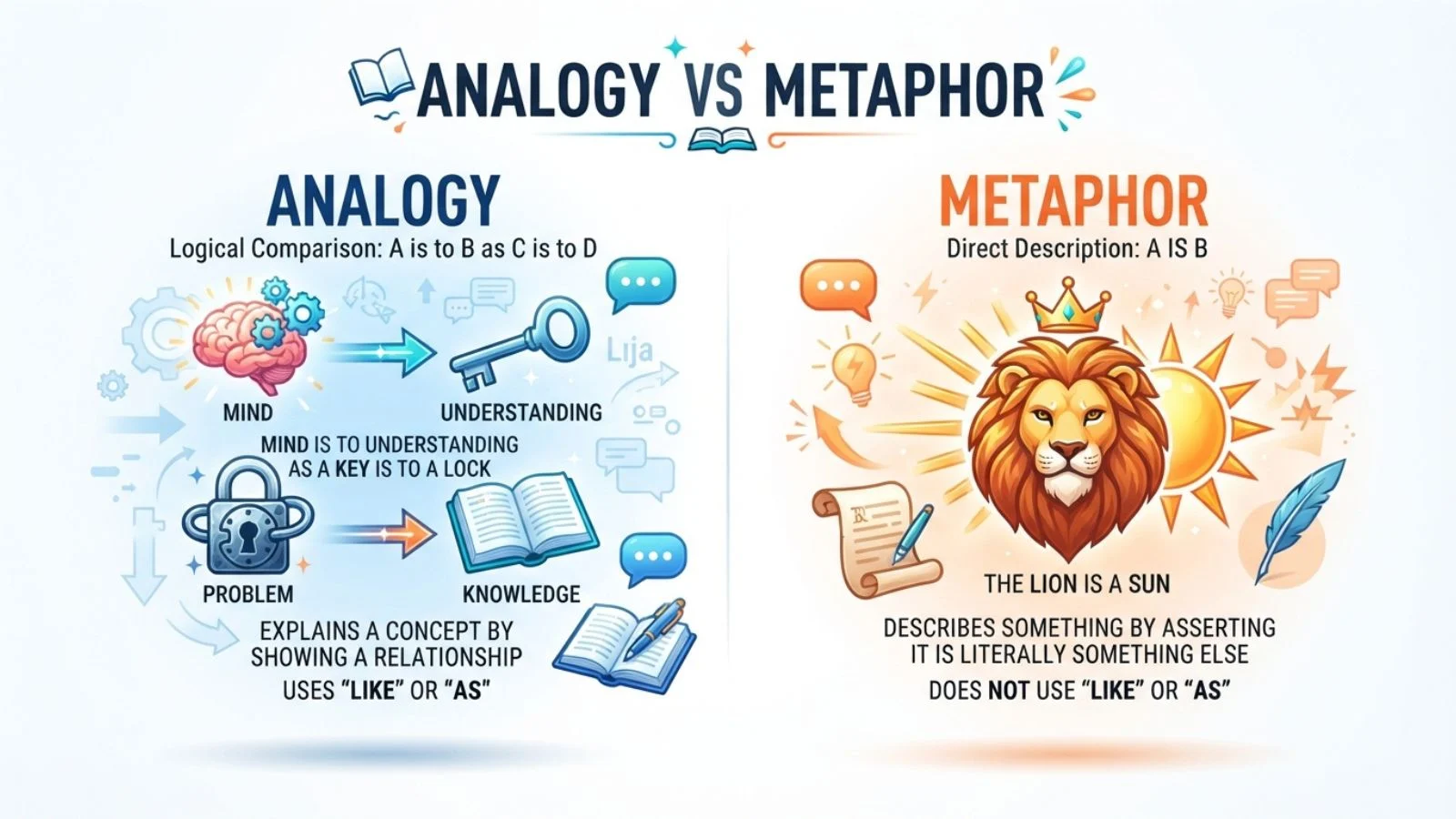
A metaphor directly states that one thing is another, used mainly to create a vivid image or feeling (“Time is money”).
An analogy explains a relationship by comparing two different things, usually to make something complex.
Easier to understand (“An atom is like a solar system, with electrons orbiting a nucleus”) metaphors aim for impact; analogies aim for clarity.
Key Takeaways
- A metaphor is a short, figurative statement that one thing is another.
- An analogy is a longer comparison that explains how two different things work the same way.
- Metaphors are built for emotional or artistic effect; analogies are built for explanation.
- Every metaphor is a kind of comparison, but not every analogy is a metaphor; many analogies use “like” or “as,” which technically makes them similes in form.
- Choose a metaphor when you want to move someone; choose an analogy when you want to teach someone.
What Is a Metaphor?
A metaphor is a figure of speech that describes one thing by calling it something else, without using “like” or “as.” It doesn’t ask the reader to picture a logical connection, it just asserts one, and lets the image do the work.
Metaphors usually have two parts: the thing being described (sometimes called the tenor) and the image used to describe it (the vehicle). When someone says “the classroom was a zoo,” the classroom is the tenor and the zoo is the vehicle. The comparison isn’t meant to be taken literally. It’s meant to be felt.
Because metaphors compress a lot of meaning into a few words, they show up constantly in poetry, song lyrics, speeches, and everyday conversation.
Metaphor Examples
- “Her voice is music to my ears.”
- “He has a heart of stone.”
- “The world is a stage.”
- “Time is a thief.”
- “Chaos is a friend of mine.”
Notice that none of these are literally true. A heart can’t actually be made of stone. That’s the point: metaphors work through suggestion, not logic.
What Is an Analogy?
An analogy is a comparison between two different things that share a similar relationship or structure, used to explain or clarify an idea. Unlike a metaphor, an analogy doesn’t just assert a connection, it walks the reader through why the comparison makes sense.
Analogies are especially useful for explaining something unfamiliar by linking it to something the audience already understands. Teachers, scientists, and writers reach for analogies constantly because they turn abstract ideas into something people can picture step by step.
A classic example: the structure of DNA was famously compared to a spiral staircase, which helped scientists and the public alike visualize its double-helix shape. That’s an analogy doing real explanatory work, not just decorating a sentence.
Analogy Examples
- “The human brain is like a computer; it processes information, stores memories, and runs calculations.”
- “Raising a child is like growing a garden; both need patience, the right environment, and regular care.”
- “Life is like a box of chocolates, you never know what you’re going to get.”
- “Just as a car needs fuel to run, the body needs food for energy.”
Each of these spells out how the two things are alike, rather than just naming one as the other.
Analogy vs Metaphor: The Key Differences
| Feature | Metaphor | Analogy |
| Purpose | Create emotional or artistic impact | Explain or clarify a concept |
| Structure | States that one thing is another | Compares two things based on a shared relationship |
| Length | Usually short, one phrase or sentence | Often longer, with reasoning included |
| Literal truth | False on its face (“he is a lion”) | Logically sound, even if not literal |
| Typical use | Poetry, speeches, persuasive writing | Teaching, science, technical explanation |
| Example | “Life is a rollercoaster.” | “Life is like a rollercoaster because it has ups, downs, and sudden turns you can’t always predict.” |
Is a Metaphor a Type of Analogy?
This is where a lot of the confusion comes from, and it’s a fair question. Both are comparisons, so they overlap conceptually. Broadly speaking, an analogy is the larger category: any comparison that highlights a shared relationship between two things. A metaphor can be seen as a compressed, implicit form of comparison but it skips the explanation that a true analogy provides.
In practice, think of it this way: an analogy shows its work, a metaphor doesn’t. If you can point to the specific reasons two things are alike, you’re likely dealing with an analogy. If the comparison is meant to be felt rather than reasoned through, it’s a metaphor.
Analogy vs Metaphor vs Simile
A simile is often mixed up with both terms, so it’s worth separating out. A simile compares two things using “like” or “as” “brave as a lion,” “slept like a baby.” A metaphor makes the same kind of comparison but drops the “like” or “as” and states it outright “he is a lion.”
An analogy can take the form of a simile (using “like” or “as”) or state a direct comparison, but it always goes further by explaining the relationship, not just naming it. So a simile and a metaphor are usually single phrases; an analogy is typically a fuller comparison that explains itself.
When to Use an Analogy vs a Metaphor
- Use a metaphor when you want to add emotional weight, rhythm, or imagery to your writing in a speech, a poem, a story, or a persuasive piece.
- Use an analogy when you need to explain something unfamiliar or technical to someone who doesn’t already understand it in a lesson, a presentation, a how-to guide, or a scientific explanation.
- If your reader needs to feel something, reach for a metaphor. If your reader needs to understand something, reach for an analogy.
Common Mistakes People Make
- Treating them as interchangeable. A metaphor that skips explanation can confuse a reader who needed an analogy’s logic instead.
- Overusing dead metaphors. Phrases like “time flies” have been used so often they’ve lost their punch they still work, but they no longer surprise anyone.
- Stretching an analogy too far. An analogy breaks down if pushed past the point where the two things are actually alike; this is sometimes called a “false analogy.”
FAQs
Is an analogy the same as a metaphor?
No. An analogy explains a relationship between two things in detail, while a metaphor simply states that one thing is another for effect. They can overlap, but they serve different purposes.
What is an example of an analogy and a metaphor on the same topic?
Metaphor: “The internet is an information superhighway.” Analogy: “The internet works like a highway system, data travels along routes, gets directed at junctions, and can face traffic jams during peak use.”
Is a metaphor a type of analogy?
In a broad sense, yes both are comparisons. But a metaphor is a compressed, implicit comparison, while an analogy is explicit and explains the reasoning behind the comparison.
What’s the difference between a metaphor, a simile, and an analogy?
A metaphor states one thing is another. A simile compares using “like” or “as.” An analogy compares two things and explains why the comparison makes sense, often using either style along the way.
Why do writers use analogies instead of metaphors?
Writers reach for analogies when the goal is to teach or clarify, especially with complex or unfamiliar topics, because analogies walk the reader through the logic rather than just evoking a feeling.
The Bottom Line
Both analogies and metaphors compare one thing to another, but they’re built for different jobs.
A metaphor is a flash of imagery meant to move the reader emotionally. An analogy is a guided comparison meant to help the reader understand.
Once you know which effect you’re going for, impact or clarity, choosing between the two becomes much easier.