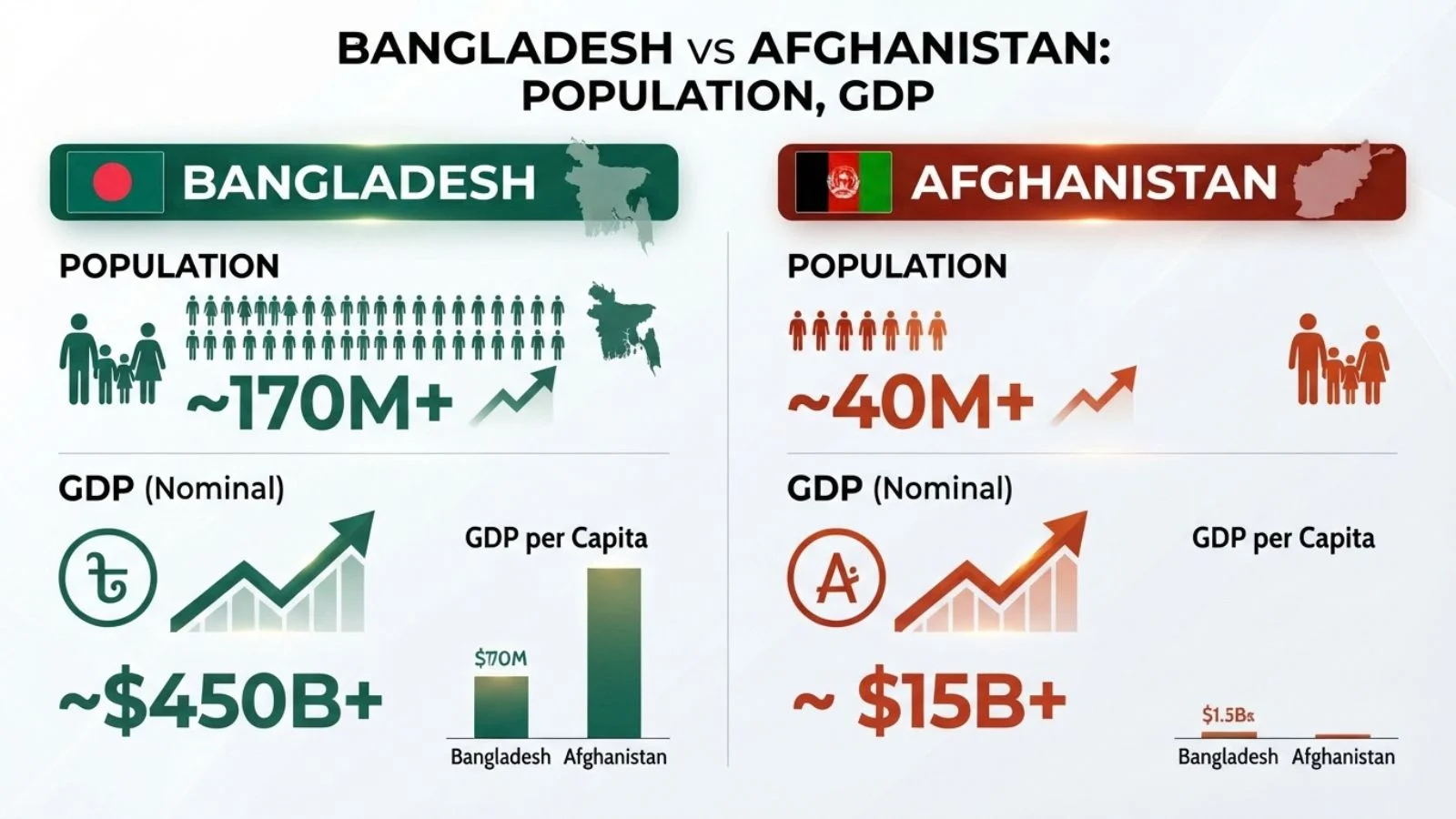
Bangladesh and Afghanistan are both South Asian, Muslim-majority nations, but they differ sharply in size, wealth, and stability.
Bangladesh is smaller in land area but far more populous and densely settled, with a growing, export-driven economy.
Afghanistan is much larger in territory but has a smaller population, a fragile economy, and has been under Taliban rule since 2021.
Key Takeaways
- Bangladesh has roughly 178 million people packed into about 148,000 km², making it one of the most densely populated countries on Earth. Afghanistan has about 45 million people spread across a much larger 653,000 km².
- Bangladesh’s nominal GDP is around $510 billion, versus Afghanistan’s roughly $17–19 billion a gap of nearly 30 times.
- Bangladesh’s GDP per capita (about 2,900–2,960) is more than seven times Afghanistan’s (around 400–414).
- Bangladesh is a parliamentary republic; Afghanistan has been governed by the Taliban’s Islamic Emirate since August 2021, without formal international recognition from most governments.
- Bangladesh’s economy leans on garment exports and remittances; Afghanistan’s has struggled since the withdrawal of foreign aid and troops in 2021.
Bangladesh vs Afghanistan at a Glance
| Category | Bangladesh | Afghanistan |
| Capital | Dhaka | Kabul |
| Population (2026 est.) | ~178 million | ~45 million |
| Land area | ~148,000 km² | ~653,000 km² |
| Population density | Very high (~1,200/km²) | Low (~70/km²) |
| GDP (nominal, 2026) | ~$510 billion | ~$17–19 billion |
| GDP per capita | ~2,900–2,960 | ~400–414 |
| Government | Parliamentary republic | Taliban-led Islamic Emirate |
| Official language | Bengali | Pashto, Dari |
| Independence | 1971 (from Pakistan) | 1919 (from British influence) |
| Major religion | Islam (majority Sunni) | Islam (majority Sunni) |
Population: A Tale of Density vs Size
This is where the two countries look almost like opposites. Bangladesh is one of the smallest countries in South Asia by land area, roughly the size of the U.S. state of Wisconsin, yet it’s home to around 178 million people. That makes it one of the most densely populated countries anywhere, with over 1,200 people per square kilometer in many areas.
Afghanistan flips that picture. Its population sits at around 45 million people, but the country is more than four times larger in land area than Bangladesh. Much of Afghanistan is mountainous or dry terrain, which keeps population density low closer to 70 people per square kilometer.
In practical terms: Bangladesh has almost four times as many people as Afghanistan living in a much smaller space, which shapes everything from housing and agriculture to urban planning and infrastructure demand.
Economy and GDP: Why the Gap Is So Wide
GDP and GDP per Capita
Bangladesh’s economy is one of the fastest-growing in Asia. As of 2026, its nominal GDP is estimated at around $510 billion, ranking it among the world’s top 40 economies. Afghanistan’s nominal GDP, by contrast, is estimated at roughly $17–19 billion meaning Bangladesh’s economy is nearly 30 times larger.
The per-person gap is just as striking. Bangladesh’s GDP per capita is around 2,900–2,960, while Afghanistan’s sits at roughly 400–414, among the lowest in the world. Even adjusted for purchasing power (which accounts for lower prices in poorer countries), Afghanistan’s per capita figure remains far behind Bangladesh’s.
What Drives Bangladesh’s Growth
Bangladesh’s growth over the past two decades has been driven largely by its ready-made garment industry, which makes it one of the world’s top clothing exporters, along with steady remittances from millions of Bangladeshi workers abroad. The country is set to graduate from the United Nations’ list of least developed countries in November 2026, a milestone that reflects sustained, if uneven, progress. Growth hasn’t been without setbacks inflation and political instability have weighed on the economy in recent years but the underlying export and remittance engine has kept it moving forward.
What’s Holding Afghanistan Back
Afghanistan’s economy has faced a much harder road. Decades of conflict, followed by the Taliban takeover in August 2021 and the near-total withdrawal of international aid and foreign troops, sharply reduced economic activity. Formal banking and trade have been constrained by international sanctions and limited diplomatic recognition. A large share of the population around 48% lives below the national poverty line, and the country remains heavily dependent on humanitarian assistance and informal trade.
Government and Politics
Bangladesh operates as a parliamentary republic, with a prime minister as head of government and regular (if sometimes contested) elections. It has faced periods of political unrest and allegations of corruption, but it maintains functioning democratic institutions, courts, and a free-market economy open to global trade.
Afghanistan has been ruled by the Taliban’s Islamic Emirate since August 2021, following the collapse of the previous Western-backed government. The Taliban governs under its own interpretation of Islamic law, and most of the international community has not formally recognized the government. This has limited Afghanistan’s access to international financial systems and foreign investment.
Geography, Climate, and Land Area
Bangladesh sits in the Bay of Bengal delta, bordered mostly by India, with a short border with Myanmar. It’s low-lying, crisscrossed by rivers, and prone to seasonal flooding during the monsoon, a major factor in its vulnerability to climate change.
Afghanistan is landlocked, dominated by the Hindu Kush mountain range, with a dry, continental climate of hot summers and cold winters. It borders Pakistan, Iran, Turkmenistan, Uzbekistan, Tajikistan, and China. Its rugged terrain has historically made transportation, trade, and governance more difficult than in flatter, river-fed Bangladesh.
Quality of Life: Poverty, Health, and Education
Bangladesh has made significant strides in human development. Its Human Development Index (HDI) score is in the medium human development category, and it has outpaced several regional peers on measures like life expectancy (around 73–74 years) and girls’ school enrollment. Poverty has fallen substantially since the 1990s, though it remains a real challenge around 19% of the population still lives below the national poverty line.
Afghanistan ranks near the bottom of most global human development measures. Decades of war, followed by the post-2021 economic contraction, have left roughly half the population below the poverty line, with limited access to healthcare, education (especially for girls and women, who face severe restrictions under Taliban policy), and basic infrastructure.
Language, Religion, and Culture
Both countries are majority Muslim, but their cultures and languages are distinct. Bangladesh’s official language is Bengali (Bangla), and its culture is closely tied to Bengali literature, music, and a secular-leaning national identity rooted in its 1971 independence movement. Afghanistan’s official languages are Pashto and Dari (Persian), and its culture reflects a mix of Pashtun, Tajik, Hazara, and other ethnic traditions, with tribal and regional identities playing a strong role in daily life.
FAQs
Is Bangladesh richer than Afghanistan?
Yes. Bangladesh’s GDP per capita is roughly seven times higher than Afghanistan’s, and its overall economy is around 30 times larger in nominal terms as of 2026.
Is Bangladesh bigger than Afghanistan?
No, not in land area Afghanistan is more than four times larger. But Bangladesh has nearly four times Afghanistan’s population, making it far more densely settled.
What language is spoken in Bangladesh vs Afghanistan?
Bangladesh’s official language is Bengali. Afghanistan’s official languages are Pashto and Dari.
Is Bangladesh safer than Afghanistan?
Bangladesh generally has more stable governance and lower conflict-related risk than Afghanistan, which has experienced decades of war and remains under Taliban rule with ongoing humanitarian and security concerns.
Why is Bangladesh’s economy stronger than Afghanistan’s?
Bangladesh built a diversified export economy led by garments supported by worker remittances and decades of relatively stable governance. Afghanistan’s economy has been disrupted repeatedly by war, the 2021 political transition, and the loss of foreign aid and investment.
Conclusion
Bangladesh and Afghanistan share a region and a majority religion, but their paths since the 1970s have diverged dramatically.
Bangladesh, despite its small size and dense population, has built a growing, export-oriented economy and functioning democratic institutions.
Afghanistan, despite its much larger territory, continues to face deep economic and political challenges under Taliban rule.
Understanding these differences offers a clear picture of how history, governance, and economic policy can shape two nations’ trajectories in very different directions.