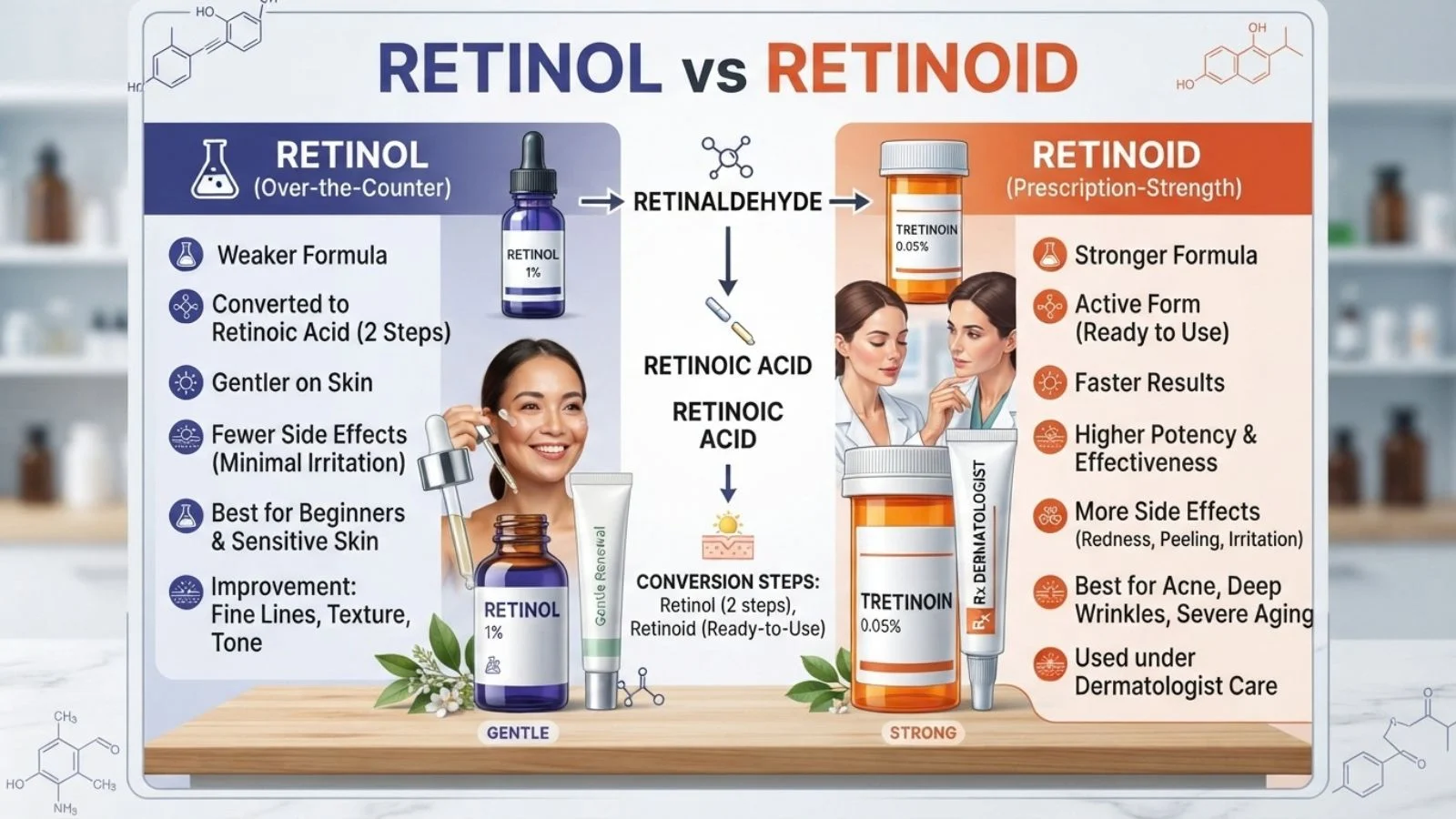
Retinoid is the umbrella term for all vitamin A-based skincare ingredients, and retinol is one specific type of retinoid.
The real difference is strength: retinol is a milder, over-the-counter form, while other retinoids like prescription tretinoin are stronger, faster-acting, and more likely to cause irritation.
Key Takeaways
- Retinol is a type of retinoid, not a separate category of ingredient.
- Prescription retinoids (like tretinoin) convert to retinoic acid faster and work quicker than retinol.
- Retinol is gentler and better suited for beginners or sensitive skin.
- Stronger retinoids show results sooner but come with more irritation, dryness, and sun sensitivity.
- Both target fine lines, acne, and uneven skin tone the choice comes down to your skin’s tolerance and your goals.
What Is a Retinoid?
“Retinoid” describes any compound derived from vitamin A that’s used in skincare or medicine. It’s a family name, not one specific ingredient. Under this umbrella you’ll find several forms, ranging from mild to very strong:
- Retinyl esters (retinyl palmitate, retinyl acetate) the weakest form
- Retinol a mid-strength, OTC form
- Retinaldehyde (retinal) stronger than retinol, still OTC
- Retinoic acid (tretinoin) the strongest, prescription-only form
Every one of these ingredients eventually has to convert into retinoic acid before your skin can actually use it. The fewer conversion steps an ingredient needs, the faster and stronger it tends to act.
What Is Retinol?
Retinol is a specific, over-the-counter type of retinoid. It’s the version you’ll see most often in drugstore and prestige skincare products, usually in concentrations between 0.01% and 1%. Because it’s one step removed from retinoic acid (it has to convert into retinaldehyde first, then into retinoic acid), it works more gradually and tends to be gentler on the skin than prescription options.
Retinol vs Retinoid: Key Differences
| Feature | Retinol | Prescription Retinoid (e.g., Tretinoin) |
| Availability | Over-the-counter | Prescription only |
| Potency | Mild to moderate | High |
| Speed of results | Slower (8–12+ weeks) | Faster (4–8 weeks) |
| Irritation risk | Lower | Higher |
| Conversion steps needed | Two steps to retinoic acid | Already active no conversion needed |
| Best for | Beginners, sensitive skin, prevention | Stubborn wrinkles, acne, sun damage |
Potency and Concentration
Prescription retinoids contain retinoic acid directly, so they’re already in their active form. Retinol has to be converted by skin enzymes first, which naturally dilutes its strength and effect.
Prescription vs. Over-the-Counter
Retinol products are sold freely in stores. True prescription retinoids tretinoin, tazarotene, and adapalene at higher strengths require a dermatologist’s prescription because of how potent and potentially irritating they are.
How Fast You’ll See Results
Because prescription retinoids skip the conversion process, they typically show visible changes in skin texture and tone within four to eight weeks. Retinol usually takes eight to twelve weeks or longer, since your skin has to do more work to activate it.
Side Effects and Skin Tolerance
Stronger retinoids are more likely to cause redness, peeling, dryness, and sun sensitivity, especially in the first few weeks of use, a phase often called “retinization.” Retinol causes fewer of these reactions, which is why it’s the more common starting point.
How Retinol Becomes Retinoic Acid in Your Skin
Retinol doesn’t work directly on your skin cells. It has to go through two conversion steps:
- Retinol converts into retinaldehyde (retinal).
- Retinaldehyde converts into retinoic acid, the form that actually binds to skin cell receptors and triggers collagen production and cell turnover.
This two-step process is the main reason retinol is milder and slower than ingredients that are closer to or already are retinoic acid.
Which One Should You Use?
Best for Beginners or Sensitive Skin
If you’ve never used a vitamin A product before, or your skin reacts easily to new ingredients, start with retinol at a low concentration (0.25–0.5%) a few nights a week. This lets your skin build tolerance before you consider anything stronger.
Best for Stubborn Wrinkles or Acne
If you’ve used retinol consistently for months without irritation and aren’t seeing the results you want, a prescription retinoid may be worth discussing with a dermatologist. They can prescribe the right strength for your skin type and monitor how you respond.
Can You Use Retinol and Retinoid Together?
Generally, no. Since prescription retinoids are already highly concentrated, layering retinol on top adds irritation risk without meaningfully boosting results. Some people use retinol on more sensitive areas, like around the eyes, while using a prescription retinoid on the rest of the face but this should be guided by a dermatologist rather than done on your own.
Retinol vs. Tretinoin (A Common Follow-Up Question)
Tretinoin is the most well-known prescription retinoid, so this comparison comes up often. Tretinoin is retinoic acid, meaning it needs no conversion and works faster and stronger than retinol. It’s also more likely to cause dryness and peeling, especially when you first start using it. Retinol remains the gentler, OTC alternative for people who want gradual results with less risk of irritation.
FAQs
Is retinol the same as a retinoid?
No. Retinoid is the umbrella category for all vitamin A skincare ingredients, and retinol is just one type within that category specifically, a milder, over-the-counter one.
Which is stronger, retinol or retinoid?
Prescription retinoids, like tretinoin, are stronger than retinol because they’re already in the active retinoic acid form and don’t need to convert.
Do I need a prescription for retinoid products?
Only for the strongest forms, like tretinoin or higher-strength adapalene. Milder retinoids, including retinol and some retinaldehyde products, are available over the counter.
Is retinol or retinoid better for beginners?
Retinol is the better starting point. It’s gentler, causes less irritation, and gives your skin time to build tolerance before moving to a stronger option.
Can retinol and retinoid be used together?
It’s not usually recommended, since layering them increases irritation risk without adding much benefit. Talk to a dermatologist before combining them.
Conclusion
Retinol and retinoid aren’t two competing ingredients; retinol is simply one member of the larger retinoid family, and the mildest widely-used one at that.
If you’re new to vitamin A skincare or have sensitive skin, retinol is the safer starting point. If you’ve built up tolerance and want faster.
More dramatic results for wrinkles or acne, a prescription retinoid like tretinoin is the next step, ideally under a dermatologist’s guidance. Either way, consistency and sun protection matter more than which one you pick.