If you’ve spent any time in horror circles lately, you’ve probably heard the name Art the Clown.
With his ghostly black-and-white harlequin costume, twisted grin, and eerie silence, Art has quickly become one of the most talked-about horror villains of the modern era often mentioned in the same breath as Pennywise, Michael Myers, and Jason Voorhees.
What makes Art the Clown so unsettling isn’t just the gore he leaves behind. It’s the way he moves, the way he “performs” for his victims, and the fact that he never says a single word. He doesn’t need to.
Born from the Terrifier franchise, Art has grown from a cult curiosity into a mainstream horror sensation.
In this article, we’ll break down who Art the Clown really is, where he came from, what makes him so terrifying, and why his popularity keeps growing.
Origins & Creation
Art the Clown wasn’t born in a big-budget studio pitch meeting; he started small, in the world of independent horror film making. Instead of a masked killer with a backstory rooted in trauma or revenge, Leon envisioned something stranger: a silent, grinning entity that seemed to enjoy the theatre of violence as much as the act itself.
Art first appeared in Leone’s early short films, long before Terrifier became a franchise. These shorts were low-budget passion projects, but they introduced the core version of the character: the black-and-white clown costume, the unsettling smile, and the complete absence of dialogue. Fans and horror festival audiences responded strongly to how different Art felt from typical genre villains.
The design draws heavily from old-school silent film performers and vaudeville-era clowns, blending old-timey charm with modern horror sensibilities. That contrast to something that should be lighthearted and comedic twisted into something menacing is central to why Art works so well.
As Leone’s projects gained traction, Art evolved from a short-film curiosity into the lead antagonist of a full feature film franchise, eventually becoming one of the most recognizable original horror characters to emerge in the last decade.
Evolution of the Character
Art the Clown didn’t arrive fully formed; he evolved significantly between his earliest appearances and the version audiences know today. In his original short film incarnation, Art was eerie and unpredictable, but the tone leaned more toward dark comedy mixed with horror. He was menacing, but there was still a playful, almost cartoonish quality to his violence.
The feature-film version of Art is more calculated, more theatrical, and considerably more brutal. His kills became more elaborate, often staged like twisted performances rather than simple attacks, reinforcing the idea that he sees his violence as art (fitting, given his name).
His backstory also expanded over time. Early appearances gave almost no explanation for who or what Art is, leaning entirely on mystery. Later films began hinting at something more supernatural suggesting he may not be human at all, but something closer to an immortal or demonic force wearing a clown’s face.
Physically, his mannerisms also sharpened. What began as exaggerated, silent-film-style movement became more deliberate and unsettling, with longer pauses, more expressive gestures, and a stronger sense of dread built through body language alone rather than dialogue or explanation.
This evolution from cult short-film character to elevated horror icon is a big reason Art has resonated so strongly with modern audiences.
Physical Appearance & Design
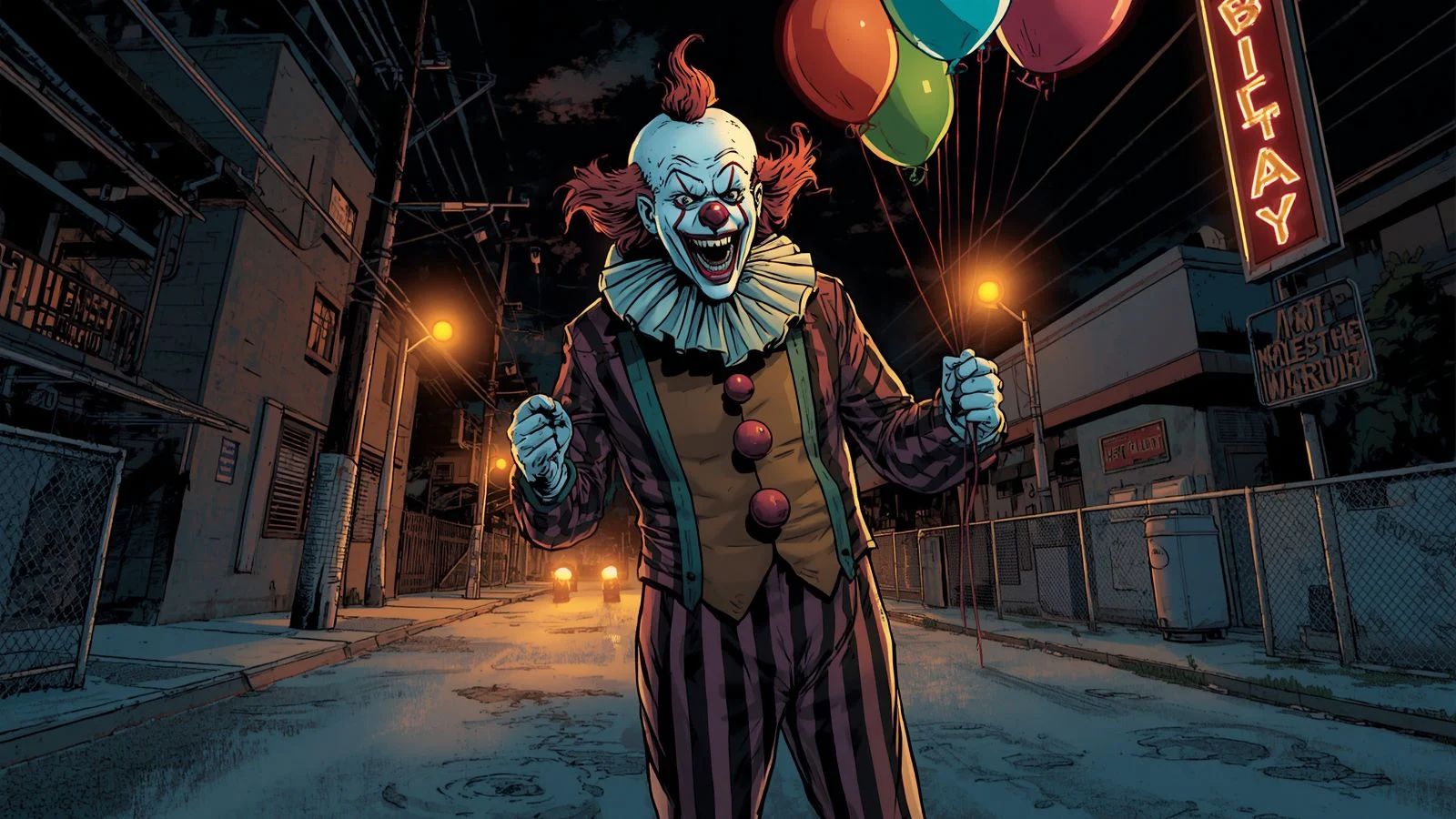
Art the Clown’s look is instantly recognisable, and much of his terror comes from how carefully his design plays against expectations. His face paint features exaggerated dark eyes, a stark white base, and a wide, unsettling grin that never quite reads as friendly even when he’s “smiling.”
The costume follows the same monochrome theme: a black-and-white striped or patterned suit reminiscent of old harlequin performers, paired with black gloves and boots. This muted color palette sets him apart from more colorful horror clowns and gives him a ghostly, almost otherworldly presence on screen. It also allows him to blend into shadows, adding to his ability to appear and disappear unexpectedly throughout scenes.
His props are simple but iconic, most notably a large trash bag he uses to carry tools and weapons, which adds a grim practicality to his violence. The plainness of his equipment contrasts with the elaborate, almost theatrical nature of his kills.
What truly elevates the design, though, is restraint. There’s no elaborate mask or CGI enhancement, just makeup, costume, and physical performance. This simplicity keeps the character grounded in practical horror filmmaking traditions, making him feel more tangible and, as a result, more frightening than many heavily stylized modern movie villains.
Personality & Traits
What makes Art the Clown so distinct among horror villains isn’t just what he does, it’s how he does it. Art never speaks a single word throughout any of his appearances, relying entirely on facial expressions, gestures, and body language to communicate. This silence adds an extra layer of unpredictability, since audiences (and victims) have no dialogue to signal his intentions or emotional state.
Despite being a killer, Art’s demeanor often feels closer to that of a mischievous performer than a traditional monster. He smirks, mocks, and toys with his victims, treating violence as a form of entertainment rather than simply a means to an end. This playful cruelty is part of what makes him so unsettling; he seems to genuinely enjoy the process, savoring reactions and drawing out fear rather than rushing to the kill.
At the same time, Art can shift instantly from comedic and theatrical to shockingly brutal, which keeps audiences off balance. His exaggerated, almost cartoonish movements borrow heavily from silent-film and mime traditions, giving him a physical expressiveness that few horror villains achieve without dialogue.
There’s also an unpredictability to his personality; he doesn’t follow a clear moral code or motive beyond apparent enjoyment of chaos. This lack of clear reasoning makes him feel more like a force of nature than a traditional human antagonist, reinforcing later suggestions that he may be something beyond human entirely.
Notable Scenes & Moments
Much of Art the Clown’s reputation comes from a handful of standout sequences that horror fans frequently cite as career-defining moments for the character. Rather than relying on jump scares alone, these scenes tend to build tension slowly, letting Art’s presence linger before anything happens, a technique borrowed from classic slasher pacing.
What makes these moments memorable isn’t graphic content alone, but the craftsmanship behind them. Practical effects, deliberate camera work, and sound design all play a major role in making Art’s scenes land.
Several sequences have become widely discussed online, not just for shock value, but for how boldly they commit to practical effects at a time when many horror films lean heavily on CGI. This commitment to old-school filmmaking techniques has earned Art comparisons to horror icons of decades past, when practical effects defined the genre.
Beyond individual set-pieces, it’s Art’s behavior during these moments, his taunting expressions, mock bows, and theatrical flourishes that elevate the scenes from simple horror to something closer to twisted performance art. Fans often point to this blend of horror and dark comedy as the defining signature of his most talked-about scenes.
The Actor Behind Art
The man behind Art the Clown’s most iconic performances is David Howard Thornton, an American actor best known for his role as Art the Clown in the Terrifier film series. Before landing the role, Thornton was waiting tables when the audition for the first Terrifier film came up, and had to convince his own agent it was worth pursuing despite the project’s tiny budget.
Thornton grew up in Huntsville, Alabama, where he was first introduced to theater as a child, eventually building a career in stage acting before transitioning into film. Interestingly, Art wasn’t his first brush with iconic villainy; he portrayed the Joker in a fan-made web series called Nightwing: Escalation before ever stepping into Art’s shoes.
Thornton first played Art the Clown in the 2016 film Terrifies, and has since reprised the role across the franchise’s sequels. Playing a silent character is uniquely demanding with no dialogue to rely on, Thornton communicates everything through exaggerated physicality, facial expressions, and timing, drawing heavily on his theater background. Thornton has spoken about compartmentalizing the character’s extreme violence from his own personality, noting that he views Off-screen, cast and crew consistently describe him as good-natured, a sharp contrast to the character that’s made him a horror icon.
Cultural Impact & Fan Reception
In just a few short years, Art the Clown has evolved from a niche indie-horror curiosity into one of the most recognizable villains in modern horror. Fans and critics alike have started placing him alongside genre legends like Pennywise, Michael Myers, and Freddy Krueger, a remarkable feat for a character that began in ultra-low-budget short films.
Much of this rise can be credited to word-of-mouth and social media. Clips, fan art, and reaction videos from the Terrifier films spread rapidly online, often centered on the shock value of the practical effects and Thornton’s physical performance. Horror conventions have also played a major role, with Thornton making frequent appearances as Art, further cementing the character’s presence in fan culture.
Cosplay has become a huge part of Art’s cultural footprint, with his black-and-white design being both instantly recognizable and relatively achievable for fans to replicate, making him a popular choice at conventions and for Halloween costumes each year.
The franchise’s box office trajectory reflects this growing fanbase, with each installment outperforming the last despite minimal marketing budgets compared to major studio horror releases. This underdog success story of a truly independent horror character breaking into mainstream conversation has only strengthened his appeal among horror fans who value practical effects and original villains over franchise reboots.
Franchise & Future

The Terrifier franchise has grown from a $250,000 passion project into one of the most successful independent horror franchises in recent memory. Terrifier 2 turned heads with a strong box office performance relative to its microbudget, while Terrifier 3 became the highest-grossing unrated film of all time and the franchise’s biggest box office success, earning over $90 million worldwide.
Following that success, a fourth installment has been confirmed, with Terrifier 4 slated for an October 1, 2026 release, once again directed by Damien Leone, with David Howard Thornton returning as Art the Clown and Lauren LaVera as Sienna Shaw.Interestingly, the road to this installment included plenty of speculation. Earlier in development, rumors about a locked October 2026 release date circulated widely on social media before being directly disputed by both Thornton and LaVera, who said filming hadn’t even started yet and that Leone was still writing the script. Leone has since confirmed the film’s status, and reports indicate this will be the final chapter in Art’s story.With each film outperforming its predecessor and mainstream horror audiences increasingly aware of the character, Art the Clown’s future looks secure whether this fourth film truly closes his saga or opens the door to future spinoffs, reboots, or expanded lore. Either way, his impact on modern horror is already cemented.
FAQs
Is Art the Clown based on a real person?
No. Art the Clown is a fictional character created by writer-director Damien Leone specifically for his independent horror projects. He isn’t based on any real killer or historical figure.
What movies is Art the Clown in?
Art first appeared in the short films The 9th Circle (2008) and Terrifier (2011), where he was played by Mike Giannelli. David Howard Thornton took over the role starting with the 2016 feature film Terrifier, followed by Terrifier 2 (2022) and Terrifier 3 (2024). A fourth film is currently in development.
Is Art the Clown silent in every appearance?
Yes. Art has never spoken a single word across any of his film appearances, relying entirely on physical performance and expression to communicate.
Who plays Art the Clown?
David Howard Thornton has portrayed Art the Clown since the 2016 Terrifier film and has reprised the role in every subsequent installment.
Is Art the Clown human?
This is left intentionally ambiguous in the earlier films, but later installments increasingly suggest Art may be something beyond human, possibly an undead or demonic entity rather than an ordinary person.
Where can I watch the Terrifier movies?
Availability varies by platform and region, so it’s best to check current streaming services or digital rental platforms for the most up-to-date options.
Will there be a Terrifier 4?
Yes. Terrifier 4 is confirmed and reportedly intended as the final chapter in Art’s story, with David Howard Thornton and Lauren LaVera both returning.
Conclusion
Art the Clown has done something remarkably rare in modern horror: he’s built a devoted, ever-growing fan base without the backing of a major studio, a massive marketing budget, or decades of built-in nostalgia.
What started as a background monster in a low-budget short film has transformed into one of the genre’s most recognizable and talked-about villains, standing shoulder-to-shoulder with icons like Pennywise, Michael Myers, and Freddy Krueger.
Much of that success comes down to smart, deliberate choices, a striking black-and-white design, a total commitment to silence over dialogue, and a performance style rooted in theatrical, almost playful menace rather than one-note brutality.
David Howard Thornton’s physical performance breathes life into a character who could have easily felt like a gimmick, instead making him feel genuinely unpredictable and threatening.