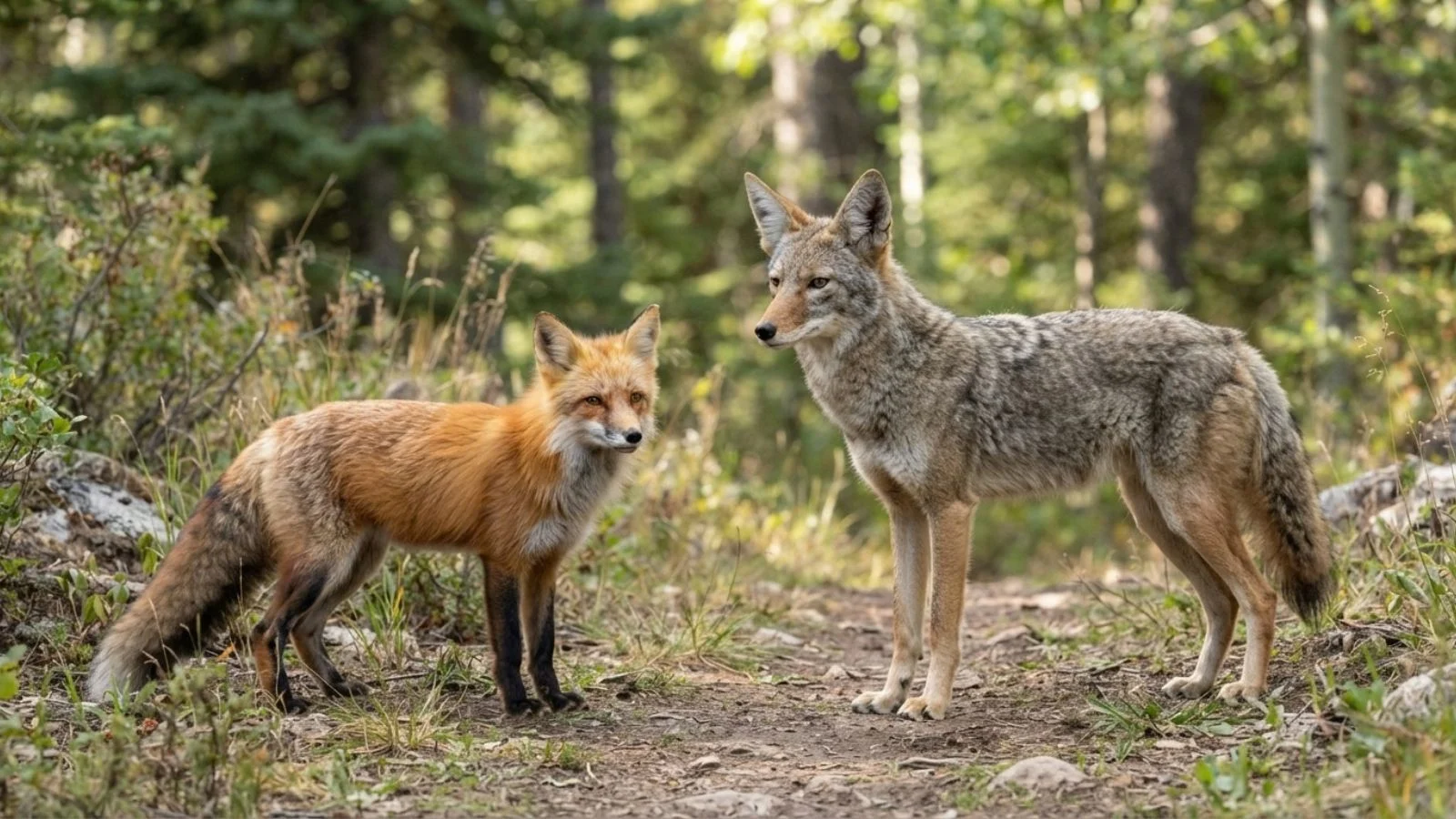
The main difference between a fox and a coyote is size and build: foxes are small, cat-sized animals (8–15 lbs) with a pointed face, triangular ears, and a thick, bushy tail.
While coyotes are larger, dog-sized animals (20–45 lbs) with a leaner body, longer legs, and a straighter, less fluffy tail.
Coyotes also travel and hunt in family groups more often, while foxes are typically solitary.
Key Takeaways
- Coyotes are roughly two to three times heavier than foxes and stand taller at the shoulder.
- A fox’s tail is thick and bushy with a white or black tip; a coyote’s tail is bushy too, but longer, straighter, and usually carried low.
- Foxes are mostly solitary hunters; coyotes often travel and hunt as mated pairs or small family groups.
- Both are opportunistic eaters, but coyotes take larger prey and scavenge more aggressively, including around trash and outdoor pet food.
- Coyotes pose a greater risk to small pets and even to foxes themselves, since coyotes will kill foxes to reduce competition.
Fox vs Coyote at a Glance
| Feature | Fox | Coyote |
| Weight | 8–15 lbs (red fox) | 20–45 lbs |
| Shoulder height | 14–16 inches | 21–24 inches |
| Body shape | Short legs, low to the ground | Long legs, lankier build |
| Face | Pointed snout, slanted eyes | Narrower snout than a wolf, but blunter than a fox’s |
| Ears | Large, pointed, close to the head | Taller, more erect, set further apart |
| Tail | Thick, bushy, often white- or black-tipped | Bushy but longer and straighter, usually held low |
| Color | Red, gray, or silver, depending on species | Grayish-brown to tan, fairly uniform |
| Social structure | Mostly solitary | Pairs or small family groups |
| Activity | Nocturnal/crepuscular | Crepuscular, more flexible |
| Typical weight advantage | 2–3x heavier than a fox |
Size and Build
Size is the fastest way to tell these two animals apart. A red fox, the most common fox species in North America, usually weighs between 8 and 15 pounds and stands about 14 to 16 inches at the shoulder close to the size of a house cat, just with longer legs. A coyote is built on a bigger frame entirely, typically weighing 20 to 45 pounds and standing 21 to 24 inches at the shoulder, putting it in the same general size range as a medium dog like a border collie or small German shepherd.
The difference in proportions matters as much as raw weight. Foxes have short legs relative to their body, which gives them a low, almost cat-like silhouette when they move. Coyotes have noticeably longer legs and a leaner, more athletic build suited for covering long distances at a trot.
Appearance Face, Ears, Tail, and Color
Up close, the face is one of the clearest giveaways. Foxes have a narrow, pointed snout, slanted almond-shaped eyes, and large ears that sit close together near the top of the head. Coyotes have a longer muzzle than a fox but a shorter, blunter one than a wolf, with eyes that sit more forward and ears that are taller, more erect, and spaced further apart.
Tails are another reliable marker. A fox’s tail is thick, full, and almost as long as its body, often with a distinctive white tip (red fox) or black tip (gray fox). A coyote’s tail is also bushy, but it’s longer in proportion to a smaller body width, and coyotes typically carry it low, almost brushing the ground, rather than straight out.
Coloring overlaps enough that it’s not a dependable identifier on its own. Red foxes are reddish-orange with black legs and a white underbelly; gray foxes are salt-and-pepper gray with rusty patches. Coyotes run from grayish-brown to tan and are usually more uniform in color, without the sharp color blocking foxes tend to show.
Tracks: How to Tell Fox and Coyote Prints Apart
If you’re going off tracks in snow, mud, or sand, size again does most of the work. A fox print is small and compact, usually under 2 inches long, with a tight, almost oval shape and fine claw marks. A coyote print runs closer to 2.5 inches long, is noticeably wider, and shows a more open toe spread with more prominent claw marks.
Stride patterns can help too. Foxes often walk in a near-straight line, placing their hind paws almost directly in their front tracks, a trait called “direct registering.” Coyotes trot more than they walk, covering ground efficiently, and their tracks tend to form a straighter, more evenly spaced line than a domestic dog’s meandering path.
Behavior and Social Structure
Foxes are largely solitary animals. Outside of a mating pair raising kits in spring, a fox typically hunts, forages, and travels alone, relying on stealth and quick reflexes rather than group effort.
Coyotes are more social. While they’re not as tightly pack-oriented as wolves, coyotes commonly operate in mated pairs or small family units, especially when raising pups or defending a territory. This group behavior extends to hunting; a pair of coyotes will sometimes work together to flush out and corner prey that a single coyote couldn’t catch alone.
Both animals are mainly active at dawn and dusk (crepuscular), but coyotes show up more often in full daylight, particularly in areas with less human pressure, while foxes lean more heavily nocturnal where people are nearby.
Habitat and Range
Foxes and coyotes overlap across most of North America and have both adapted well to life near people. Foxes tend to favor edge habitat, the boundary between woods, fields, and suburban yards where cover is close and small prey is abundant. Coyotes are even more flexible, thriving in deserts, prairies, forests, and dense urban centers alike, including city parks and greenbelts.
Where the two species share territory, coyotes generally have the upper hand, and fox populations often shrink or shift to the margins of coyote range as a result.
Diet: What Foxes and Coyotes Eat
Both species are opportunistic omnivores, but their everyday menus differ in scale. Foxes mostly eat small prey mice, voles, rabbits, insects, birds, eggs supplemented with berries and fallen fruit. Their small size means they rarely take anything much larger than a rabbit.
Coyotes eat a similar range of small prey but will also take larger animals, including fawns, and are far more willing to scavenge carrion, raid garbage, and target outdoor pet food or unsecured chickens. Their bigger body size and pack-assisted hunting let them pursue prey that a lone fox simply can’t handle.
Do Coyotes and Foxes Get Along?
Not particularly. Coyotes view foxes as competitors for the same small prey, and in many documented cases, coyotes will actively kill foxes not necessarily for food, but to eliminate competition in a shared territory. This is one reason fox sightings often drop in areas where coyote populations expand. Foxes, in turn, tend to avoid coyotes and will shift their activity patterns or territory to reduce contact.
Which Is More Dangerous To Pets, Livestock, or People?
For most households, coyotes present the bigger practical risk. Their larger size and pack behavior make them capable of taking small to medium dogs and cats, and they’re increasingly comfortable in suburban and urban settings. Foxes, by contrast, are too small to pose a real threat to anything larger than a small chicken or rabbit, and they’re naturally more skittish around people and pets.
Neither species is a significant threat to adult humans; attacks on people are rare for both, and far more common from domestic dogs. Basic precautions apply either way: don’t leave pet food or unsecured trash outside, supervise small pets at dawn and dusk, and secure chicken coops and rabbit hutches.
How to Tell a Fox From a Coyote at a Glance (Field Checklist)
- Size: Cat-sized, low to the ground → fox. Medium-dog-sized, leggy → coyote.
- Tail: Fluffy with a bright white or black tip, held level or up → fox. Bushy but longer, carried low → coyote.
- Face: Narrow, pointed, almost catlike → fox. Longer muzzle, more dog-like → coyote.
- Behavior: Alone, darting and low to the ground → fox. In a pair, trotting steadily with purpose → coyote.
- Sound: High-pitched yips and screams → fox. Yips rising into a wavering group howl → coyote.
FAQs
Is a coyote bigger than a fox?
Yes. Coyotes typically weigh 20–45 pounds, compared to 8–15 pounds for a red fox roughly two to three times heavier, with a taller, leggier build overall.
Can a fox and a coyote mate?
No. Foxes and coyotes belong to different genera within the dog family and cannot interbreed, unlike coyotes and wolves, which can occasionally produce hybrid offspring.
Do coyotes kill foxes?
Yes, coyotes sometimes kill foxes to reduce competition for food and territory, even without eating them. This is a documented reason fox numbers can drop where coyote populations grow.
How do you tell a coyote from a fox at night?
Size and tail position are the most useful cues after dark: a fox looks small and cat-sized with its tail held level or up, while a coyote looks taller and leggier with its tail hanging low, closer to the ground.
Are coyotes or foxes more dangerous to pets?
Coyotes pose more risk to pets because of their larger size and willingness to target small to medium dogs and cats; foxes are generally too small to threaten anything bigger than small poultry or rabbits.
What is the difference between fox and coyote tracks?
Fox tracks are smaller (under 2 inches), tighter, and more oval, while coyote tracks run closer to 2.5 inches, are wider, and show a more open, splayed toe pattern.
Conclusion
At a glance, a fox and a coyote can look similar both are wild canines with pointed ears and bushy tails.
But once you know what to look for, telling them apart is straightforward. Size is the biggest clue: a fox is roughly cat-sized and low to the ground, while a coyote is built more like a medium dog, taller and leaner.
Tail position, face shape, and behavior back that up a fox tends to be solitary and quick, while a coyote often moves with a mate or family group and carries its tail low.
For homeowners, the practical takeaway matters most: coyotes are the bigger concern around pets and livestock, while foxes are mostly harmless to anything larger than small poultry.
Either way, basic precautions securing trash, supervising small pets at dawn and dusk, and keeping coops and hutches enclosed go a long way toward living alongside both animals safely.